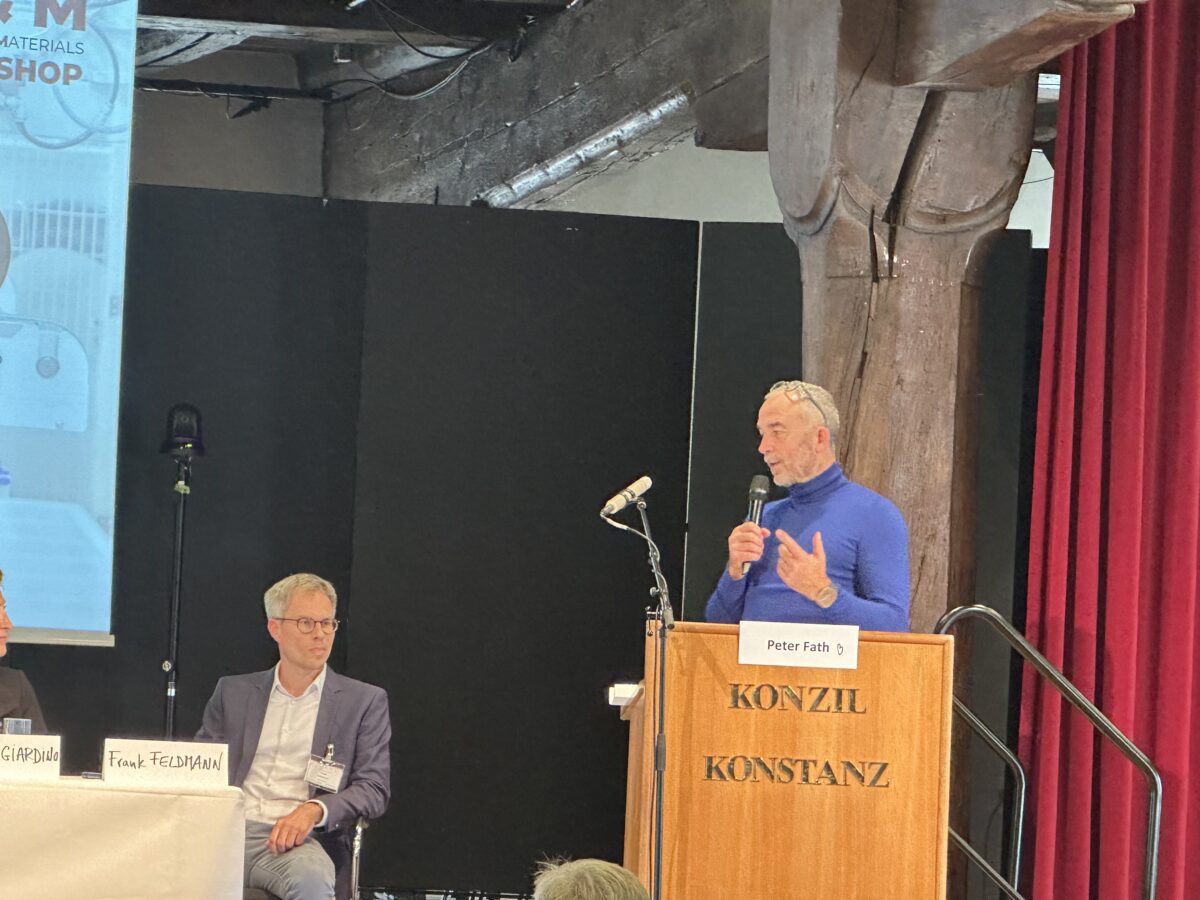
At the Modules and Material Worksop in Konstanz, organized by RCT Solutions and ICS Konstanz, experts from the European PV equipment manufacturing industry gathered to discuss the current and future trajectory of production costs, technological advances and capabilities of equipment and raw materials. CEO of RCT Solutions, Peter Fath, said pv magazine that a 1 GW European module assembly facility using the same supply chain as its Chinese Tier 1 counterparts could achieve module production costs of €0.11-0.12/W.
According to Peter Fath, the CEO of Germany-based RCT Solutions, production costs for solar modules in Europe could be close to those of the booming Indian PV industry.
“Producing modules for €0.15-0.16 ($0.17-0.18)/W is already feasible,” he said pv magazine at the Modules and materials workshop organized in Konstanz, southern Germany, by RCT Solutions in collaboration with the German research institute ICS Konstanz. “If we want to reach these price levels, we obviously need the corresponding production equipment with gigawatt scale and a high degree of automation. In addition, we have to use the same materials as our Chinese competitors.”
Fath states that a European 1GW module assembly facility using the same supply chain as its Chinese Tier 1 counterparts could even achieve module production costs of €0.11-0-12/W. “Given the circumstances I mentioned earlier, which means we use the same bill of materials as the module maker, this could be achieved now, not many years from now,” he continued. “With cell production in Europe and with wafers sourced from China or India, module production costs of €0.15/W would be easily achievable. If we include block and wafer production in Europe, module production costs could increase to €0.17-0.18/W.”
According to Fath, labor costs would be irrelevant today due to the high degree of automation and the scale that European factories can achieve. “A 1 GW factory would be sufficient just for module assembly,” he said. “We may need a larger scale for cell production, but also a 1 GW cell factory could have a good cost structure in Europe today.”
Fath highlighted that Chinese solar products are currently sold below production costs in Europe. “The entire supply chain in China is selling below production costs, including raw material suppliers,” he said. “The real price difference between Chinese and European modules, with the same cost estimates, is about 15-20%.”
During one of the sessions of the Modules and materials workshopLaura Sartore, Executive Managing Director of Italian PV production equipment supplier Ecoprogetti, said module production costs of €0.10-11/W would allow the European solar industry to scale up without government subsidies. “We just need incentives to temporarily close the gaps,” Sartore said.
“Continued subsidies would never deliver a stable outcome,” Fath added. “What is much more important is to establish European rules for the production of PV systems. For example, we should not allow the sale of solar products in Europe below the cost of production. Dumping is not allowed in Europe in theory, but we continue to buy products below the cost of production. We then have social and environmental standards to take into account.”
During one of the event’s sessions, Puzant Baliozian, photovoltaic equipment group leader at the German Machinery and Equipment Manufacturers Association (VDMA), emphasized the importance of building factories that can range from 5 GW to 10 GW.
“In Europe we have 28 suppliers of PV production equipment, with all relevant technologies ready,” he said. “The global PV equipment market is expected to reach €43.8 billion by 2035. Are we really willing to give this up?”
Baliozian also acknowledged the importance of public support at the current stage of the industry, adding that support for Opex is needed.
Radovan Kopecek, co-founder and director of Germany’s ISC Konstanz, warned that we must act quickly if we want a European PV industry without losing highly qualified workers.

Michael Schmela of SolarPower Europe highlighted the political difficulties facing efforts to rebuild a PV manufacturing industry at EU level. “Brussels is the sum of European members, acting individually. Perhaps if France, Italy and Germany work together, we can achieve different results,” Schmela suggested. “Ursula Van der Lyen is still pushing to maintain the Green Deal, but the fossil fuel lobby is very strong. We have to play the policy game.”

In another session at the event, two French companies took part in plans to build a 5 GW cell and module factory each – Holosolis and Carbon – albeit with different approaches. The first has decided to collaborate with the Chinese module maker Trinasolar for its project, while the second wants to rely exclusively on a European ecosystem.
“We still need to build the ecosystem, but we see a commodity choice outside of China,” says Carbon’s Managing Director, Raffaella Giardino. “We want Cell European production equipment, but at this stage we may be open to Chinese imports of billet and wafer equipment.”
“High market risk can only be limited by regulation,” says Frank Feldmann, Cell Development manager at Holosolis. “We need the knowledge from China and strong partners like Trina. We don’t need 100% of production to be in Europe.”
Meanwhile, Xabier Otaño of Spanish PV equipment supplier Mondragon emphasized that capital expenditure on purchasing production lines has very little impact on the final price of a product. “Saving on Capex is not a good choice,” he said. “We can rebuild a European PV industry and we probably need to hybridize it with the Chinese ecosystem.”
This content is copyrighted and may not be reused. If you would like to collaborate with us and reuse some of our content, please contact: editors@pv-magazine.com.
Popular content