

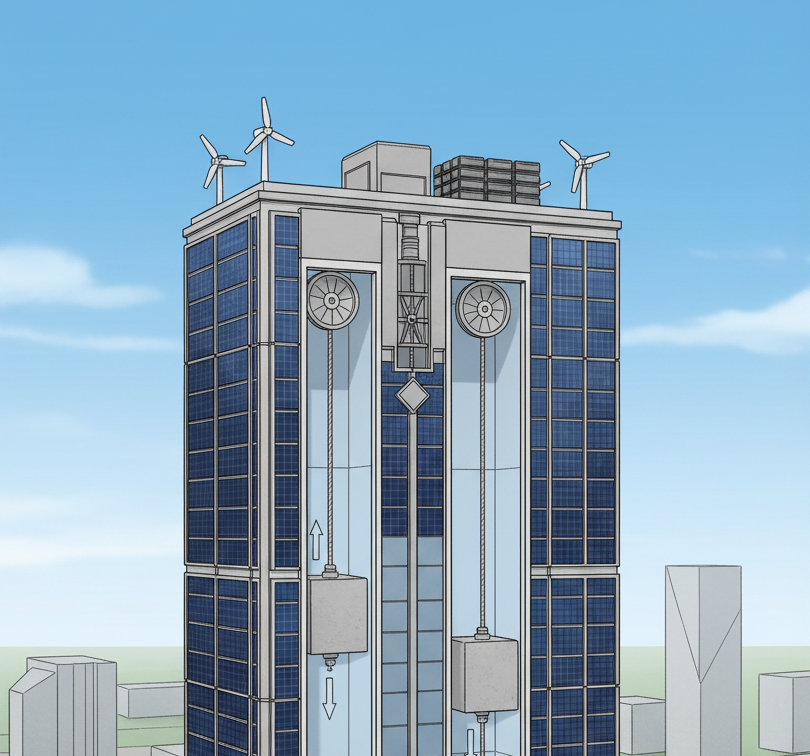
Researchers in Canada have proposed using gravity-based energy storage in tall buildings, in combination with photovoltaic facades, small wind turbines and lithium-ion batteries. Their modeling indicated that this hybrid system could achieve a levelized energy cost ranging from $0.051/kWh to $0.111/kWh.
Researchers from the University of Waterloo in Canada have designed a solid gravity energy storage system that can be used to store renewable energy high-rise buildings urban buildings.
The cable hoist-based system is designed to work in combination with photovoltaic facades installed on the south, east and west walls, as well as small wind turbines on the roof and lithium-ion (Li-ion) batteries.
In the proposed configuration, the gravity-based system serves as the primary energy storage unit, while the batteries are used only for rapid response storage during hours of significant production surplus or deficit. The system uses the energy generated by the PV facades and wind turbines to lift a heavy mass into a shaft during the charging phase. This stored potential energy is then released to run an electrical generator during the discharge.
The system consists of a motor-generator unit, lifting cables, transmission gears and steel or concrete blocks. It functions in the same way as conventional elevators in city buildings and operates at almost the same speed.
“This design is technically feasible and has recently been commercially proven,” says the lead author of the study. Mohammed A. Hassantold pv magazine. “Specifically, Gravitricity has demonstrated a 15 meter high 250 kW prototype system in Leith Harbor in Edinburgh, with two 25 tonne hanging weights and two grid-connected generators. The same company has also started two large-scale commercial projects since 2021 with capacities of 4 MW and 8 MW.”
The researchers modeled the system for 625 generic building designs, taking into account factors such as the ratio of facade area to volume, the ratio of length to width and the ratio of height to footprint. They also used a multi-objective genetic algorithm (MOGA) to assess both the levelized cost of electricity (LCOE) and each building’s dependence on electricity from the grid.
The analysis indicated that this hybrid system could achieve LCOE values ranging from $0.051/kWh to $0.111/kWh, and electricity costs between $0.195/kWh and $0.888/kWh. These results are reported to be consistent with those of similar building-integrated renewable energy systems in Canada and other regions with limited renewable energy sources.
“Taller buildings with large floor areas tend to have lower LCOE, but higher electricity costs,” the researchers explained, noting that the capacity of the gravity storage system should increase as the intensity of a building’s energy use increases.
Modeling results also showed that the gravity storage system could achieve a payback period of 9 to 17 years, and in most cases a payback period of less than 25 years.
“This confirms the long-term financial viability,” Hassan said. However, he emphasized that industry consensus remains critical on several fronts, including operational complexity, upfront costs and the need to demonstrate 24/7 reliability over years of field operations.
“While the mechanical principles are proven, the challenge will be to scale up the technique, secure competitive capital costs and integrate within network or industrial environments. Therefore, market acceptance still depends on proving that these systems can outperform battery, chemical and other gravity alternatives over their expected operational lifetime, especially for applications requiring multi-hour energy delivery. up to days without reducing capacity,” he added.
“Independent analyzes suggest that commercial maturity in terms of affordable, mainstream deployment in developed markets outside China is likely to occur around the late 2020s, pending a few years of operational data from current flagships,” he continued. “At this time, above-ground gravity storage is commercially proven at initial scale, but not yet in mass adoption with volume discounts. Sustainable contracts and reliability performance over the next three years should bring the status to full commercial maturity.”
The system was introduced in “Building geometry-aware life cycle optimization of hybrid renewable energy systems with solid gravity storage”, published in Applied Science.
This content is copyrighted and may not be reused. If you would like to collaborate with us and reuse some of our content, please contact: editors@pv-magazine.com.
