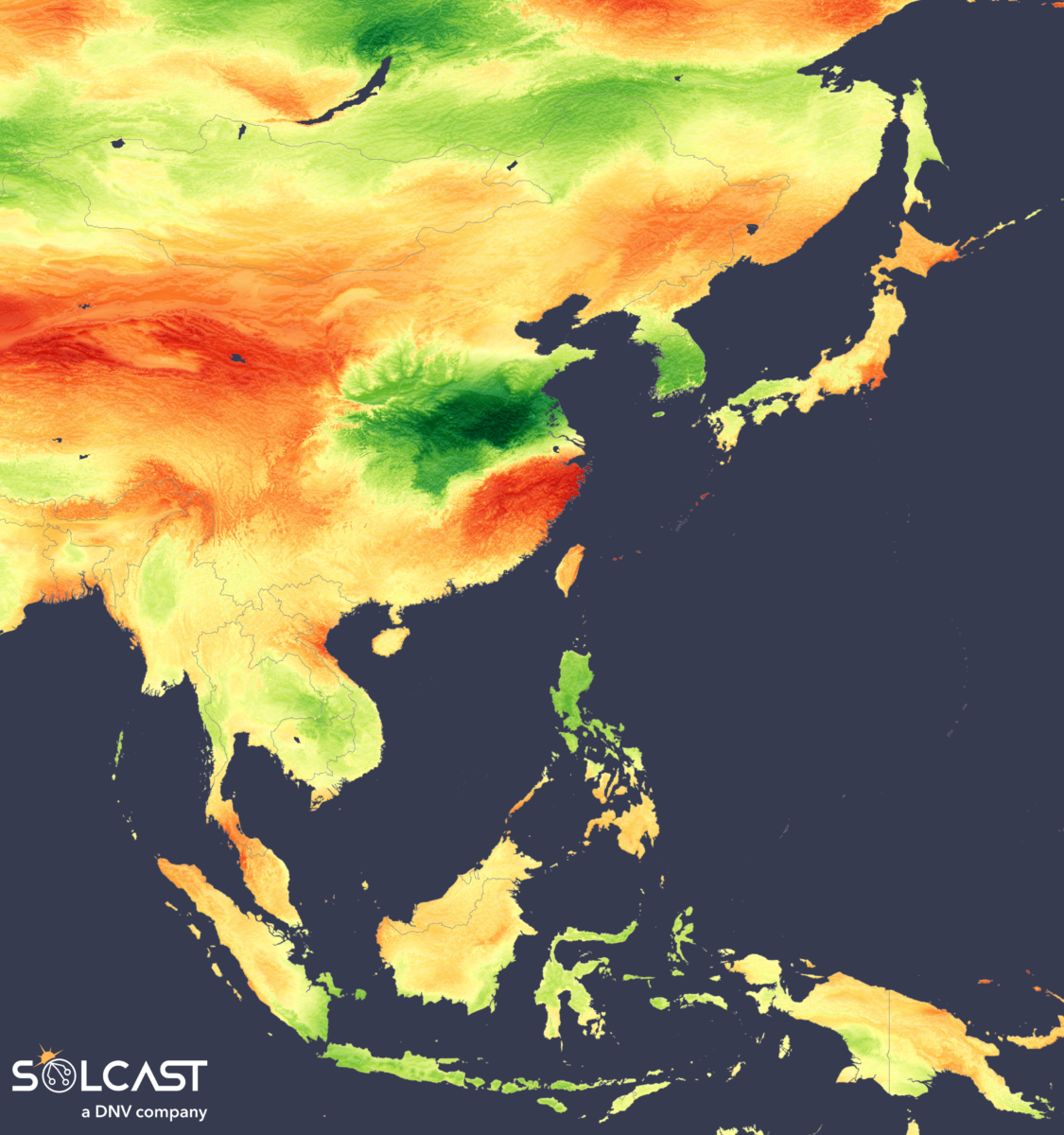
In a new weekly update for pv magazineSolcast, a DNV company, reports that southern and western China enjoyed above-average insolation in September, while eastern parts of the country experienced wetter conditions.
In September, a notable shift in solar radiation patterns was observed across East and Southeast Asia, with a clear split in outcomes across China and emerging La Niña signals in the tropics. In eastern China and the Yellow Sea Basin, which have experienced above-average insolation year-round so far, conditions finally turned cloudy and wet, while the southern and western parts of the country remained sunnier than normal. These shifts were caused by an anomalously strong ridge over mid-latitudes and the warm waters of the North Pacific Ocean, according to analysis using the Solcast API.
The main negative anomalies were recorded around the Yellow Sea, including coastal areas from Qingdao to central China. This downturn marked the end of a long series of positive radiation anomalies in the region. A persistent high-pressure ridge, interacting with unusually warm sea surface temperatures in the North Pacific, has intensified convection and rainfall over this basin. The resulting cloud cover suppressed solar radiation by as much as 30% below the seasonal norm. Meanwhile, circulation around high offshore winds brightened skies over northern China and Japan, with Hokkaido seeing insolation rise 10% to 15% above average.
Elsewhere in China, irradiation remained above average. The reduced frequency of typhoons this season – apart from the intense Typhoon Ragsa – combined with strong trade winds and the dominant anticyclonic pattern, led to suppressed cloud formation across much of the south and west. Regions from Shanghai through northern Vietnam to the Tibetan Plateau recorded irradiance anomalies up to 25% above climatic conditions. Despite Ragsa’s disruption in Taiwan, Hong Kong and the South China Sea, its local impact did not significantly change the broader radiation pattern.

In the tropics, September was characterized by classic, early La Niña signatures. The western Pacific Ocean, especially the Philippine Sea, experienced increased irradiance as convective activity moved out of the region. Conversely, the Indian Ocean side of the monsoon belt saw increasing cloud cover and rainfall, suppressing irradiance. Over the Philippines, a particularly strong southwest monsoon, likely fueled by warm sea temperature anomalies, produced persistently cloudy conditions and low insolation levels.

Looking ahead, seasonal forecasts point to a continuation of these broad patterns. While the recent July forecast predicted favorable solar conditions for the remainder of 2025, the models are tuning into a scenario of decreasing insolation over Southeast Asia and Oceania into the final months of the year, consistent with the developing La Niña phase of the ENSO cycle.
Solcast produces these figures by tracking clouds and aerosols worldwide at a resolution of 1-2 km, using proprietary satellite data AI/ML algorithms. This data is used to drive irradiance models, allowing Solcast to calculate high-resolution irradiance, with a typical deviation of less than 2%, as well as cloud tracking predictions. This data is used by more than 350 companies that manage more than 300 GW of solar energy worldwide.
The views and opinions expressed in this article are those of the author and do not necessarily reflect those of the author pv magazine.
This content is copyrighted and may not be reused. If you would like to collaborate with us and reuse some of our content, please contact: editors@pv-magazine.com.
Popular content