

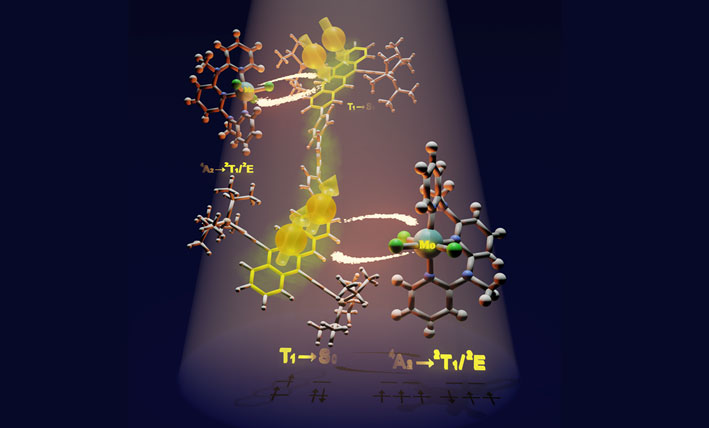
Japanese researchers developed a molybdenum-based spin-flip emitter that efficiently harvests triplet excitons from singlet fission tetracene dimers, producing strong near-infrared emission. This approach could increase the efficiency of solar cells and enable new quantum technologies by converting otherwise ‘dark’ excitons into usable light.
A research team from Kyushu University in Japan has reported a breakthrough that could drive photovoltaic technology past long-standing efficiency barriers by using a quantum process known as singlet fission (SF).
Singlet exciton fission is an effect observed in certain materials where a single photon can generate two electron-hole pairs when absorbed in a solar cell instead of the usual one. The effect has been observed by scientists as far back as the 1970s and although it has become an important area of research for some of the world’s leading institutions over the past decade; translating the effect into a viable solar cell has proven to be complex.
Singlet fission solar cells can produce two electrons from one photon, making the cell more efficient. This is done via a quantum mechanical process in which one singlet exciton (an electron-hole pair) is split into two triplet excitons. By combining SF with a specially designed spin-flip molybdenum complex, the scientists demonstrated energy conversion and harvesting in solution with an effective quantum yield of approximately 130%.
“The applications of this work in solar cells require the integration of singlet-fission (SF) materials with spin-flip emitters into solid-state systems,” said Nobuo Kimizuka, lead author of the study. pv magazine. “As fundamental research, our first step is to develop high-efficiency SF and spin-flip emitters with well-controlled energy levels and luminescence quantum yields in solid-state environments, and then evaluate the performance of these integrated systems.”
“We are actively working to build a better performing solid-state system,” he added. “Achieving robust performance in solid-state solar cells remains a challenge, but we expect the efficiency to exceed that of conventional SF technology alone. This approach, which multiplies photons and converts otherwise ‘dark’ triplet excitons into light, could open the door to new quantum technologies such as quantum sensors and exciton circuits, while contributing to the design of next-generation quantum materials.”
The team developed a molybdenum-based spin-flip emitter that selectively captures the energy of triplet excitons before they disappear. The molecular design allows electron spin to reverse during absorption or emission of near-infrared (NIR) light, allowing more efficient harvesting of the multiple excitons generated by singlet fission.
Further analysis showed that the efficiency of sensitization strongly depends on the structure of the linker connecting tetracene units. The linker dictates not only the spatial arrangement and electronic coupling of the chromophores, but also the exchange interaction within the correlated triplet pair. Variations in the length, stiffness, and conjugation of the linker can significantly affect the rate and yield of triplet energy transfer to the spin-flip emitter, affecting both the efficiency and dynamics of the singlet fission process.
“The methodology we developed for assessing doublet yields provides a practical way to estimate triplet yields from SF dimers, even in systems with complex energy transfer pathways involving both correlated and free triplets,” Kimizuka explains. “Reducing losses due to correlated triplet-pair recombination requires rapid separation into long-lived multi-excitons or faster triplet transfer to an acceptor molecule, achievable by careful energy-level design in oligomers or solid-state structures.”
“With a versatile selection of central metals, including chromium, molybdenum and vanadium, and tunable ligands based on Tanabe-Sugano diagrams and ligand field theory, spin-flip emitters show strong potential as NIR-emitting materials for efficient triplet extraction, especially with recent developments in air-stable designs,” he added.
The interface design will be critical for converting triplet excitons generated by tetracene singlet fission into charge carriers on the silicon solar cell surface. “In SF-sensitized silicon cells, a major source of energy loss is the transfer of the SF molecule to silicon via its excited singlet state,” Kimizuka noted. “Our proof-of-concept method blocks these loss pathways, allowing selective extraction of the excited triplet states resulting from singlet fission.”
The research results are available in the study “Exploring selective spin-state harvesting pathways, from singlet fission dimers to a near-infrared emitting spin-flip emitter”, published in the Journal of the Chemical American Society.
This content is copyrighted and may not be reused. If you would like to collaborate with us and reuse some of our content, please contact: editors@pv-magazine.com.
