

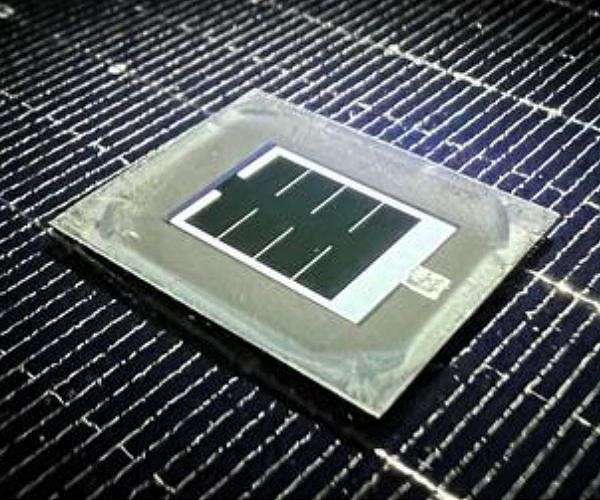
Stability of perovskite solar cells reinforced with innovative protective layer
Scientists at Northwestern University have unveiled a new protective coating that dramatically improves the lifespan of perovskite solar cells, an important step toward making these cells viable for real-world applications.
Perovskite solar cells offer greater efficiency and lower costs compared to traditional silicon-based cells. However, the lack of sustainability has historically hindered widespread adoption. Conventional coatings using ammonium-based compounds, while effective at improving efficiency, degrade quickly under environmental conditions such as heat and moisture.
To address this limitation, the research team introduced an amidinium-based protective layer, which significantly outperformed ammonium coatings. Laboratory tests have shown that this innovative layer is 10 times more resistant to decomposition. In addition, it tripled the T90 lifespan of the cells: the length of time before a cell’s efficiency drops to 90% of its original level under extreme conditions.
“Work on the stability of perovskite solar cells has been underway for a long time,” says Bin Chen, co-leader of the study. “So far, most reports focus on improving the stability of the perovskite material itself, ignoring the protective layers. By improving the protective layer, we were able to improve the overall performance of the solar cells.”
The study, published in ‘Science’, marks a crucial advance in perovskite solar cell technology.
“This work addresses one of the critical barriers to the widespread adoption of perovskite solar cells: stability under real-world conditions,” explains Mercouri Kanatzidis, another co-leader of the study. “By chemically strengthening the protective layers, we have significantly improved the durability of these cells without compromising their exceptional efficiency, moving us closer to a practical, low-cost alternative to silicon-based solar photovoltaics.”
Bridging the sustainability gap
Although silicon remains the most widely used material for solar cells due to its reliability and durability, it is expensive to produce and reaches its maximum efficiency potential. Researchers have turned to perovskites as a more affordable and efficient alternative. However, the limited lifespan of perovskite under sunlight, temperature fluctuations and moisture remains a major challenge.
The Northwestern team addressed this problem by using amidinium ligands, stable molecules capable of interacting with perovskites to improve protection and prevent defects. Compared to ammonium-based molecules, amidinium compounds are structurally more resilient under harsh conditions.
“State-of-the-art perovskite solar cells typically have ammonium ligands as the passivation layer,” said Yi Yang, the first author of the study. “But ammonium tends to break down under thermal stress. We did some chemistry to convert the unstable ammonium into a more stable amidinium.”
This transformation, achieved through a chemical process called amidination, replaced the ammonium group with amidinium, preventing degradation and improving thermal stability.
Record-breaking performance
With this innovation, the perovskite solar cells achieved an efficiency of 26.3%, converting 26.3% of sunlight into usable electricity. Additionally, the amidinium-coated cells retained 90% of their initial efficiency after 1,100 hours of rigorous testing under heat and light, demonstrating their vastly improved durability.
These results build on previous advances by Northwestern’s research team. Over the past two years, the Sargent lab has achieved record-breaking energy efficiency, introduced inverted perovskite structures and incorporated liquid crystals to improve cell performance.
“Perovskite-based solar cells have the potential to contribute to the decarbonization of the electricity supply once we finalize their design, achieve the combination of performance and durability, and scale up the devices,” said Ted Sargent, co-lead of the study. “The main barrier to the commercialization of perovskite solar cells is their long-term stability. But due to its decades-long head start, silicon still has an advantage in some areas, including stability. We are working to close that gap.”
The study supports the Trienens Institute’s Generate pillar, which focuses on promoting solar energy production through innovative technologies. By improving perovskite solar cells, Northwestern aims to develop the next generation of efficient, cost-effective solar energy solutions.
Research report:Amidination of ligands for chemical and field effect passivation stabilizes perovskite solar cells
