

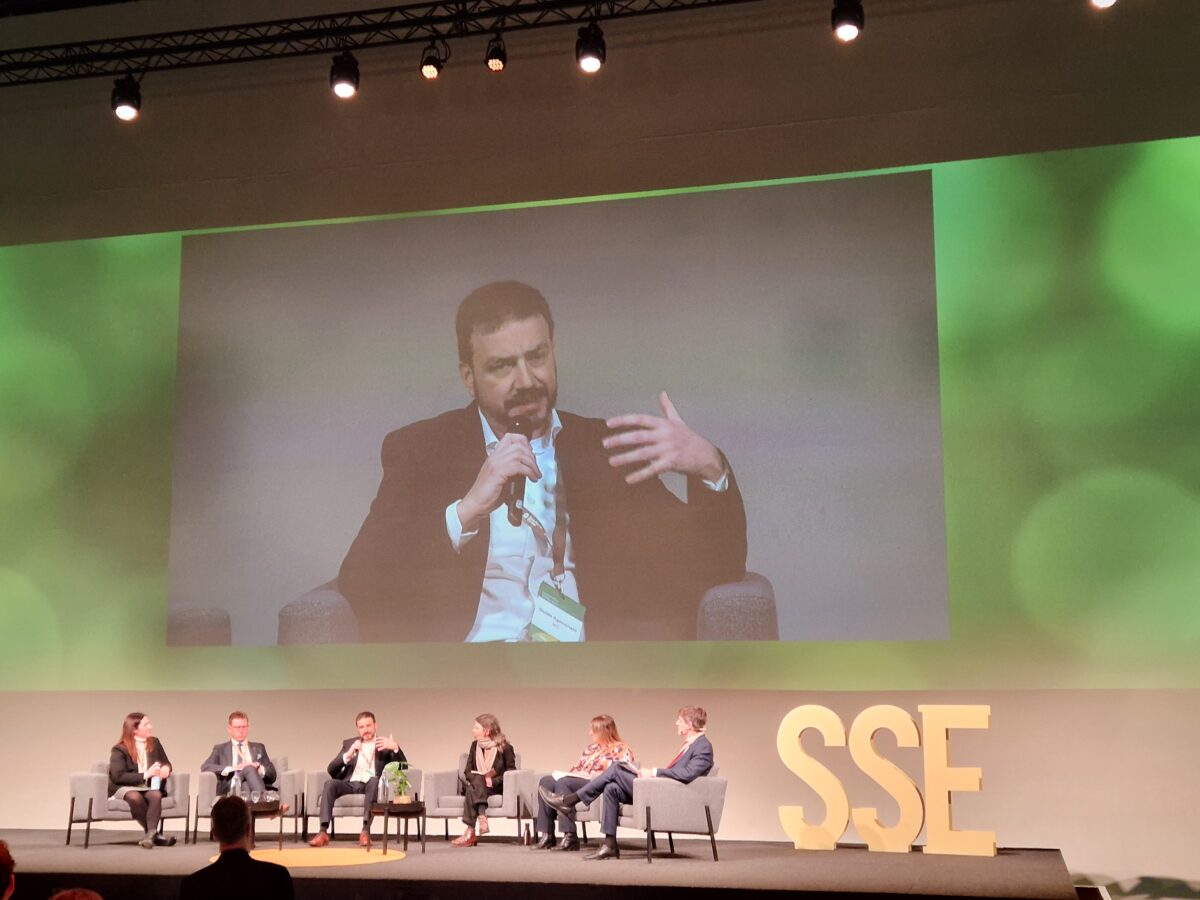
Discussions at the Sustainable Solar Europe event, held yesterday in Brussels, show that clearly recorded and available information is key to ensuring sustainable and ethical practices throughout the solar energy supply chain. And clear standards for the accuracy and relevance of this information are needed to ensure everyone is working toward the same goal. On this day, such a standard was also launched in the Supply Chain Traceability Standard of the Solar Stewardship Initiative.
Sustainable Solar Europe, an annual event jointly organized by trade association SolarPower Europe and event organizer SolarPromotion, took place yesterday in Brussels, offering a full day of high-level discussions on the solar industry’s efforts to ensure its own sustainability , and the growing importance of environmental, social and governance (ESG) factors in customer expectations, corporate reputation and financial risk management.
From the outset it was made clear that interventions on the policy side are needed. “Carbon markets cannot solve this alone, and we must ensure that national governments do not get caught up in a subsidy race,” Belgian MP Sara Mathieu told the audience during the opening session.
The scope and form of those interventions were widely discussed for the rest of the day. And the key takeaways from these conversations mean companies must clearly report their own material purchasing, labor practices and other factors, as well as be open to third-party audits.
In addition to providing ESG assurance, such information has valuable applications in quality assurance and determining responsibility in the event of warranty claims, as well as for recyclers, many of whom spoke of the challenge posed by modules whose exact contents are difficult to determine . Factors such as whether glass contains antimony, or what material was used as a dopant in cell production, can have a significant impact on recycling, and a ‘digital product pass’ detailing the exact contents of a module would go a long way can contribute to solving this problem.
However, many also spoke about the current tangle of different standards and practices that ESG reporting entails. Differences between regions and regulatory authorities leave many customers confused about what is actually relevant or necessary, and create the risk of ‘audit fatigue’ for many suppliers.
Traceability standard
The Solar Stewardship Initiative (SSI) has positioned itself as an antidote to this, yesterday announcing the publication of its Supply Chain Traceability Standard. Speaking at the launch, SSI Secretariat Head Alexia Ruvoletto said the standard sets a benchmark for the entire solar industry to adhere to, to avoid audit fatigue and ensure collaboration as the entire supply chain moves toward the same goal.
The standard was developed after consultation with more than twenty stakeholder organizations and tested during audits at fourteen locations covering the supply chain from polysilicon to modules. The goal is to create an “uninterrupted chain of custody” to ensure that “certified materials remain distinguished from non-certified materials, thereby strengthening the integrity of solar products,” according to an announcement on the company’s website initiative.
Recycling innovations
Also on display at Sustainable Solar Europe was a wealth of innovation in PV module recycling, with European and global initiatives showing strong progress in automating and scaling up the initial module dismantling processes, and extracting materials that are purely be enough to go back into the solar supply chain. Making these processes more cost-effective and reducing the use of toxic chemicals are also goals for the initiatives.
The interest in module recycling was further underlined this year when Jan-Phillip Mai, from German company Solar Materials, received the event’s sustainability award for his plans to open a module recycling center in Magdeburg, Germany, next year to be scaled up in 2014. 2026 to process up to 36,000 tons of module waste per year. The winner was chosen by attendees from a shortlist selected by a jury.
This content is copyrighted and may not be reused. If you would like to collaborate with us and reuse some of our content, please contact: editors@pv-magazine.com.
