

In April 2024, the nonprofit Climate Central published a report on the potential for renewable energy in the United States, based on a decade of solar and wind energy data.
The 238,181 GWh of solar energy generated in the United States in 2023 was more than eight times the volume produced in 2014. Wind energy had more than doubled to 425,325 GWh.
Solar and wind energy could have powered more than 61 million average American homes by 2023. California led the way, with 68,816 GWh of solar energy. Texas led the way in wind energy, with 119,836 GWh, and also generated 31,739 GWh of solar energy in 2023.
However, energy generation needs to be more evenly distributed across the country, and in an effort to advance America’s energy transition, groups of young activists have turned to the courts.
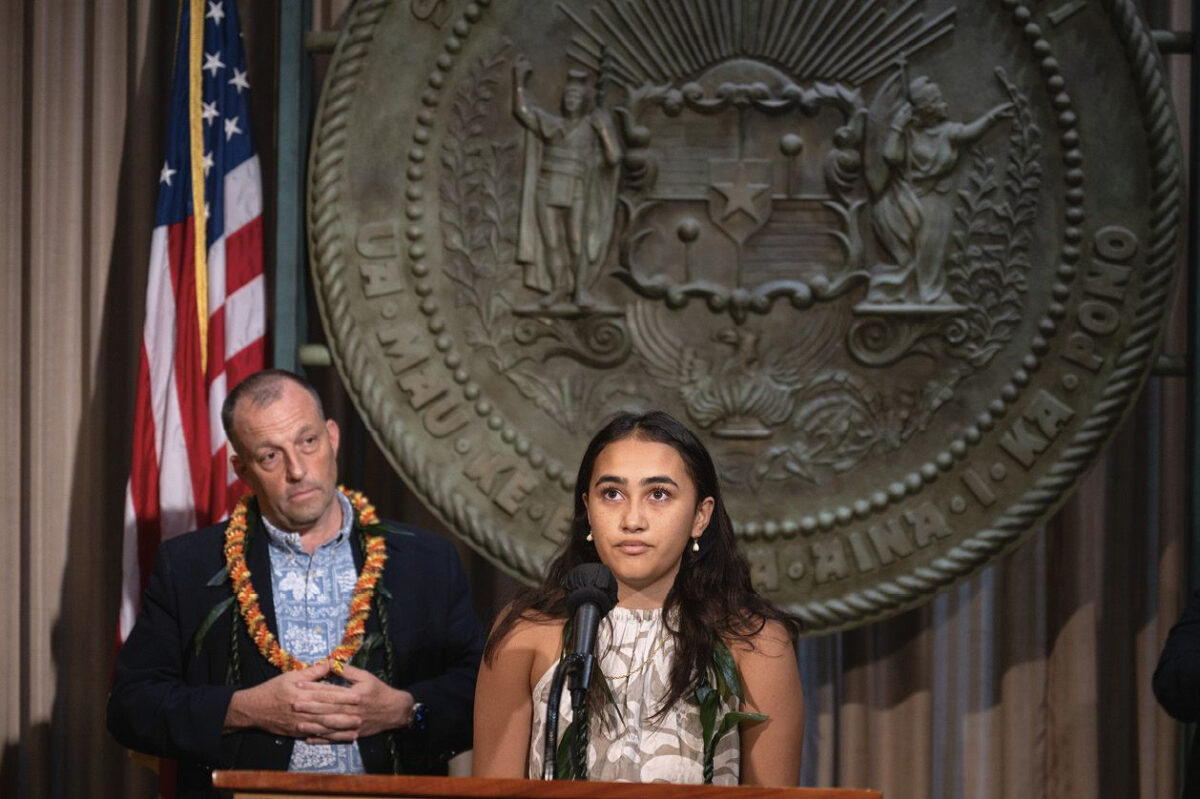
In 2022, plaintiff Navahine F., whose last name was not disclosed, and twelve other young Hawaiians filed a case requiring the Hawaii Department of Transportation (HDOT) to take responsibility for providing a life-sustaining environment. Navahine vs. HDOT was settled in favor of the plaintiffs on June 20, 2024, in what is considered the world’s first youth-led, transportation-focused constitutional climate case.
“This agreement provides a holistic roadmap that states and countries around the world can follow,” said Andrea Rodgers, co-counsel for the plaintiffs.
HDOT is now required to transform its transportation system to achieve net-negative emissions by 2045, as demanded by activists.
Renewable energy scientist and Stanford University professor Mark Z. Jacobson, who models air pollution and 100% renewable energy transitions, was an expert witness for the plaintiffs. The Navahine case was his first legal victory.
“The Hawaii case was the third one I was involved in,” Jacobson said pv magazine. “I also testified in a previous case in Oregon, where this group sued the federal government on climate grounds, but that was postponed or thrown out. We have developed plans for every US state to transition to 100% renewable energy sources and I was called to testify on how they can do that.”
The Oregon case is Juliana versus the United States. The plaintiffs argued that the state violated their constitutional rights by causing dangerous levels of carbon dioxide.
In Montana, Jacobson was involved in a case that concluded in June 2023. The case of Held vs. Montana was successful in lower courts and is back before the Supreme Court after an appeal from the state. “I think it will hold up,” said Jacobson, who was poised to release an article in early August 2024 analyzing California’s path to a 100-day milestone of 100% clean energy.
Unequal generation
Clean energy generation is uneven across the United States, with some states embracing solar, wind, and other renewable energy sources more effectively than others.
“What we need now is to deploy, deploy, deploy renewables and other technologies; clean, renewable energy and electrification at scale,” said Jacobson, discussing the action needed to bridge the gap.
Jacobson said he wants to see “more policies put in place to move towards 100% renewables” – a requirement he will remain steadfast on regardless of the outcome of the upcoming US election. Jacobson has been heavily involved in the Democratic party in the past, but said the effort for 100% renewable energy is “not a partisan issue.”
“I have always been open to cooperation with any party,” he says. “It just so happens that the states that are more interested in 100% renewable energy have had more Democratic governors. But in fact, for example, the states with the most wind, like nine out of ten states with most of their electricity from wind, are all Republican states.
“My goal is to solve problems. The solution is 100% clean, renewable energy for 100% of the people. We need everyone involved, across party lines, including internationally. I’m not specifically speaking only to Democrats; it’s just like I said, it’s that most people are interested in this and open to involvement. But in fact, the Republicans are also interested. They just don’t want to admit it.”
Like many of the activists he has testified for, Jacobson blames “Big Oil” donors for the stranglehold fossil fuels have on certain states. But what about the impact ‘Big Tech’ has had on the climate? From data centers to greenwashing, there are many offenders to choose from.
Technological progress can of course also benefit the energy transition, according to Jacobson.
“We need technology to solve problems – through electrification, through solar energy, wind energy, heat pumps, battery electric vehicles, battery storage, electric induction hobs and industrial flint technologies.”
According to Jacobson, technology can be a double-edged sword. “There are certain technologies that are not useful, such as nuclear energy, carbon capture, direct air capture, blue hydrogen, electrofuels and bioenergy. These technologies are not useful,” he said. “On the other hand, there are technologies that are more energy efficient and consume less energy, I mean like the LED lamp instead of the incandescent lamp. And compared to gas or combustion, heat pumps use a quarter of the energy for air and water heating.
“Using technologies wisely and reducing energy consumption are important for energy efficiency. But we should not be afraid of technologies, we should be careful about which technologies we use.”
Jacobson’s goal for the future of the 100% renewable energy movement is to continue on the same trajectory. “In terms of our own research, we want to put out a lot of research that is policy relevant, looking at the ability to transition to clean renewable energy, and [we want to] Try to focus on what really works and not on what doesn’t work.”
Earlier in 2024, Jacobson’s team published plans for 149 countries to transition to renewable energy sources using refractory bricks – bricks that can store large amounts of heat. “For that study, we started with International Energy Agency (IEA) energy data for 149 countries and projected it out to 2050… We find that in 149 countries, we can transition every country to 100% clean, renewable energy without any problems.”
Various factors were examined in the study. It looked at electricity demand and the electrification of energy sources, including the shift from gas-powered vehicles to electric vehicles; the number of wind turbines and solar panels required for the transition; and the costs of the transition; land use; job creation and loss; and air pollution.
“The costs are so much better than fossil fuel systems,” says Jacobson. “The range doesn’t even matter that much because they are all much lower. Even the high range is much smaller than the low range of fossil fuel costs.”
The right technology
At the very top of the list of solutions he strongly opposes is carbon capture and storage (CCS). A 2023 article written by Jacobson and published in “Environmental Science and Technology” analyzed a case study of a proposal to capture and store carbon dioxide from 34 ethanol refineries in five U.S. states and build a pipeline to transport it to transport CO.2 to an underground storage facility.
“Adding CO2 capture always requires energy and equipment,” says Jacobson. “You can achieve more CO2 reduction by using it [energy and equipment] just to replace a fossil source rather than using it to power carbon capture equipment. You always increase carbon dioxide by using carbon capture. You’re abusing the energy required to do that, and you could use it to essentially replace a fossil fuel source. You also increase air pollution and fossil fuel mining because you cannot reduce the fossil source or eliminate the air pollution it causes,” Jacobson added.
His views are not isolated. Scientists from the University of Oxford published a study in December 2023 claiming that a heavy reliance on CCS could be economically wasteful. Others, however, have taken a less harsh approach for fear of undoing hard-won progress.
In 2020, the IEA described CCS as “one of the key technology areas” to put energy systems around the world on a more sustainable path. However, the organization also recognized that the need for CCS was due to the lack of a better alternative.
This content is copyrighted and may not be reused. If you would like to collaborate with us and reuse some of our content, please contact: editors@pv-magazine.com.
