

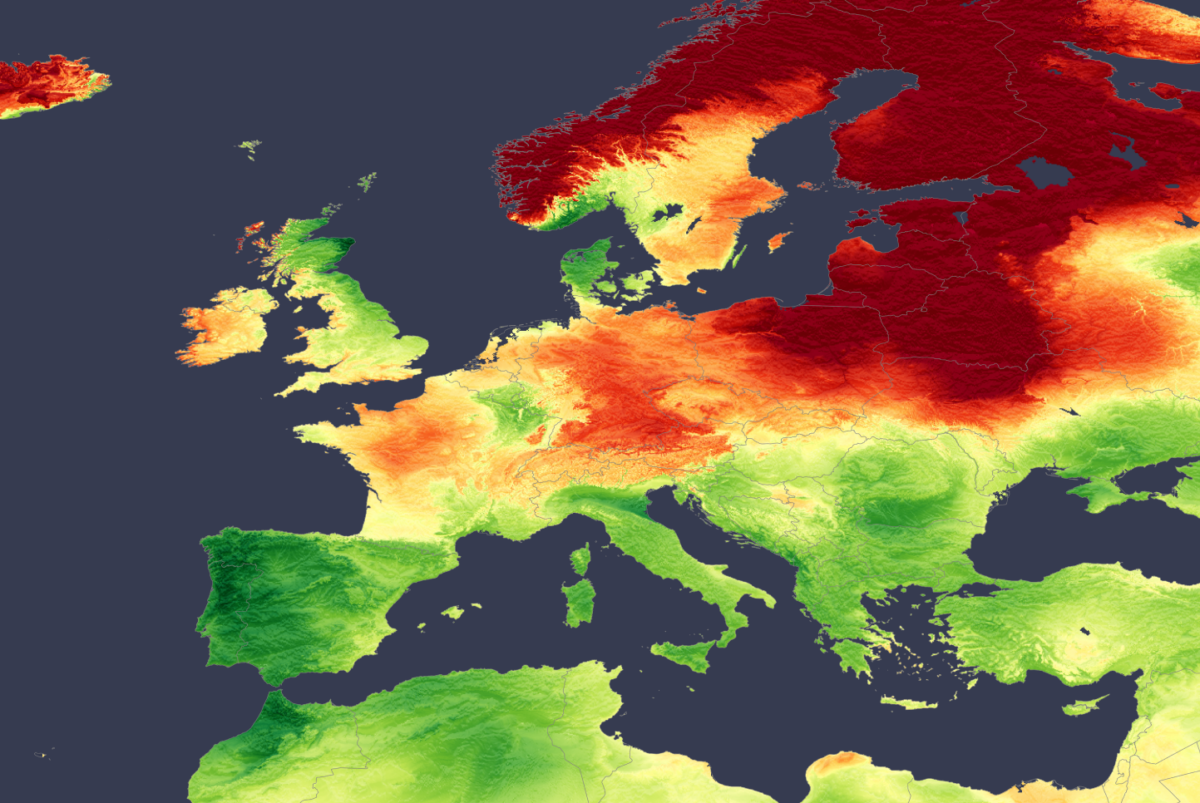
In a new weekly update for pv magazineSolcast, a DNV company, reports that January 2026 was Europe’s coldest month since 2010, with Eastern Europe and Scandinavia enjoying above-average solar radiation under stable, dry air, while Britain, Spain and Portugal experienced record cloud cover and rainfall that sharply reduced PV production.
January 2026 delivered Europe’s coldest January since 2010, an exception to warm global temperatures. At the same time, record warm sea surface temperatures in the North Atlantic Ocean contributed to the formation of a succession of powerful storm systems. The result was a month of sharp regional contrasts for solar energy, according to analysis using the Solcast API. Eastern Europe and Scandinavia recorded above-average insolation under cold, stable air masses, while Britain and parts of western Europe experienced suppressed insolation due to persistent Atlantic lows. The major PV markets saw mixed results, with Germany ultimately ending the month with favorable irradiance, while Spain and Portugal experienced one of their bleakest starts to a year in decades.
Across the Iberian Peninsula, Spain and Portugal recorded a month well below average in terms of solar radiation. Storm Kristin brought widespread cloud cover and repeated rain showers, limiting clear-sky windows and lowering daily irradiation totals. January 2026 was the bleakest on record in most parts of Spain, and nothing has been seen since 2016. Rainfall reached 85% above normal, making it the wettest January in 25 years. Portugal recorded 233.4mm of rainfall nationwide, around double the 105mm average from 1991 to 2020, making it the second wettest January since 2000. Persistent cloud cover throughout the month, rather than isolated storm peaks, was the dominant feature shaping PV
conditions throughout Iberia.
Further north, a series of strong Atlantic low-pressure systems, including Storm Goretti in Britain, repeatedly moved into northwestern Europe. These systems produced thick cloud bands, heavy rainfall and strong winds that greatly reduced insolation in the United Kingdom and Great Britain
parts of Europe. Northern Ireland and southern England recorded the wettest January since the 19th century, with flooding and power outages accompanied by prolonged cloudy conditions. Germany also experienced several storm episodes, with heavy rain and strong winds interrupting solar energy during frontal passages. Clearer, colder air in the wake of these systems due to post-frontal cold spells reduced atmospheric moisture and cloud formation, allowing monthly insolation to end above the long-term average despite the uncertain pattern.

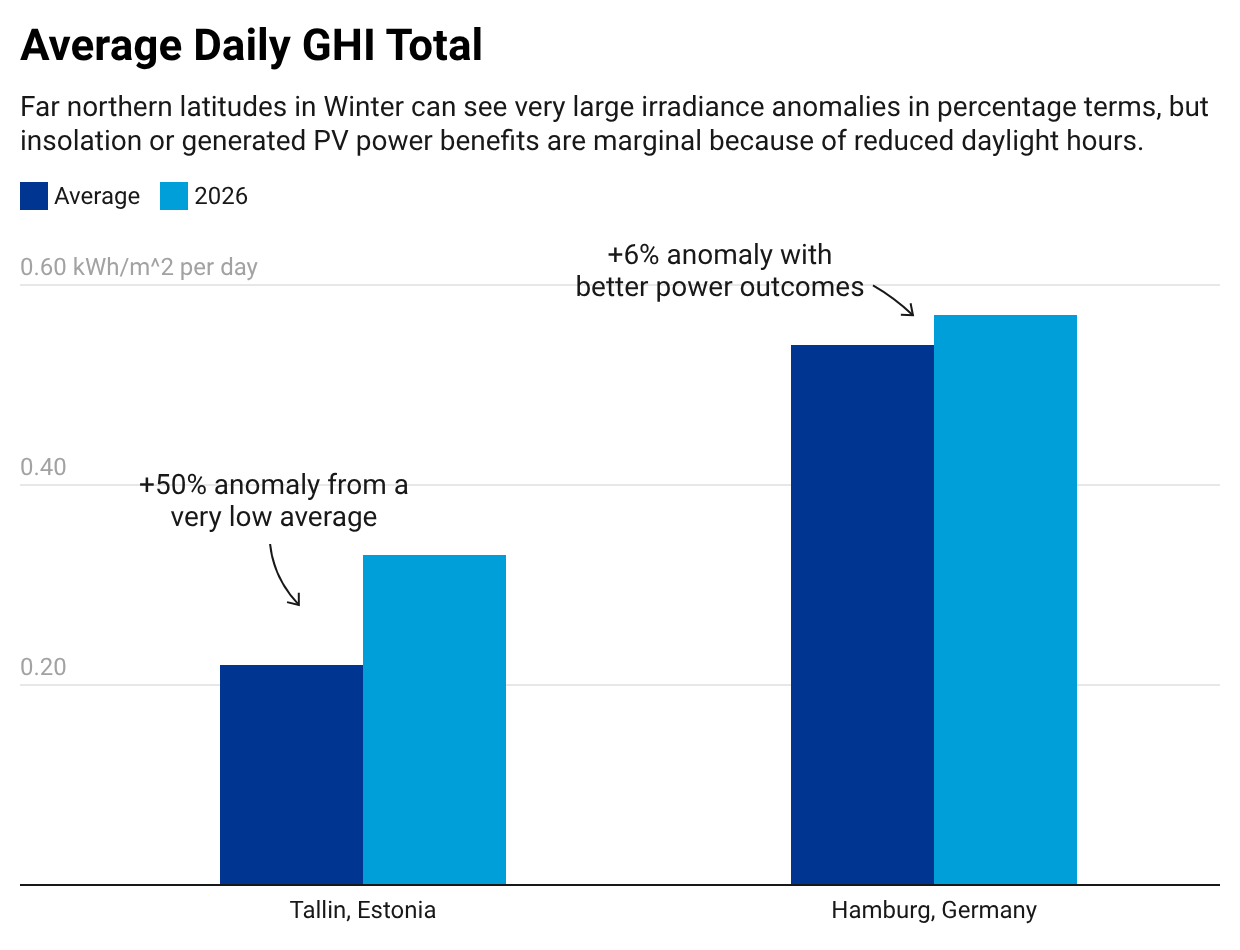
In Scandinavia, the Baltics and Poland, solar radiation was 10% to 50% above average, while a severe cold snap in mid-month brought dry, stable air to Eastern Europe. January 2026 was widely reported as the coldest January in Europe since 2010, causing travel disruptions and local power outages. Although the length of winter days inherently limits the availability of solar energy at these latitudes, reduced humidity and more frequent clear or partly cloudy skies made for brighter than usual winter days. At the far northern latitudes there were very large percentage deviations, but with limited real benefit to solar energy generation.
Solcast produces these figures by tracking clouds and aerosols worldwide at a resolution of 1-2 km, using proprietary satellite data AI/ML algorithms. This data is used to drive irradiance models, allowing Solcast to calculate high-resolution irradiance, with a typical deviation of less than 2%, as well as cloud tracking predictions. This data is used by more than 350 companies that manage more than 300 GW of solar energy worldwide.
The views and opinions expressed in this article are those of the author and do not necessarily reflect those of the author pv magazine.
This content is copyrighted and may not be reused. If you would like to collaborate with us and reuse some of our content, please contact: editors@pv-magazine.com.
Popular content

