

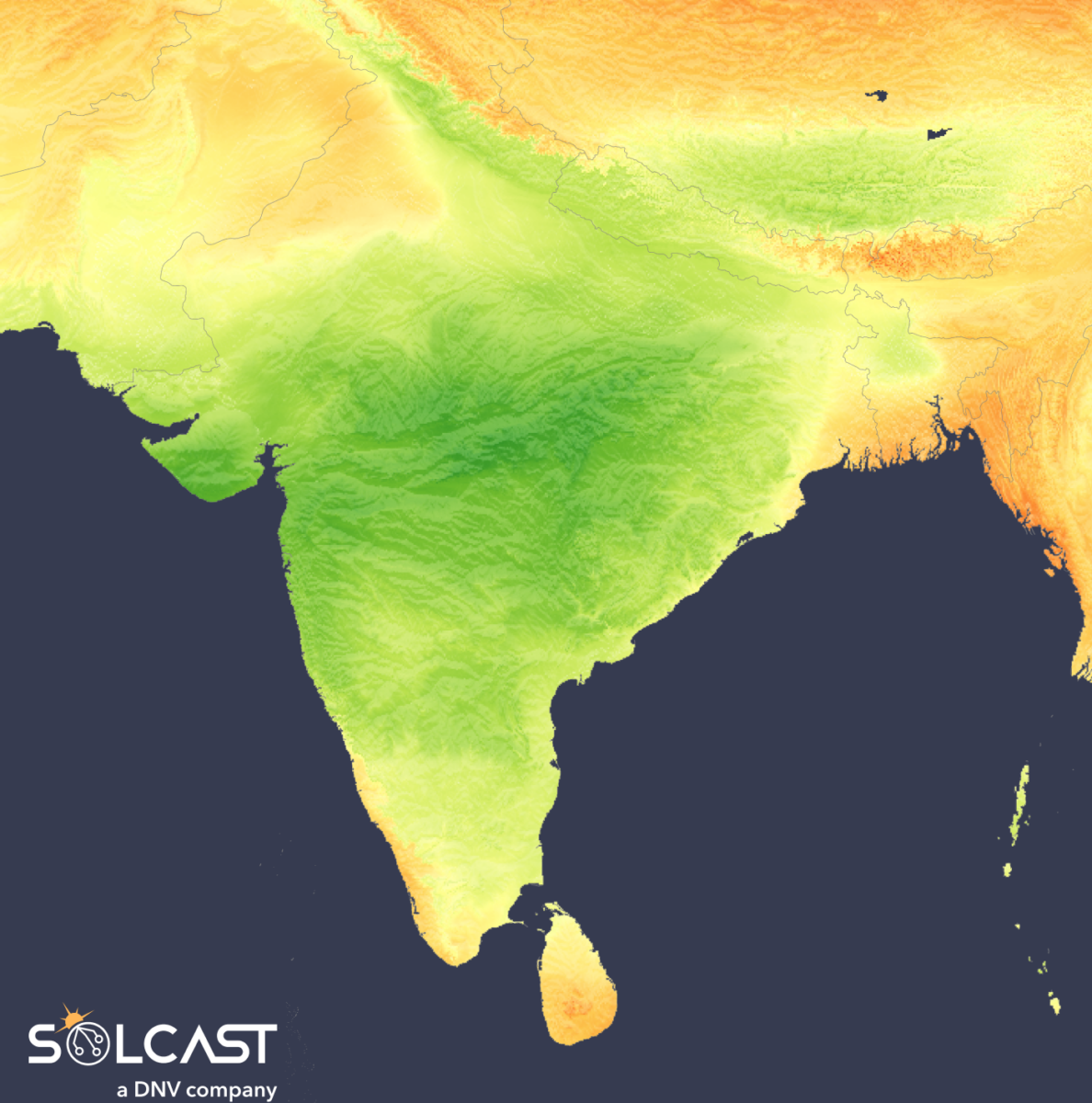
In a new weekly update for pv magazineSolcast, a DNV company, reports that India’s solar generation potential was significantly hampered in September and October due to an intensified southwest monsoon, resulting in a 15% decrease in irradiance compared to the long-term average.
India’s solar power generation potential was significantly hampered in September and October due to an intensified southwest monsoon, resulting in a 15% decline in irradiance compared to the long-term average, according to analysis using the Solcast API. The effects were not uniform across the country, with some regions experiencing notable declines in production, while others, especially in the Northeast, benefited from drier than normal conditions. The start of November has brought a cold snap, with mixed expectations for the rest of the year as the conflicting climate points to complicated forecasts.
The southwest monsoon withdrew completely on October 16, delivering 934.8 mm of rainfall across India – 8% above seasonal normal and the highest since 2020. Central India saw the biggest increase, recording almost 20% more rainfall than normal, driven by the frequent development of low-pressure systems in the Bay of Bengal. Conversely, Northeast India experienced rainfall 20% below average due to persistent high pressure that limited cloud formation and rainfall. Late in the season, Cyclone Montha brought additional rainfall to Andhra Pradesh and surrounding areas, further disrupting irradiation. This intensified monsoon activity had a tangible impact on regional solar performance. In the northwestern and central regions, increased cloud cover and rainfall suppressed insolation, reducing cumulative generation.
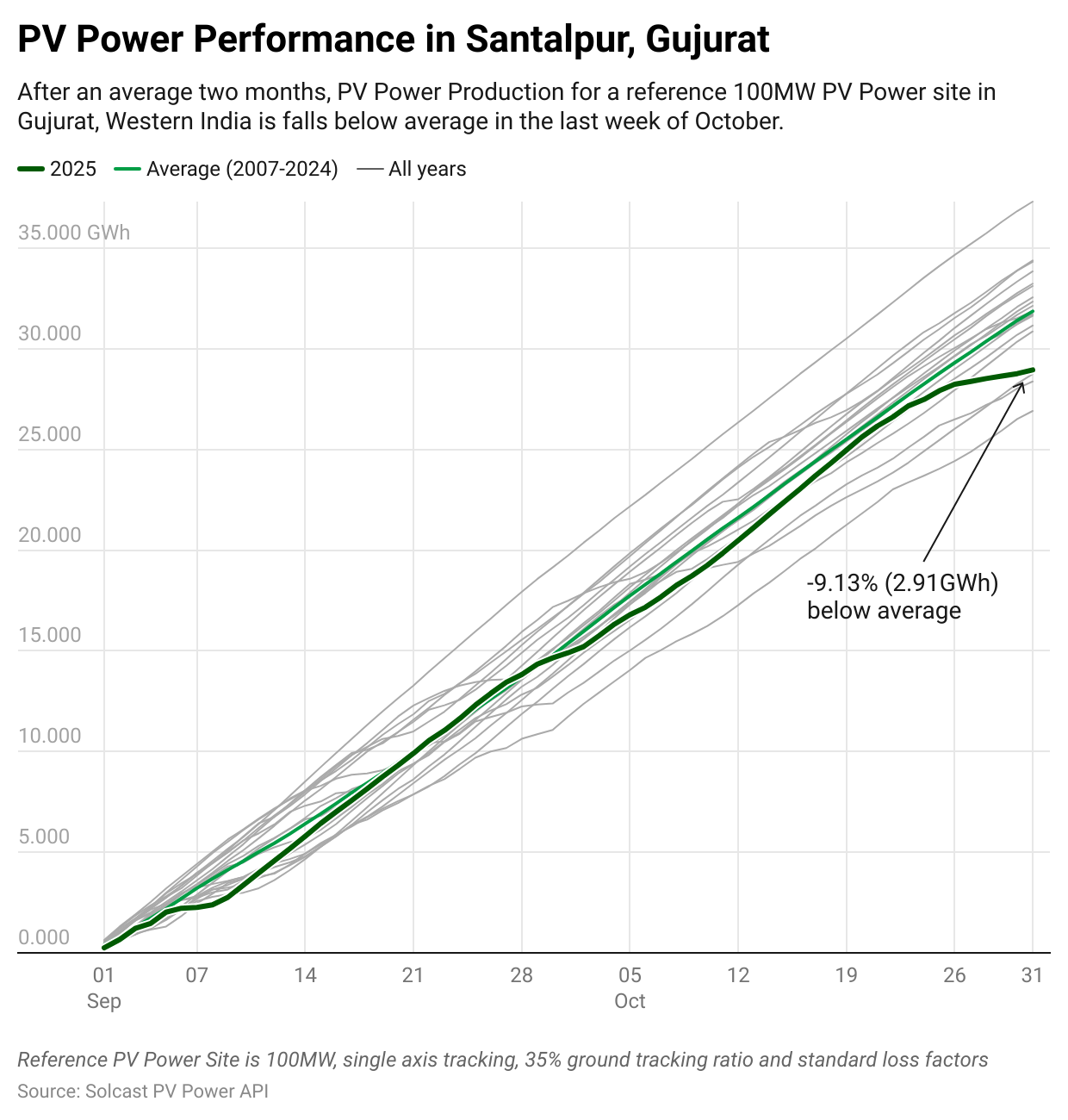
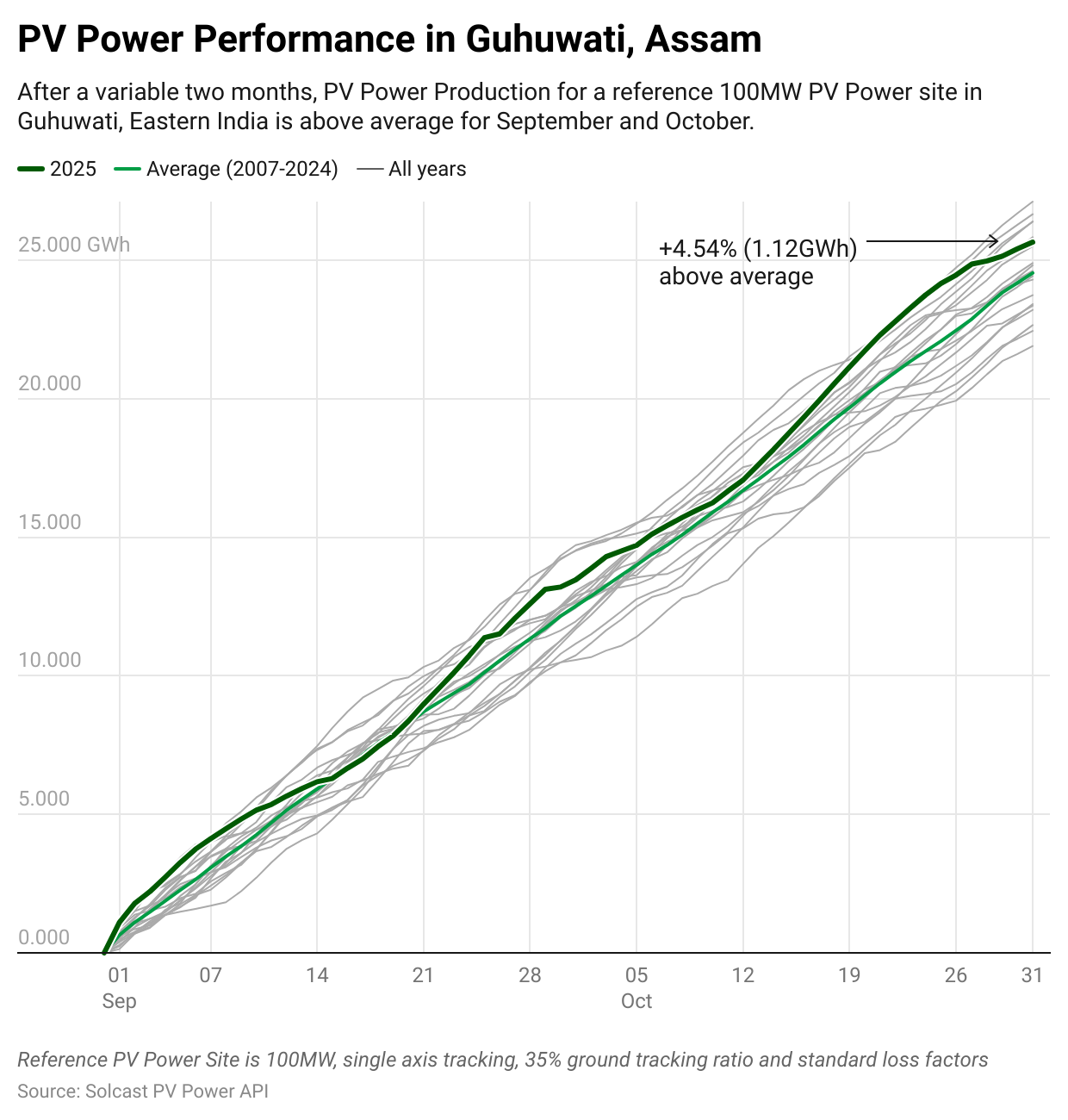
Modeling for a representative 100 MW solar power plant at Badod in Madhya Pradesh recorded a 19.1% decline in cumulative generation in September and October compared to the 2007-2024 average. In Gujurat, Santalpur saw a decline of 9.13%, 2.91 GWh, almost entirely in the last week of October. In contrast, Guwahati in Assam experienced a 4.54% increase in cumulative generation, thanks to clear skies associated with the drier than normal conditions.
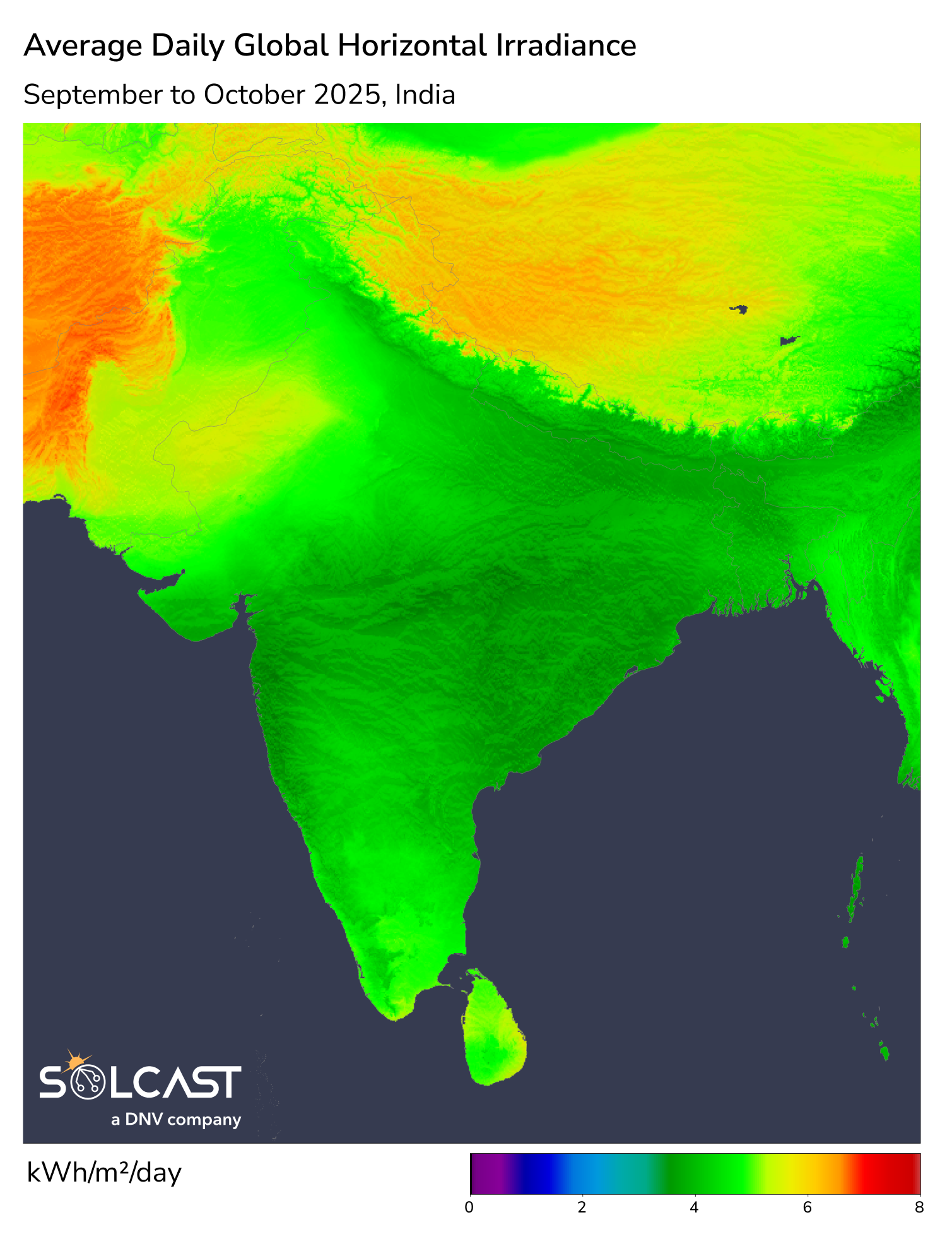
As November began, temperatures fell sharply, with readings up to 3 degrees below average in many regions, and forecasts pointing to possible drops of up to 5 degrees below normal in parts of the north. The onset of the northeast monsoon, which normally brings about 20% of India’s annual rainfall mainly to the southeast, complicates the seasonal outlook. While a negative dipole in the Indian Ocean indicates a weaker monsoon and possibly drier conditions, dynamic seasonal forecast models refute expectations of above-average rainfall and continued lower-than-average insolation into December. This difference highlights the uncertainty in the coming weather effects on solar energy generation, with actual outcomes likely influenced by evolving atmospheric patterns.
Solcast produces these figures by tracking clouds and aerosols worldwide at a resolution of 1-2 km, using proprietary satellite data AI/ML algorithms. This data is used to drive irradiance models, allowing Solcast to calculate high-resolution irradiance, with a typical deviation of less than 2%, as well as cloud tracking predictions. This data is used by more than 350 companies that manage more than 300 GW of solar energy worldwide.
The views and opinions expressed in this article are those of the author and do not necessarily reflect those of the author pv magazine.
This content is copyrighted and may not be reused. If you would like to collaborate with us and reuse some of our content, please contact: editors@pv-magazine.com.
Popular content

