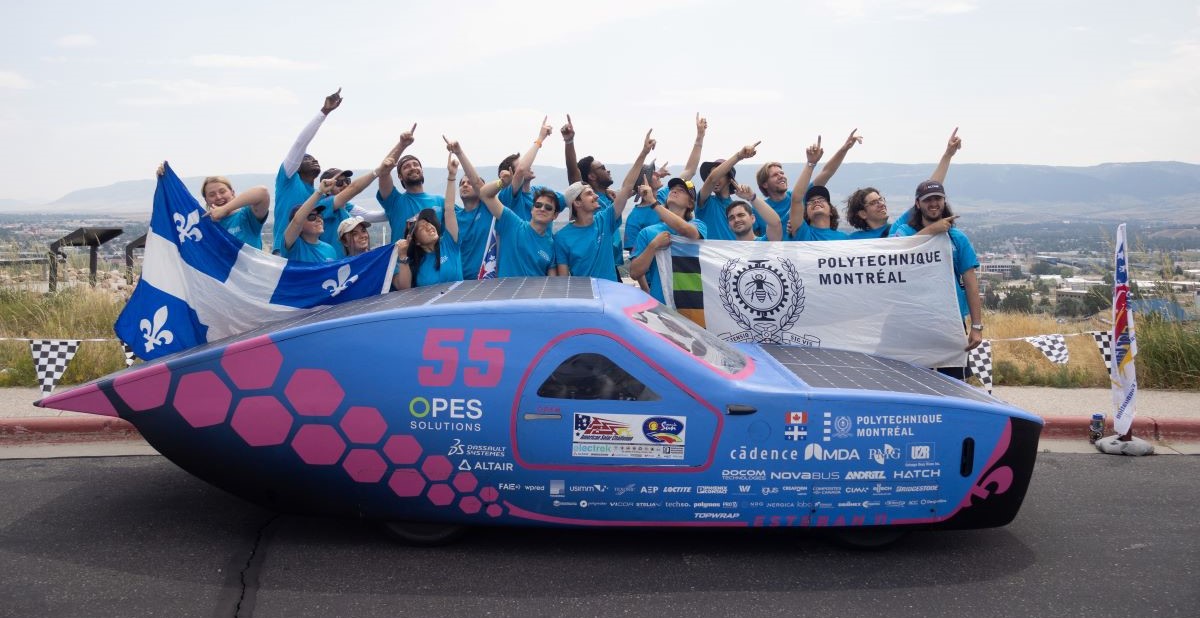
Solar car teams from Canada performed better in two categories of the latest Electrek American Solar Challenge. The student team from Polytechnique Montréal won first place in the multi-occupant vehicle category, and the students from École de techno supérieure took second place in the single-occupant vehicle category.
Student solar car teams from Canada’s Polytechnique Montréal and École de technology supérieure reached the podium of the Electrek American Solar Challenge 2024, a distance-based solar car competition.
Driving a multi-occupant vehicle (MOV) named Esteban 11, students from Polytechnique Montréal won first place in the MOV category in both the qualifying circuit race, known as the Electrek Formula Sun Grand Prix (FSGP), and in the main race, the Electrek American Solar Challenge, which requires a minimum of 2,400 km to be covered.
The Esteban team covered 1,610.3 miles at an average speed of 36.2 mph (58.26 km/h), with an overall score of 73.86. The MOV category is scored based on factors beyond distance traveled, such as usability, amount of external energy used and whether the target average speed of 55 km/h was maintained.
The other team from Montreal, from the École de technology supérieure, won silver in the single-occupant car (SOV) category, covering 3,004.5 miles with the Éclipse XI solar car. The SOV class is scored solely on the basis of kilometers driven. Only in the event of a tie, the elapsed time is relevant.
This year’s winner of the SOV class was the University of Michigan student team with their Astrum solar car, which traveled 3,372 km (2,095.5 miles) at an average speed of 37.51 mph.
Esteban 11 by the student team of Polytechnique Montréal
This was said by the spokesperson for the Esteban project pv magazine that the team started competing in 2019 with a two-seater MOV. “Switching categories allowed us to get more creativity into our design. The fact that we have several occupants also shows the efficiency of our car. Especially during the event, the broader public will learn how technology is evolving,” said Esteban’s spokesperson.
The team used a 1218W solar panel with cells from Singapore-based Maxeon and encapsulation by German specialist PV panel manufacturer OPES Solutions. The four-wheeled vehicle weighed 293 kg and measured 4.92 x 1.8 x 1.04 m. The battery was a 9.2 kWh from the Chinese BAK Technologies and weighed 47 kg, combined with two 5 kW M2096D-3 hub motors from the Japanese Mitsuba in a carbon fiber monocoque.
“A big challenge we had was splitting the battery pack. This allowed us to have a lower center of gravity, but complicated monitoring and protection,” the spokesperson said, adding that a new circuit board design that meets professional standards with features to manage heat effects also made a difference this year.
Éclipse XI by the student team of the École de technology supérieure
The Éclipse solar cells. It had a 20 kg, 5 kWh lithium-ion battery from Japanese manufacturer Panasonic.
The Éclipse XI team not only won a silver medal in the American Solar Challenge competition, it also won two awards: an Electrical Design Award and the Abe Poot Award. The latter is named after an influential figure in the American solar car racing community, which recognizes the team spirit of cooperation and collaboration, according to the Éclipse XI team spokesperson.
The Electrical Design Award recognized the performance of the electrical installation. “At FSGP we were the first team to complete the inspection of both the electrical system and the battery protection system with a green status. We also proved during both races that our electrical systems were robust and reliable, driving more than 4,500 km without any problems,” said the Éclipse team spokesperson. pv magazine.
“For this race we used a custom engine case with air cooling system to help us climb the steepest hills along the route,” they said, adding that the team is currently working on improved tracking of maximum power points that will “maximize the efficiency across all operating ranges” to reduce overall weight and costs.


The Electrek American Solar Challenge 2024 attracted more than 30 student-run teams from the US and Canada. It started on July 20 in Nashville, Tennessee, and ended on July 27 in Casper, Wyoming. The primary route must cover a total of 1,562.2 miles and vehicles must travel at an average speed of at least 35 miles per hour for the event. There are seven optional loops to earn extra points.
This content is copyrighted and may not be reused. If you would like to collaborate with us and reuse some of our content, please contact: editors@pv-magazine.com.
Popular content