

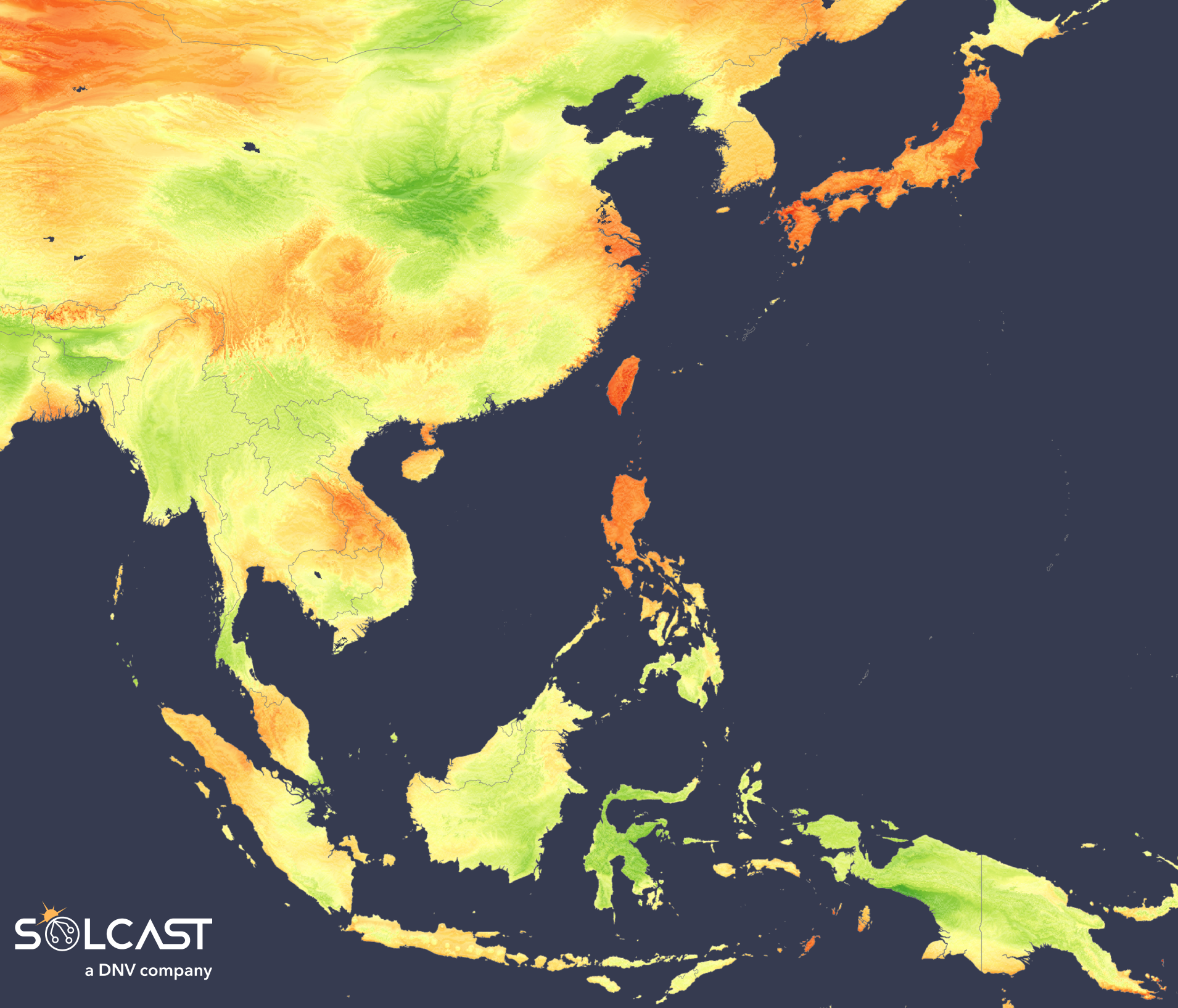
Clearer skies meant May insolation was well above average in coastal areas of East Asia, with Japan, Korea, eastern China, Taiwan and the northern Philippines all seeing stronger solar sources, according to analysis using the Solcast API. A persistent high was the main driver, raising coastal radiation above the May long-term average, while a rain band at the end of the month reduced radiation inland in parts of southern and central China.
Japan saw some of the strongest increases in the region. Tokyo recorded May irradiance about 15% above the 2007-2025 average, while Osaka was 14% above average, making it Osaka’s sunniest May in the Solcast record. Seoul was more modest, at 6% above average, but still within the broader band of unusually warm and calm conditions in Japan and the Korean Peninsula. The clear skies that caused this increase also contributed to record heat in May in northern China, Mongolia and Japan, with records being broken in several locations. High temperatures were less good news for PV operators in these regions due to the decrease in efficiency caused by the heat.
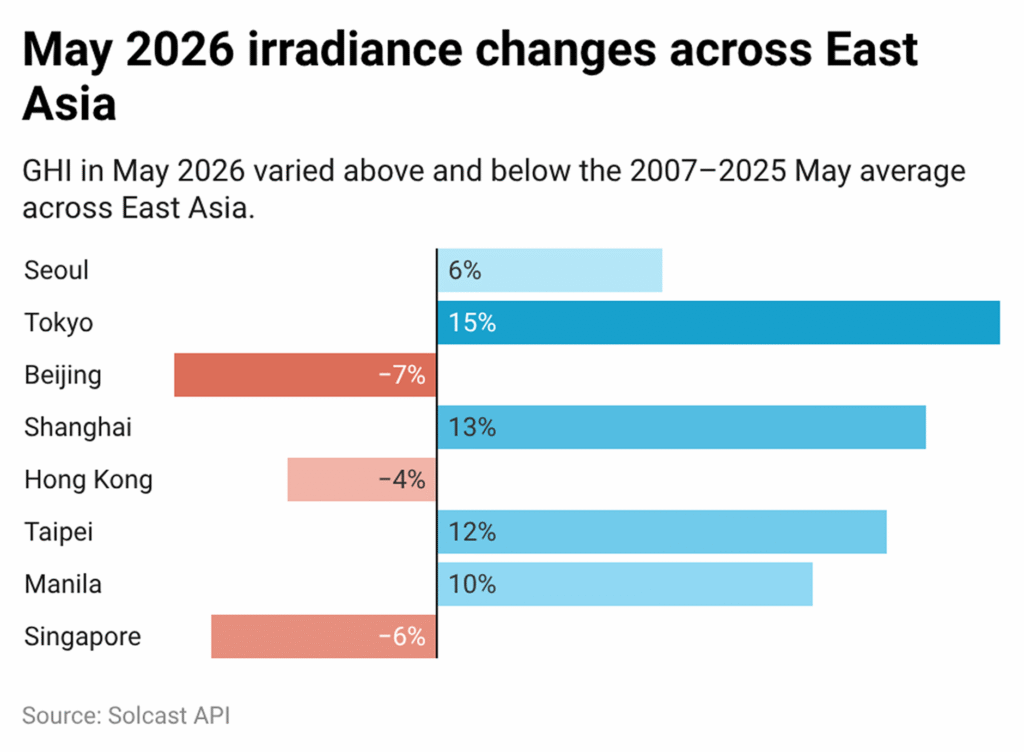
The sunny coastal corridor stretched from eastern China through Taiwan to the northern Philippines. In the north, Manchuria remained about 9% above average
further south, Shanghai recorded irradiance 13% above average in May, while the broader Yangtze Delta was about 6 to 10% above average. This corridor spanned the Taiwan and Luzon Straits, with Taipei and Manila experiencing similar increases to Shanghai, more than 10% above average, helped by reduced storm activity.
Unlike some increases in irradiance seen recently in eastern China, where reduced aerosols played a major role, the increase over the past month is mainly due to reduced cloud cover, while clear-sky irradiance is only a few percent above normal.
A contrast to the sunny conditions came late in the month. Around the last third of the month, a slow-moving rain band brought heavy rainfall to southern and central China as the humid ocean area converged, including 24-hour totals of almost 100 mm. Causing severe damage and lives lost, net solar for the month in affected areas was more mixed, but with areas a few percent above or below average. Small deviations above and below average were also true for Southeast Asia.
Multiple national weather agencies, including NOAA, the Australian Bureau of Meteorology and the China Meteorological Administration, have forecast a strong to very strong El Niño peak later in 2026. Surface temperatures in the tropical Pacific Ocean have already reached record highs since April, even above recent El Niño periods. Both agencies predict. For May, however, the story was less about El Niño and more regional: reduced cloud cover pushed coastal East Asia above average, while other areas were more mixed.
Solcast produces these figures by tracking clouds and aerosols worldwide at a resolution of 1-2 km, using proprietary satellite data AI/ML algorithms. This data is used to drive irradiance models, allowing Solcast to calculate high-resolution irradiance, with a typical deviation of less than 2%, as well as cloud tracking predictions. This data is used by more than 350 companies that manage more than 300 GW of solar energy worldwide.
