

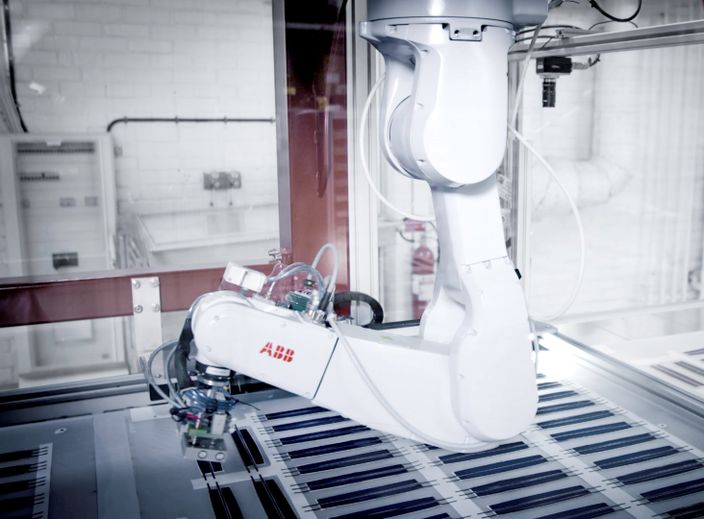
A Swedish government agency is investing 130 million SEK ($13.8 million) in Exeger’s next generation indoor solar cell technology. The company’s Powerfoyle solar cells are an evolution of dye-sensitive solar cells and are said to offer a thousand times better conductivity.
The Swedish Energy Agency has awarded SEK 130 million ($13.8 million) to Swedish deep-tech company Exeger to support the development and industrialization of its next-generation indoor solar cell technology.
Exeger’s solar cells, known as Powerfoyle, are capable of converting both indoor and outdoor light into electricity. Billed as the world’s only fully customizable solar cell, the product aims to replace disposable batteries in electronics by offering a flexible design that can be integrated into existing products.
According to details on the company’s website, Powerfoyle is an evolution of dye-sensitized solar cells. The company says its technology uses a completely new material with a thousand times lower resistance than the conductive layer typically found in flexible solar cells. This means that much larger cells can be produced without the need for current collectors.
The Powerfoyle series can be optimized for different light levels by combining different light-absorbing dyes and electrolytes within the cell. Exeger says this ensures the maximum output power is generated to match typical light levels for a given device, meaning users never have to charge devices.
“We are creating a silicon-free solar cell technology that can replace millions of disposable batteries while reducing the need for critical raw materials,” said Giovanni Fili, CEO and founder of Exeger. “The support of [SEA’s national program] Industriklivet is crucial in enabling the industrialization of the technology.”
A statement published on Exeger’s LinkedIn page adds that the financing “serves as a strong confirmation that our strategy and our continued commitment to building a new sustainable energy industry in Sweden are on the right track.”
SEA added that Exeger’s technology is based on Swedish research, with the solar cells produced through a mainly European supply chain. “Investments in new solar cell technologies open the door to innovative solutions that can support the transition to a sustainable energy system,” said Klara Helstad, deputy head of the agency’s Research, Innovation and Business Development department. “Exeger’s technology can help reduce the use of disposable batteries while reducing the extraction of critical raw materials.”
Earlier in November, Exeger announced that it had secured at least SEK 160 million in financing for the second half of 2025.
This content is copyrighted and may not be reused. If you would like to collaborate with us and reuse some of our content, please contact: editors@pv-magazine.com.
