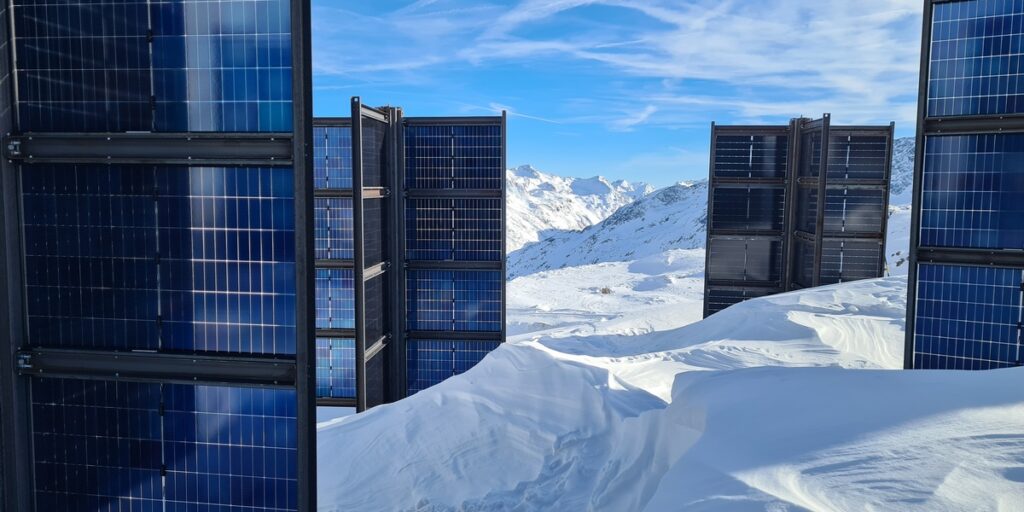
The researchers used computational fluid dynamics-based modeling of snow patterns in an effort to identify best practices to reduce snow accumulation in alpine PV installations.
Researchers from the Ecole Polytechnique Fédérale de Lausanne (EPFL) and WSL Institute for Snow and Avalanche Research SLF in Switzerland have modeled snow patterns to identify some best practices for PV installations built with Helioplant, a patented Austrian vertical PV frame structure.
“PV systems in the Alps have shown strong potential for electricity production in winter, particularly due to the reflection of incoming solar radiation by the snow cover. While this reflection helps improve energy absorption, snow can also cause problems by covering or burying the solar panels, causing losses or damage,” said Océane Hames, co-first study author. pv magazine.
The optimal design for solar PV systems in the Alps has yet to be determined, not only for individual installations, but also for larger clusters comparable in scale to future commercial power plants in the Alps, said Yael Frischholz, co-first author of the study.
“Helioplant structures have shown significant potential in limiting snow accumulation, which is why we explored this design,” Frischholz said. pv magazine.
Image: EPFL, Cold, Cold Regions Science and Technology, Creative Commons CC by 4.0
Helioplant is a patented vertical PV frame structure developed by Ehoch2, an Austrian PV engineering company, to reduce snow accumulation. It has a cross-shaped load-bearing structure with four solar wings designed to passively prevent snow accumulation within the wing area.
The researchers used a computational fluid dynamics (CFD) modeling tool known as Snowbedfoam to simulate snow transport and investigate the snow drift effects of Helioplant structures. According to the research, Snowbedfoam is an Openfoam-based Eulerian-Lagrangian solver for snow transport modeling.
“It is the first time that such a detailed snow transport model has been applied to solar panel structures. The sensitivity analysis simulations are specifically designed to provide practitioners with important messages or guidance on how to plan for these types of structures,” Hames explains.
The study used simulations and field observations of an identical test site. Some of the parameters considered were azimuth, height above surface, spatial arrangement of multiple units, spacing, group size and alignment.
The analysis identified a number of initial recommendations for best practice. For example, the height above the bare surface, the ground clearance, should be greater than 0.6 m, and the orientation of the Helioplant units with respect to the prevailing wind directions should be as close as possible to 0°. “If set to 45°, an undesirable erosion-free area is created in the inner lee of the structures. Locations with primary wind directions that are perpendicular or opposite to each other are therefore preferable,” the researchers said.
Further guidance is outlined in their article: “Optimizing snow distribution in alpine PV systems: CFD-based design guidelines for power plant layout”, published in Science and technology in cold areas.
The conclusion noted that the results “confirmed the importance of using CFD-based studies in addition to small-scale test sites,” especially when scaling up from smaller installations to large-scale solar PV installations.
The technology is not limited to a particular type of solar PV mounting solution. “The methods developed for this research can be used for any type of construction. Simulations on a more conventional row-based layout had already been carried out,” said Frischholz.
The team continues research into developing yield simulations that compare snow deposition patterns with actual PV electricity losses, and modeling more complex, non-flat terrain.
This content is copyrighted and may not be reused. If you would like to collaborate with us and reuse some of our content, please contact: editors@pv-magazine.com.
Popular content