
Close Menu
  • News
  • Industry
  • Solar Panels
  • Commercial
  • Residential
  • Finance
  • Technology
  • Carbon Credit
  • More
    • Policy
    • Energy Storage
    • Utility
    • Cummunity
What's Hot

Dutch solar owners asked to switch off during peak periods to ease the distribution crisis

June 7, 2026

The hydrogen flow: Toyota demonstrates its racing prototype on liquid hydrogen

June 7, 2026

Era of electrification exposing Australia’s weakest link

June 6, 2026
Facebook X (Twitter) Instagram
Solar Energy News
Sunday, June 7
  • News
  • Industry
  • Solar Panels
  • Commercial
  • Residential
  • Finance
  • Technology
  • Carbon Credit
  • More
    • Policy
    • Energy Storage
    • Utility
    • Cummunity
Solar Energy News
Home - News - Symmetrical surfaces open up new photovoltaic paths
News

Symmetrical surfaces open up new photovoltaic paths

solarenergyBy solarenergyFebruary 5, 2026No Comments3 Mins Read
Facebook Twitter Pinterest LinkedIn Tumblr Email
Share
Facebook Twitter LinkedIn Pinterest Email


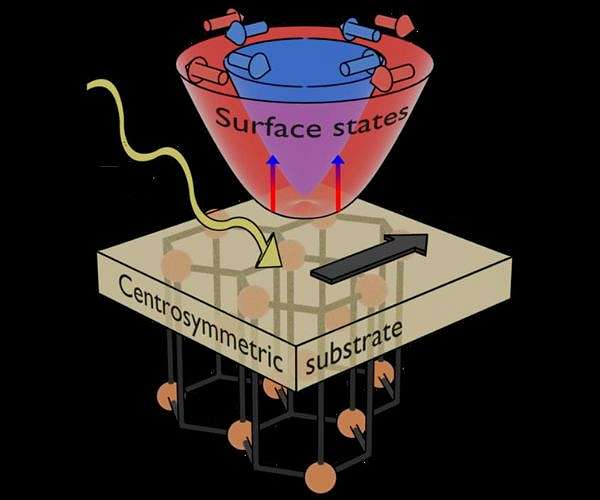
A new study shows that perfectly symmetric materials can generate strong photocurrents when their surfaces are designed to accommodate special electronic states, overcoming a long-standing limitation in photovoltaic design. The work points to new strategies for both solar energy conversion and ultrafast spintronic technologies by exploiting the physics of surfaces rather than relying solely on the properties of bulk crystals.

Conventional solar cells use interfaces such as p-n junctions to separate photo-generated charges and produce usable power. Another mechanism, known as the bulk photovoltaic effect, can create direct current in a homogeneous material without such bonds, but traditionally requires a non-centrosymmetric crystal structure, severely narrowing the pool of candidate compounds for practical devices.

The research team from EHU, the Materials Physics Center, nanoGUNE and DIPC investigated how this symmetry requirement can be relaxed if the electronic structure of the surface is taken into account. Using basic calculations, they investigated metals and semiconductors with strong relativistic spin-orbit interactions and found that their surfaces can support electronic states significantly different from those in the bulk interior.

These surface states locally break the inversion symmetry, even though the underlying crystal remains perfectly symmetrical. As a result, when light shines on the surface, the electronic response becomes nonlinear and robust photocurrents are generated along the surface. The calculations predict not only charging currents, but also pure spin-polarized currents confined to the surface region.

After pinpointing the mechanism on the well-studied Au(111) surface, the researchers identified Tl/Si(111) as a particularly promising platform to realize this effect. According to their results, Tl/Si(111) should exhibit photocurrents similar in magnitude to those observed in leading ferroelectric materials that rely on bulk non-centrosymmetry to produce large photovoltaic responses.

See also  Peco initiates RFPs for 25 MW Zonne -Zon in Pennsylvania

The work suggests a new direction for the conversion of light to electricity, with device designers focusing on tuning the electronic properties of the surface rather than just looking for complex, non-centrosymmetric crystals. By designing suitable surface states on otherwise symmetrical substrates, it may become possible to build efficient photovoltaic systems from a much wider range of materials.

In addition to energy harvesting, the ability to generate and control spin currents with light at a surface has important implications for spintronics. The proposed mechanism does not require magnetic materials or applied voltages to create spin-polarized currents, opening a path to ultrafast, low-power spin-based devices that operate purely via optical excitation.

The study appears in the journal Physical Review Letters, where the authors outline both the theoretical framework and specific experimental signatures that could confirm their predictions. These features include characteristic flow directions and surface spin textures, which experimentalists can investigate using established spectroscopic and transport techniques.

Research report: Surface-State Engineering for the Generation of Nonlinear Charge and Spin Photocurrents


Source link

open paths photovoltaic surfaces Symmetrical
Share. Facebook Twitter Pinterest LinkedIn Tumblr Email
solarenergy
  • Website

Related Posts

Hybrid tidal photovoltaic system for the deployment of modular renewable energy sources in estuarine channels – SPE

May 11, 2026

Autonomous photovoltaic vehicle Infinite Apollo validates urban circulation performance – SPE

May 8, 2026

Arctech introduces TOPCon’s photovoltaic paving solution

May 7, 2026
Leave A Reply Cancel Reply

Don't Miss
Technology

New passivation strategy increases efficiency of chloride-iodide-based perovskite solar cells by 15% – SPE

By solarenergyOctober 30, 20240

Although local defects in chloride-iodide-based perovskite are difficult to avoid due to ion migration, a…

Topcon Solar cell based on aluminum contacts achieves slightly lower efficiency than counterpart on Silverbasis-PV Magazine International

March 28, 2025

NJBPU opens third application of the program Competitive Solar Incentive (CSI))

April 24, 2025

Letter from China’s PV Industry: Arctech wins 2.1 GW solar deal

June 5, 2026
Stay In Touch
  • Facebook
  • Twitter
  • Pinterest
  • Instagram
  • YouTube
  • Vimeo
Our Picks

Dutch solar owners asked to switch off during peak periods to ease the distribution crisis

June 7, 2026

The hydrogen flow: Toyota demonstrates its racing prototype on liquid hydrogen

June 7, 2026

Era of electrification exposing Australia’s weakest link

June 6, 2026

‘Come out from behind your screen, our industry is ultimately about people’

June 6, 2026
Our Picks

Dutch solar owners asked to switch off during peak periods to ease the distribution crisis

June 7, 2026

The hydrogen flow: Toyota demonstrates its racing prototype on liquid hydrogen

June 7, 2026

Era of electrification exposing Australia’s weakest link

June 6, 2026
About
About

Stay updated with the latest in solar energy. Discover innovations, trends, policies, and market insights driving the future of sustainable power worldwide.

Subscribe to Updates

Get the latest creative news and updates about Solar industry directly in your inbox!

Facebook X (Twitter) Instagram Pinterest
  • Contact
  • Privacy Policy
  • Terms & Conditions
© 2026 Tsolarenergynews.co - All rights reserved.

Type above and press Enter to search. Press Esc to cancel.