

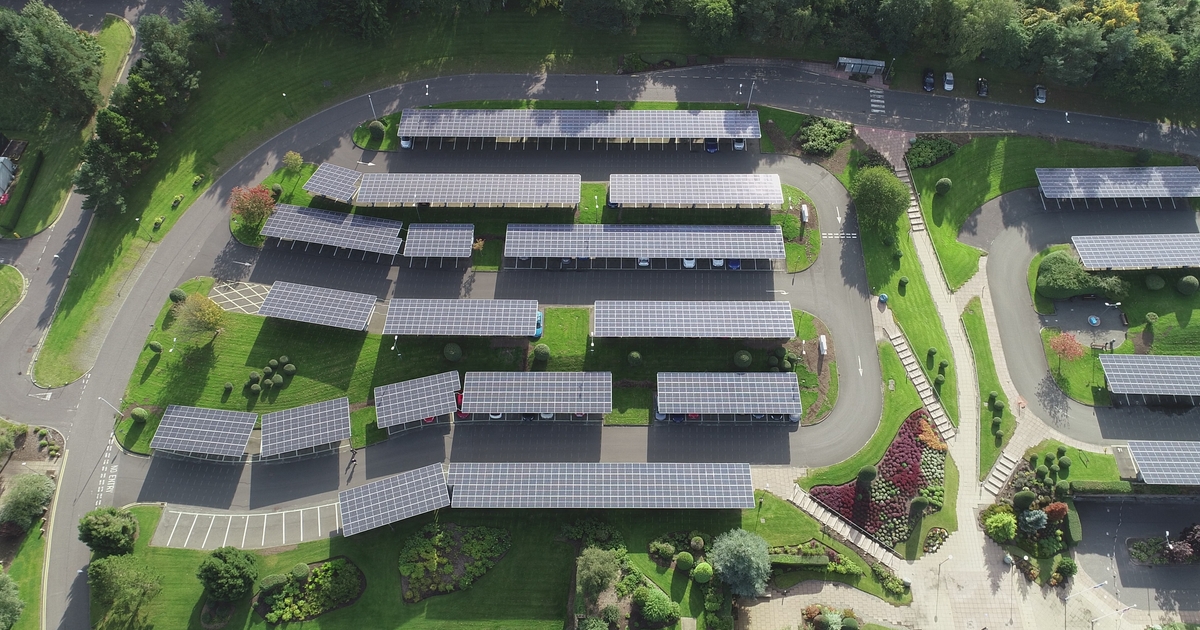
Installing solar panels over car parks at 151 UK petrol stations would generate around 124 GWh per year, a £19 million opportunity.
This was the conclusion of a study conducted by RenEnergy, which showed that 46,153 parking spaces at gas stations would be suitable for the installation of solar carports.
Solar carports are located above parking spaces and generate energy from solar panels on the canopy, which can be fed back to the business or used to charge electric vehicles on any space, while providing shelter and shade for vehicles.
Norwich-based RenEnergy, a company that provides sustainable energy solutions including solar carports, EV charging stations and solar power, conducted the research.
Damian Baker, founder and chief executive of RenEnergy, said: “The answer to a major electric vehicle charging conundrum is right in front of us in car parks across the country. Our research shows that a significant amount of energy could be harnessed from forecourt car parks, which could be used to create the EV infrastructure we need.”
The report is part of broader research is being conducted by RenEnergywhich published its findings in February that car parks owned by British companies could generate 1.57 GW of solar energy if fitted with solar carports.
The British government launched a call for evidence earlier this year to determine the potential benefit of mandating that all public parking lots be equipped with a solar PV array.
In France, a 2022 mandate required that parking garages with space for at least 80 vehicles be covered with solar panels. The mandate applied to new and existing parking garages and gave parking owners five years to comply with the measures: three years for parking garages with more than 400 spaces.
Unlocked capacity is expected to be around 11 GW – the same figure was given by the BBC as a conservative estimate of the capacity Britain could achieve under similar legislation.
The technology can help reduce dependency on network upgrades, as increased electrification means companies face long wait times for the connection needed to meet clean energy obligations. The same applies to the implementation of EV infrastructure.
While ground-mounted solar PV arrays undergo a lengthy process to gain planning or landowner approval, RenEnergy said solar carports can gain approval within eight weeks under permitted development with prior approval. The company said it can then support businesses by obtaining approval from the District Network Operator (DNO) to secure network capacity and exports.
Companies can sell energy back to the grid or through long-term energy purchase agreements (PPAs), but for petrol stations a better route may be to integrate electric vehicle charging, a necessity along Britain’s main road network, to reduce energy costs and thus lower the price of charging.
