

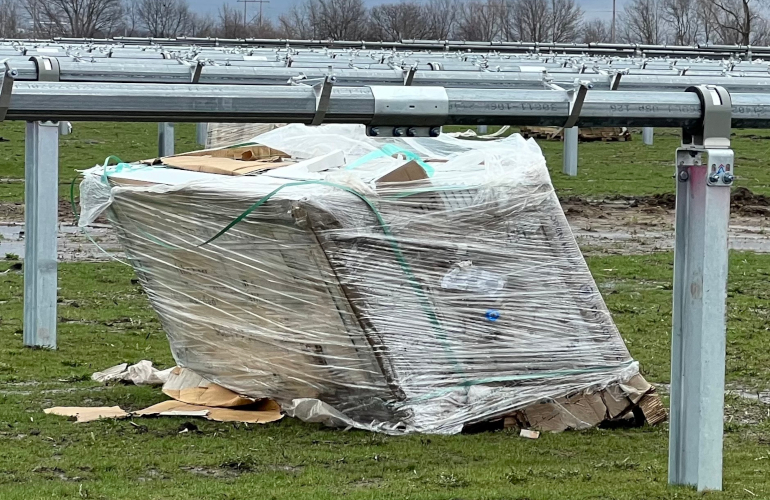
For a product made primarily of fragile glass, solar panels can absorb many stressors and still function successfully well beyond their 30-year guaranteed lifespan. After passing a barrage of tests – including mechanical stress, hail stress and thermal cycling – solar panels receive their stamp of approval and can be installed without worrying about performance in the field.
The real risk of panel damage lies somewhere between leaving the module factory and final installation on roofs or in fields. Accidental breakage and damage to parts are most common during the shipping and handling phase, and while the likelihood is still small, even a 1% chance of product loss due to damage can be significant.
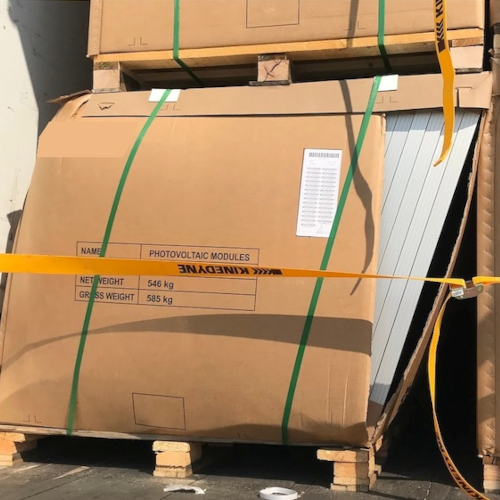
Solar panels that lean during transport.
“We tend to find 1 to 2% breakage at every touchpoint in the supply chain,” said Philip Schwarz, CEO and co-founder of PV pallet, a supplier of sustainable solar panel pallets made from recycled plastic. “You’re talking about a small percentage, but it amounts to several million dollars in failed panels per year that can be avoided.”
The risk of damage can be seen where solar panels are placed on pallets and how hands or equipment transport those modules to the next point in the chain. Panels are usually stacked flat or stacked vertically in a horizontal position on wooden pallets, wrapped in plastic or cardboard and secured with strapping. In a typical storage situation, this storage option is great for panel protection, says Tristan Erion-Lorico, VP of sales and marketing at Kiwa PVELan independent testing laboratory.
“Considering how many modules are stored in warehouses in the United States, we are not getting calls for assistance with warranty claims because modules in safe havens have self-destructed,” he said. “Module breakage in the field is a much bigger problem than breakage during storage.”
This may be due to the disposable packaging in which solar panels are stored and shipped. Wooden pallets do not have the most stable base and wrapping modules in plastic foil provides little benefit for 360° protection. Once the packaging is cut onto vertically stacked panels, those 20kg panels are at risk of falling. And now that solar panels are becoming larger, heavier and more cumbersome in size, the chance of damage simply by unloading the product increases.
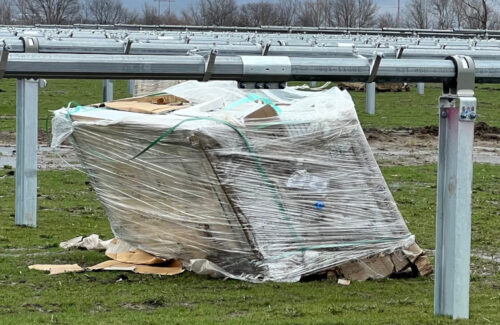
Packaging for solar panels in the field.
“I’m a tall guy and I wouldn’t want to be standing next to one of those pallets while you’re opening it up and trying to unload it,” Erion-Lorico said. “I don’t know how they hold the modules securely as you go through the pallet. Even on their side, that still weighs heavily.”
The recyclable PV pallet is not only a more sustainable choice, but also a safer packaging option for both the panels and the people moving them. The company’s flagship Series It can be adapted to different module sizes and prevents the domino effect of unpacked pallets.
“That’s a big breaking point: when people break free or try to load and unload pallets, and the stack falls over and breaks,” Schwarz said. “We have load management handles in our walls that slide along a rail, so if they want to ship partial loads, those handles can be clamped in [the panels] very tightly together. That keeps them upright and prevents them from falling over and contributing to additional breakage.”
The adjustability of the PV pallet is ideal for warehouses, especially when individual panels from multiple pallets need to be regrouped. The plastic pallet is also useful for large-scale installers who work on long rows of panels over many weeks or months under varying weather conditions. Solar panels that are on wooden pallets and wrapped in cardboard are not very well protected from the elements.
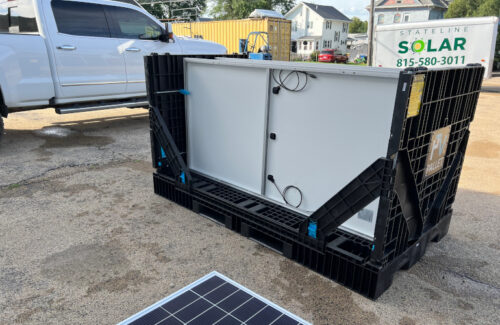
PV pallet Series X with vertically stacked solar panels.
“Months of sitting outside in the elements, the problem is the pallet falls over and there may be some glass breakage. But it is also contaminants that end up in connectors, and connectors that are not shipped with caps,” Erion-Lorico said. “Pallets are not weatherproof. Sure, traditional vertical stacking is safer from a micro-cracking perspective, but now you have every cable at the bottom, on a pallet that could collect water. The cardboard is decomposing, creating fibers that end up in the water and into the connectors. That would be my biggest concern.”
Currently, there are not many solutions to prevent shipping and shipping damage to solar panels, other than using common sense and the utmost care. There is an International Electrotechnical Commission (IEC) code for testing the safety of panels during pallet transport. although IEC 62759-1 largely tests how modules respond to long-term truck transport vibrations, more intensive industry research into this testing method could lead to better practices for unloading panels using different packaging materials.
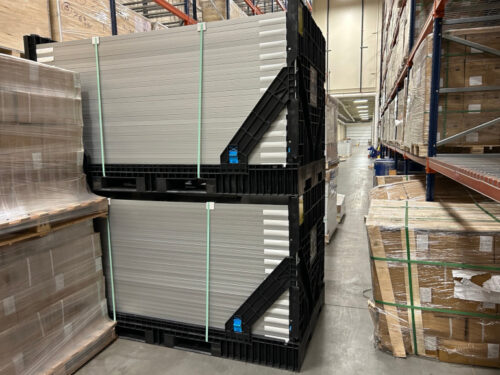
PV pallet Series
PVpallet would like to have its pallets in more warehouses and at the end of the production lines. The company has an agreement with Minnesota panel manufacturer Heliene to load panels onto PV pallets for Heliene’s made-to-order panel supply agreements. Schwarz said PVpallet is focusing on more domestic manufacturing relationships for panels, especially as the market grows. The company hopes to create a circular economy to reduce a lot of waste and save many broken panels in the process.
With so many imported panels in warehouses across the United States, there will be more touchpoints as panels change hands more often before finding their end customer. PVEL proposes to test modules at their first warehouse point to have the data they work with and are protected.
“Even in a non-temperature controlled warehouse, [panels are] probably fine for a longer period of time,” Erion-Lorico said. “But even as you go into warehouse modules, do purchasing due diligence and test factory audits, having that data will make them a more replaceable product.”
