

A new scientific review describes how a little-understood class of cathode materials for lithium-ion batteries could support safer, higher energy storage while reducing reliance on critical metals such as cobalt and nickel.
Researchers have synthesized and analyzed recent global advances in cation-ordered rock salt, or DRX, cathode materials, which are emerging as a promising alternative to the layered cathodes that dominate lithium ion batteries in electric vehicles, consumer electronics and networked storage systems.
Unlike conventional layered materials, DRX cathodes rely on a flexible crystal structure in which lithium and transition metal ions are randomly mixed rather than arranged in well-ordered layers. This disordered arrangement enables unusually high energy storage capacity and rapid three-dimensional transport of lithium ions, but also introduces new stability problems that have so far had limited commercial application.
“DRX cathodes offer an exciting path to batteries with much higher energy density and lower dependence on scarce elements such as cobalt,” says lead author Tongen Lin. “The challenge is translating their impressive theoretical advantages into materials that are stable, durable and practical for real-world use.”
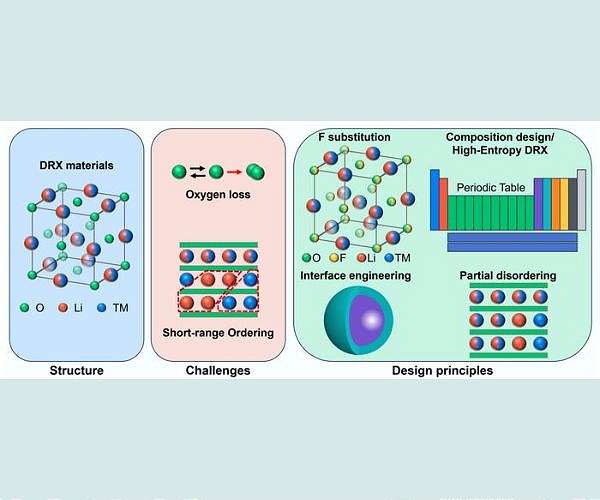
The review, published in Energy and Environment Nexus, links key electrochemical performance issues directly to the atomic-scale structure of DRX materials. The authors explain how excess lithium enables rapid three-dimensional diffusion pathways, but at the same time activates oxygen redox processes that can cause oxygen loss, voltage instability and rapid capacity decay during cycling.
The analysis identifies short-range order within the otherwise disordered lattice as another critical concern. Even subtle local correlations between cations can fragment lithium diffusion networks, slowing ion transport and degrading performance as batteries function over time.
“Our goal was to go beyond isolated observations and provide a unified design logic,” says co-corresponding author Yuan Wang. “By connecting structure, composition and degradation mechanisms, we can provide practical guidance for building better DRX cathodes.”
Based on this framework, the authors outline five design strategies that have demonstrated benefits to DRX performance. One strategy involves carefully balancing lithium levels so that lithium ions can move efficiently without causing excessive oxygen loss and associated structural damage.
A second approach introduces a moderate fluorine substitution into the crystal lattice to help stabilize the structure and reduce harmful oxygen redox reactions. A third strategy focuses on technical protective interfaces and coatings that suppress surface degradation and parasitic reactions with electrolytes.
The review also highlights the use of high-entropy cation mixing as a way to disrupt harmful short-range ordering. By including multiple different metal species, researchers can reduce the chance of local clustering that limits lithium pathways, supporting more uniform transport through the material.
In an additional tactic, the authors describe how deliberately introducing controlled partial ordering can generate low-barrier diffusion channels. In this design, a constrained arrangement is used to create continuous paths for lithium movement without reintroducing the disadvantages of fully layered structures.
The authors emphasize that no single change is sufficient on its own to unlock DRX’s potential. Instead, successful cathode design requires a coordinated approach that integrates compositional tuning, local structural control, and interfacial engineering to manage both bulk and surface degradation processes.
“This work provides a roadmap for rational design instead of trial and error,” said co-corresponding author Lianzhou Wang. “It helps identify which combinations of chemistry and structure are most likely to produce long-lasting, high-energy batteries.”
By reducing reliance on expensive and geopolitically sensitive metals while enabling higher energy density than current commercial cathodes, DRX materials could become important components in future electric vehicles and renewable energy storage infrastructure.
The review notes that while engineering and technical challenges remain, rapid recent progress indicates that commercially viable DRX-based lithium-ion batteries are moving closer to reality.
“These materials are no longer just a laboratory curiosity,” says co-corresponding author Matthew Dargusch. “With the right design principles, they have real potential to reshape the next generation of energy storage technologies.”
Research report:Cation-disturbed rock salt cathode materials for high-energy lithium-ion batteries
