

China’s PV manufacturing sector is running at full capacity ahead of an April 1 export tax change, contributing to module price increases of 20% to 30% in parts of the supply chain and increasing risks for price-sensitive commercial and utility-scale European projects in early 2026.
I would like to start the new solar year with a brief overview. 2026 is already shaping up to be a year of radical change, and this trend shows no signs of slowing down.
Last year ended relatively quietly, especially in terms of module prices, which remained largely stable for months. During the December holidays, the sector also closed early, giving everyone the opportunity to rest, reflect on the past year and make plans for the future.
Join us on January 28 for pv magazine Webinar+ | The Solar Module Market Playbook: Managing Prices, Risks, and Other Procurement Challenges.
We combine real-time market data, case studies and an interactive Q&A to help EPCs, developers, investors and distributors secure high-quality PV modules at competitive prices, ensuring project financeability.
However, that peace came to an end in the opening days of 2026. According to early predictions, the year will bring a mix of changes, opportunities and challenges. In China and throughout Asia, it is astrologically the Year of the Fire Horse – a symbol of independence, dynamism and a strong drive for change that occurs only once every sixty years. In many ways, that spirit seems to have arrived in force in global markets, fueled not only by harsh winter weather but also by significant geopolitical upheavals. It feels like nothing has been left untouched and the world is looking for a new order.
The call for change is resounding in various regions, often turbulent and sometimes violent: energy, fire, transformation. The solar energy market is not immune; the changes are expected to be substantial, even if the impact is much less dramatic than in crisis-hit regions. Many expected an increase in module prices, but the timing and magnitude of the recent increases have taken most people by surprise.
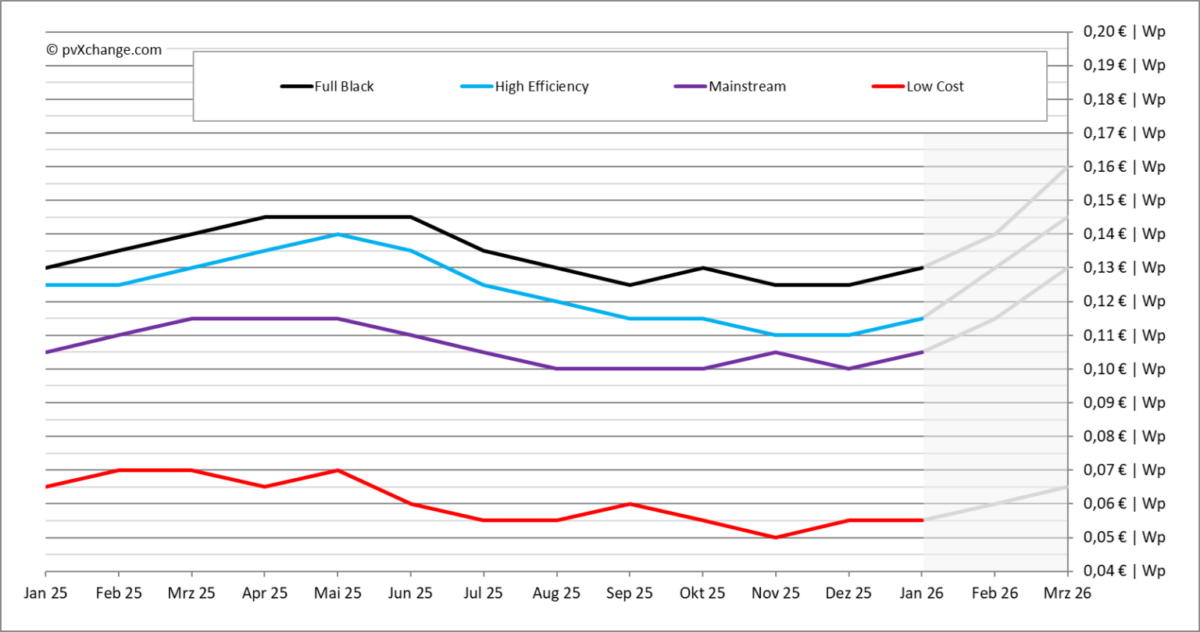
In China the secret is out: the announced abolition of export discounts will come into effect on April 1. What initially seemed like a gentle breeze is now turning into a full-blown tsunami – faster than expected. To show this, the graph below has been expanded with a forecast for two months.
If we look at the average price development across all technology categories in January, with increases of up to 0-5%, everything seems to be progressing normally. However, if we look ahead and take into account recent announcements from manufacturers, a very different picture emerges.
Many distributors are already informing customers, via email, social media or in person, that prices will increase from early April, advising them to stock up based on their project portfolio. But as customers try to secure supplies for the second quarter, they are often faced with prices far higher than the 9% increase that changes in China alone would justify. In the project sector, price increases of up to 20% are now expected, while in distribution and online stores, module prices have already risen by as much as 30% in some cases in recent days.
Now that production cost increases are much lower, where does this sudden jump come from? Asian manufacturers point to the removal of export tax exemptions, as well as rising prices for upstream materials – from silicon ingots to silver pastes, cells, glass and aluminum for module frames. But does this fully justify a 20 to 30% price increase? Hardly. Is it sustainable? Hardly.
Production in China is currently running at full capacity, with the aim of producing as much as the lines can handle until March. Until the end of the month, the motto is simple: sell everything. By then, as many goods as possible should be shipped by sea or already delivered to the destination countries to benefit from prices that already take into account the upcoming tax increase. Production lines are expected to be scaled back in April to reduce costs.
Many producers appear eager to take advantage of the price increase announced by the government, meeting expectations as an opportunity to return to profitability and compensate for the significant losses incurred during the low price period of recent years. This tendency to overcompensate for price-influencing events has been observed repeatedly in recent years. However, prices often cannot be maintained at such high levels due to declining demand, and downward adjustments usually follow shortly afterwards.
These calculations often overlook the buyers themselves. In Europe, for example, the number of small-scale installations continues to decline, with project developers and installers increasingly focusing on larger commercial and utility-scale projects. Early indications suggest this trend will continue into 2026. Such projects are highly price sensitive, meaning that currently expected sharp price increases could undermine profitability and derail planned developments.
To prevent the photovoltaic market from being suffocated in the first months of the year, price adjustments must be implemented carefully. At the same time, long-requested reductions in bureaucracy must finally gain momentum so that delays in grid connections, permits and other necessary certifications do not halt construction projects altogether.
 About the author: Martin Schachinger studied electrical engineering and has been active in the field of photovoltaics and renewable energy for almost 30 years. In 2004, he founded the online trading platform pvXchange.com. The company has standard components in stock for new installations and solar panels and inverters that are no longer produced.
The views and opinions expressed in this article are those of the author and do not necessarily reflect those of the author pv magazine.
This content is copyrighted and may not be reused. If you would like to collaborate with us and reuse some of our content, please contact: editors@pv-magazine.com.
Popular content

