

According to SolarPower Europe’s report, the global solar market will add a record 664 GW of solar energy by 2025. Global solar market outlook 2026-2030.
The figure represents an increase of 69 GW compared to 2024 and 212 GW compared to 2023, but indicates that annual market growth is slowing, from 85% in 2023 and 32% in 2024 to 12% last year.
The Asia-Pacific region accounted for 487 GW, or 73%, of solar added last year, while China alone installed 382 GW, for a record 57% market share. India added 45.7 GW, overtaking the United States as the second largest solar market.
Europe installed 81.6 GW of solar power last year, up 3% year-on-year, led by Germany as the fourth largest global market. The Americas added 43.2 GW, down 13% year-over-year, while the Middle East and Africa added 23.7 GW, up 51% from 2024 installations.
Last year’s ten largest markets – China, India, the US, Germany, Brazil, Spain, Saudi Arabia, France, Italy and Japan – accounted for 82% of new solar installations by 2025.
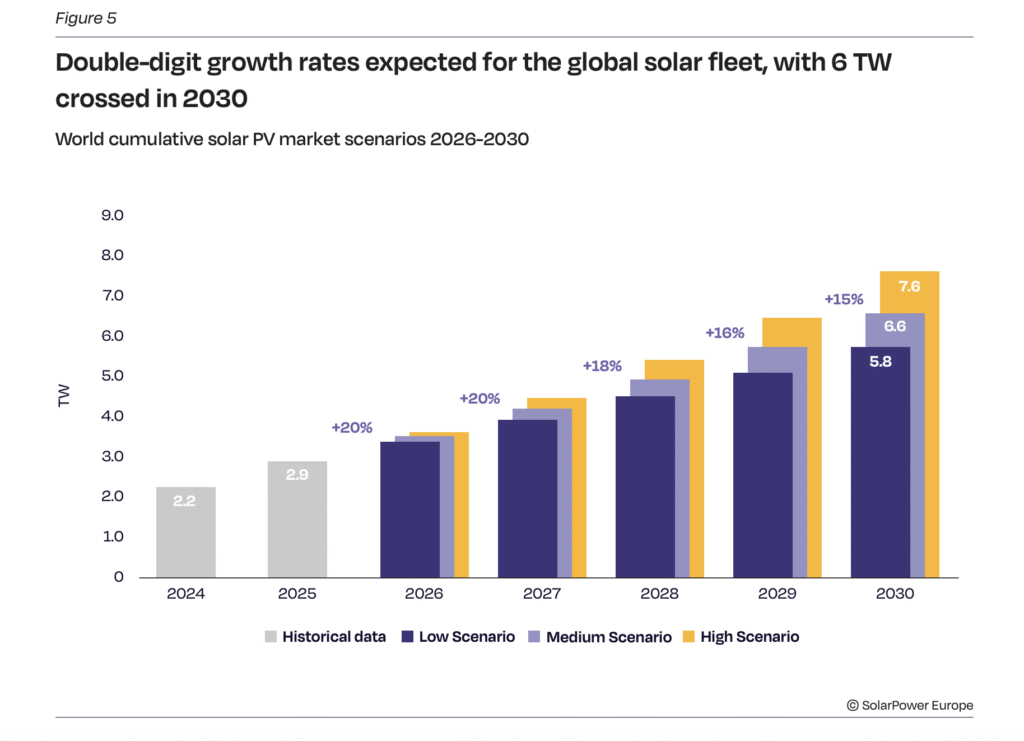
Growth has continued this year, with SolarPower Europe reporting that total global capacity exceeded the 3 TW milestone earlier this year, less than two years after reaching 2 TW and four years after exceeding 1 TW. Solar energy now meets 9% of global electricity demand, three times as much as five years ago.
Despite this momentum, the report predicts that annual global solar installations will decline this year. In an average scenario, an estimated 612 GW is expected, which represents an annual decline of 8% and the first contraction in more than twenty years.
SolarPower Europe explains that this downturn is largely driven by China, which is on track to reduce installations by 24% due to policy changes. “The decline outweighs continued growth in all other regions, highlighting China’s influence on global installations,” the report says, before adding that the global decline should not be mistaken for a structural slowdown.
Installations in the Asia-Pacific outside China are expected to grow by 18% this year, while European solar deployment is expected to grow by around 3%. The report adds that solar deployment in the Americas will increase by 11% this year, while installations in the Middle East and Africa are expected to increase by 48%.
The report’s mid-range scenario predicts that global solar capacity will more than double to 6.6 TW by the end of the decade, a downward revision from last year’s forecast of 7.1 TW. It cites grid congestion, insufficient storage, limited system flexibility, permitting delays, financing barriers and supply chain resilience as key challenges hindering further growth.
“While near-term uncertainties persist, the long-term prospects for solar energy remain strong, with the technology continuing to expand at an unprecedented pace, strengthening its role at the core of global decarbonization efforts and its emerging role as a key technology for countries seeking greater energy security,” the report adds.
It also highlights the role of solar energy amid geopolitical tensions and a second fossil fuel crisis in less than four years. By 2025, electricity generated by solar energy was equivalent to almost five years of liquefied natural gas through the Strait of Hormuz.
Solar energy accounted for about 80% of renewable capacity additions last year, while outpacing combined additions of fossil fuels and nuclear power. “These remarkable achievements reflect the extraordinary pace at which solar energy has become the backbone of the global energy transition,” the report said.
Walburga Hemetsberger, CEO of SolarPower Europe, noted that the slowdown in growth in 2025 and the expected decline in 2026 are important signals that highlight a new reality.
“Scaling up solar energy is no longer just about deploying more capacity, but also about how well it can be integrated into the system,” said Hemetsberger.
“We urgently need to invest in networks, battery storage and other non-fossil flexibility solutions to continue integrating large volumes of renewable energy into our networks,” Hemetsberger added. “If policymakers address these challenges, solar energy will continue to lead the energy transition and remain the most powerful tool to achieve energy security, competitiveness and decarbonization.”
