

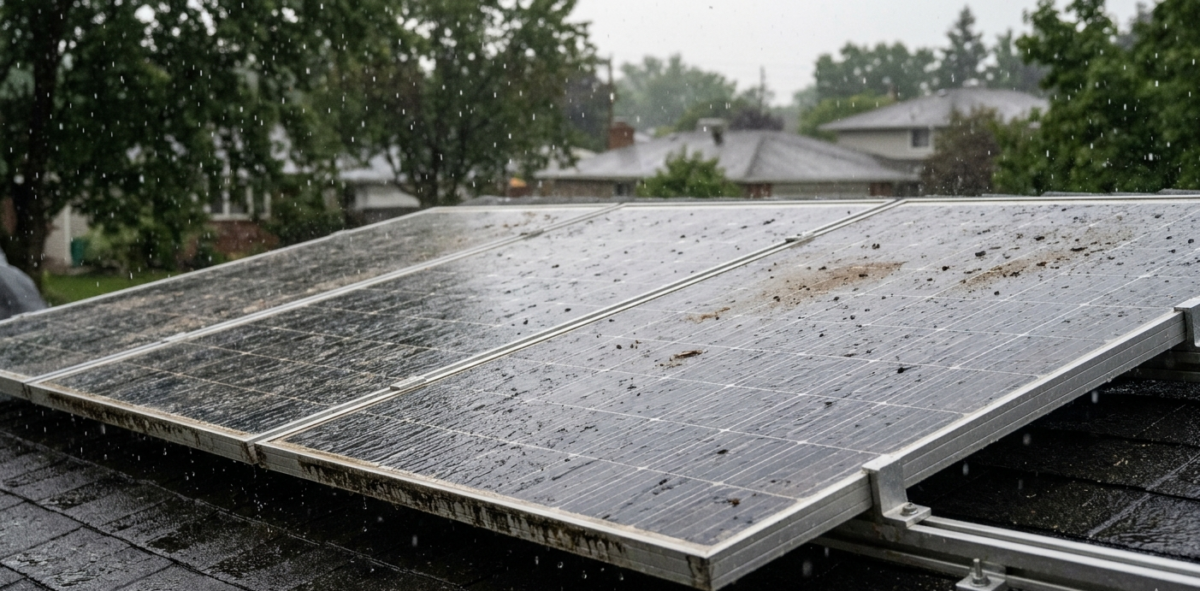
Researchers in India developed a predictive framework that combines degradation experiments, weather data and environmental stress models to assess how rainfall affects anti-pollution solar coatings. They discovered that the lifespan of coatings is highly dependent on the local climate, the slope of the installation and the pH of the rainwater.
Researchers from the Indian Institute of Technology Bombay have assessed the impact of rain on anti-fouling coatings for solar panels and found that their lifespan can vary significantly depending on the local climate and installation scenario.
“The main novelty of this work is the development of a framework to predict the service life of anti-fouling coatings under rain exposure by integrating experimentally derived degradation parameters with the Arrhenius-modified Peck model, which separately considers the temperature and pH effects on degradation, and Miner’s rule, which predicts the failure of a material under variable cyclic stress,” said corresponding author Sonali Bhaduri. pv magazine. “The study investigates how environmental parameters, such as rainwater pH, temperature and installation conditions, influence the degradation and service life of coatings.”
“The results showed that coatings exposed at tilt angles smaller than their roll-off angle exhibit significantly shorter service life due to long-term water retention on the surface. The work also highlights the greater dependence of some fluoropolymer-based coatings on the pH of rainwater than that of phenylsilicone-based coatings,” added Bhaduri.
The researchers experimentally determined the activation energy and pH dependence factor for four commercial hydrophobic anti-fouling coatings using accelerated water immersion tests at different temperatures and pH levels. These degradation parameters were then linked to real weather data from different geographical locations to estimate the coating life under realistic outdoor conditions.
The research group investigated the durability of four types of hydrophobic coatings on solar glass samples measuring 5 cm x 2.5 cm. Three coatings, labeled A, B, and D, were fluoropolymer-based, while a fourth coating, labeled C, was phenylsilicone-based. Fifteen samples of each coating were immersed in pH-controlled water solutions at temperatures of 25 C, 45 C, 65 C and 97 C to evaluate degradation behavior under simulated rainwater conditions.
Contact angle measurements were taken periodically and coatings were considered failed when the angle fell below 90°, indicating loss of hydrophobicity and self-cleaning ability. Additional experiments at pH 5, 6, and 7 at 45°C were performed to determine the pH dependence factor of the coatings.
The tests showed that the coating life for all coating types decreased with increasing temperature. Furthermore, the scientists found that fluoropolymer-based coatings showed significantly greater pH dependence than their phenylsilicone-based counterparts, highlighting the differences in degradation behavior under acidic conditions.
The analysis also showed that coatings exposed to higher rainfall and acidic conditions had shorter lifespans, while Coating C showed the least sensitivity to pH changes and had the most stable performance overall. “All coatings showed lower coating life under varying pH when exposed to a ramp angle lower than their respective roll-off angle,” the academics added.
The researchers cautioned that the lifespan predictions presented in the study should be interpreted as relative indicators of coating performance under specific conditions, rather than accurate estimates of actual lifespan. “In real outdoor environments, coating degradation is controlled
due to the combined influence of multiple environmental stressors,” they also stated.
“Our approach provides a route for climate-specific coating selection and can serve as a basis for future modeling of combined environmental stressors that influence PV reliability and sustainability,” concluded Bhaduri.
The research results were presented in the study “Lifetime prediction of dirt-resistant coatings that deteriorate due to rain”, published in Progress in photovoltaics.
This content is copyrighted and may not be reused. If you would like to collaborate with us and reuse some of our content, please contact: editors@pv-magazine.com.
