

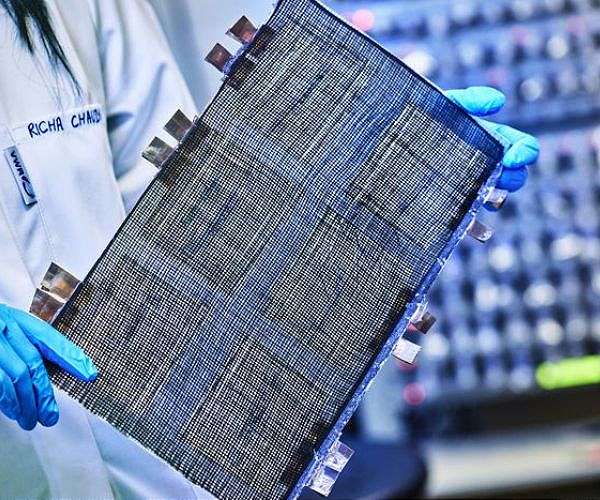
The world’s strongest battery could enable lightweight, energy-efficient vehicles
Building vehicles or electronics with materials that serve as both batteries and structural components could significantly reduce weight and energy consumption. A research group at Chalmers University of Technology, Sweden, has introduced a major development in the field of massless energy storage. Their newly developed structural battery has the potential to reduce the weight of devices such as laptops by half, make mobile phones as thin as credit cards and increase the driving range of electric cars by as much as 70% on a single charge.
“We have managed to create a battery from carbon fiber composite that is as stiff as aluminum and energy dense enough to be used commercially. Like a human skeleton, the battery performs several functions at the same time,” explains Richa Chaudhary. a researcher at Chalmers and lead author of a scientific article published in ‘Advanced Materials’.
Research into structural batteries has been conducted at Chalmers for several years, sometimes in collaboration with researchers from the KTH Royal Institute of Technology in Stockholm. The breakthrough came in 2018 when Professor Leif Asp and his colleagues demonstrated how stiff, strong carbon fibers could chemically store electrical energy, attracting global attention. The discovery that carbon fiber can serve as electrodes in lithium-ion batteries was one of the top 10 scientific achievements of the year, according to ‘Physics World’.
Less weight, more efficiency
Since 2018, the research team has made progress in improving both stiffness and energy density. In 2021, they achieved a major milestone with a battery that delivers 24 watt-hours per kilogram (Wh/kg), equivalent to approximately 20% of the capacity of a typical lithium-ion battery. Today they have improved this figure to 30 Wh/kg. While still inferior to current commercial batteries, the weight reduction benefits create a new dynamic. Because the battery is part of the vehicle’s structure, less energy is required overall.
“Investing in light and energy-efficient vehicles is self-evident if we want to save energy and think about future generations. We have made calculations on electric cars showing that they could run up to 70 percent longer than they do now if they had competing structural batteries,” says Leif Asp, professor at Chalmers’ Department of Industrial and Materials Sciences.
For vehicles, strength is of utmost importance to meet safety standards. The structural battery developed by the team has significantly increased stiffness, increasing its modulus of elasticity from 25 to 70 gigapascals (GPa). This means that the material can carry loads as effectively as aluminum, while being much lighter.
“In terms of multifunctional properties, the new battery is twice as good as its predecessor – and even the best ever made in the world,” said Asp, who has been involved in structural battery research since 2007.
Progress towards commercialization
The ultimate goal from the beginning has been to achieve performance levels suitable for commercialization. Thanks to continued research, stronger links with the market have now been established through the establishment of Sinonus AB, a Chalmers Venture company based in Boras, Sweden.
Despite the progress, more engineering work is needed to scale up production from small laboratory batches to the large-scale production needed for consumer electronics or vehicles.
“You can imagine that cell phones or laptops that are as thin as a credit card, that weigh half as much as they do today, would be the closest in terms of time. It is also possible that components such as electronics in cars or aircraft are powered by structural batteries. This requires large batteries. investments to meet the challenging energy needs of the transport sector, but this is also where technology can make the most difference,” says Leif Asp.
Research report:Unveiling the multi-function structural carbon fiber battery
