
Close Menu
  • News
  • Industry
  • Solar Panels
  • Commercial
  • Residential
  • Finance
  • Technology
  • Carbon Credit
  • More
    • Policy
    • Energy Storage
    • Utility
    • Cummunity
What's Hot

Dutch solar owners asked to switch off during peak periods to ease the distribution crisis

June 7, 2026

The hydrogen flow: Toyota demonstrates its racing prototype on liquid hydrogen

June 7, 2026

Era of electrification exposing Australia’s weakest link

June 6, 2026
Facebook X (Twitter) Instagram
Solar Energy News
Sunday, June 7
  • News
  • Industry
  • Solar Panels
  • Commercial
  • Residential
  • Finance
  • Technology
  • Carbon Credit
  • More
    • Policy
    • Energy Storage
    • Utility
    • Cummunity
Solar Energy News
Home - News - The redesigned carbon framework increases battery safety and power
News

The redesigned carbon framework increases battery safety and power

solarenergyBy solarenergyDecember 26, 2025No Comments2 Mins Read
Facebook Twitter Pinterest LinkedIn Tumblr Email
Share
Facebook Twitter LinkedIn Pinterest Email


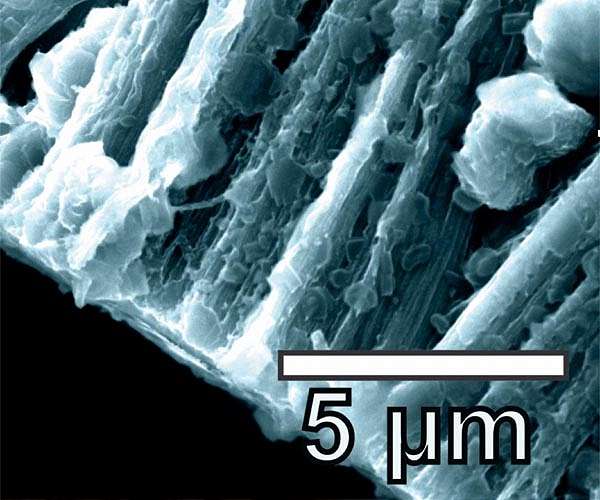
Researchers at Tohoku University have developed a covalently bridged fullerene framework that allows carbon-based lithium-ion battery anodes to store lithium in a more stable configuration while supporting fast charging. The new material, called Mg4C60, links fullerene (C60) molecules via covalent bridges, creating a layered structure that resists structural collapse and loss of active material during repeated cycles.

Conventional lithium-ion batteries typically use graphite anodes, which can limit fast charging performance and create safety hazards due to lithium plating on the anode surface at high charging rates. In contrast, the Mg4C60 framework provides a different lithium storage mechanism within a carbon host that remains structurally robust, addressing both fast-charging limitations and degradation pathways that have hindered previous fullerene-based anodes.

The team reports that the layered Mg4C60 structure, confirmed by X-ray diffraction and electron microscopy, maintains integrity as lithium ions move in and out, avoiding the pulverization and loss of electrical contact that can occur in less stable architectures. Spectroscopic analysis, including carbon K-edge X-ray absorption, further characterizes the binding environment and supports the proposed covalent bridge scheme between fullerene units.

According to distinguished professor Hao Li of the Advanced Institute for Materials Research (WPI-AIMR), the group now plans to extend the covalent bridge concept to a broader range of fullerene and carbon frameworks to build a family of stable, high-capacity anode materials designed for fast-charging batteries. “Our next steps are to extend this covalent bridging strategy to a broader range of fullerene and carbon frameworks, with the aim of creating a family of stable, high-capacity anode materials suitable for fast-charging batteries,” says Professor Hao Li (Advanced Institute for Materials Research (WPI-AIMR)).

See also  The US solar industry is demanding an end to the Department of the Interior's licensing blockade

Future work will also include collaboration with industry to evaluate the scalability of Mg4C60-type materials and integrate them into practical cell formats. The researchers emphasize that assessing manufacturability and performance under real-world conditions is essential for translating laboratory results into battery technologies for electric vehicles, consumer electronics and renewable energy storage systems.

Research report:Covalent bridges enable layered C60 as an exceptionally stable anode in lithium-ion batteries


Source link

battery carbon framework increases power redesigned safety
Share. Facebook Twitter Pinterest LinkedIn Tumblr Email
solarenergy
  • Website

Related Posts

UK government considers community grant for battery storage

June 5, 2026

Aura Power secures financing for 49.9 MWp Staffordshire PV project

June 4, 2026

Video: Understanding Safe Harbor Programs | Power forward!

June 3, 2026
Leave A Reply Cancel Reply

Don't Miss
Policy

As solar AD/CVD investigation continues for India, Indonesia and Laos, petitioners now cite ‘critical conditions’

By solarenergyFebruary 4, 20260

The Commerce Department would release its provisional anti-dumping/countervailing duty (AD/CVD) tariff amounts for Indian, Indonesian…

The U.S. International Trade Commission is expanding tariffs on Chinese and Taiwanese solar imports

May 29, 2026

SSE Renewables commissions 150MW/300MWh Ferrybridge BESS

March 24, 2026

How solar farms shape the local climate and vegetation in dry areas – SPE

April 14, 2026
Stay In Touch
  • Facebook
  • Twitter
  • Pinterest
  • Instagram
  • YouTube
  • Vimeo
Our Picks

Dutch solar owners asked to switch off during peak periods to ease the distribution crisis

June 7, 2026

The hydrogen flow: Toyota demonstrates its racing prototype on liquid hydrogen

June 7, 2026

Era of electrification exposing Australia’s weakest link

June 6, 2026

‘Come out from behind your screen, our industry is ultimately about people’

June 6, 2026
Our Picks

Dutch solar owners asked to switch off during peak periods to ease the distribution crisis

June 7, 2026

The hydrogen flow: Toyota demonstrates its racing prototype on liquid hydrogen

June 7, 2026

Era of electrification exposing Australia’s weakest link

June 6, 2026
About
About

Stay updated with the latest in solar energy. Discover innovations, trends, policies, and market insights driving the future of sustainable power worldwide.

Subscribe to Updates

Get the latest creative news and updates about Solar industry directly in your inbox!

Facebook X (Twitter) Instagram Pinterest
  • Contact
  • Privacy Policy
  • Terms & Conditions
© 2026 Tsolarenergynews.co - All rights reserved.

Type above and press Enter to search. Press Esc to cancel.