

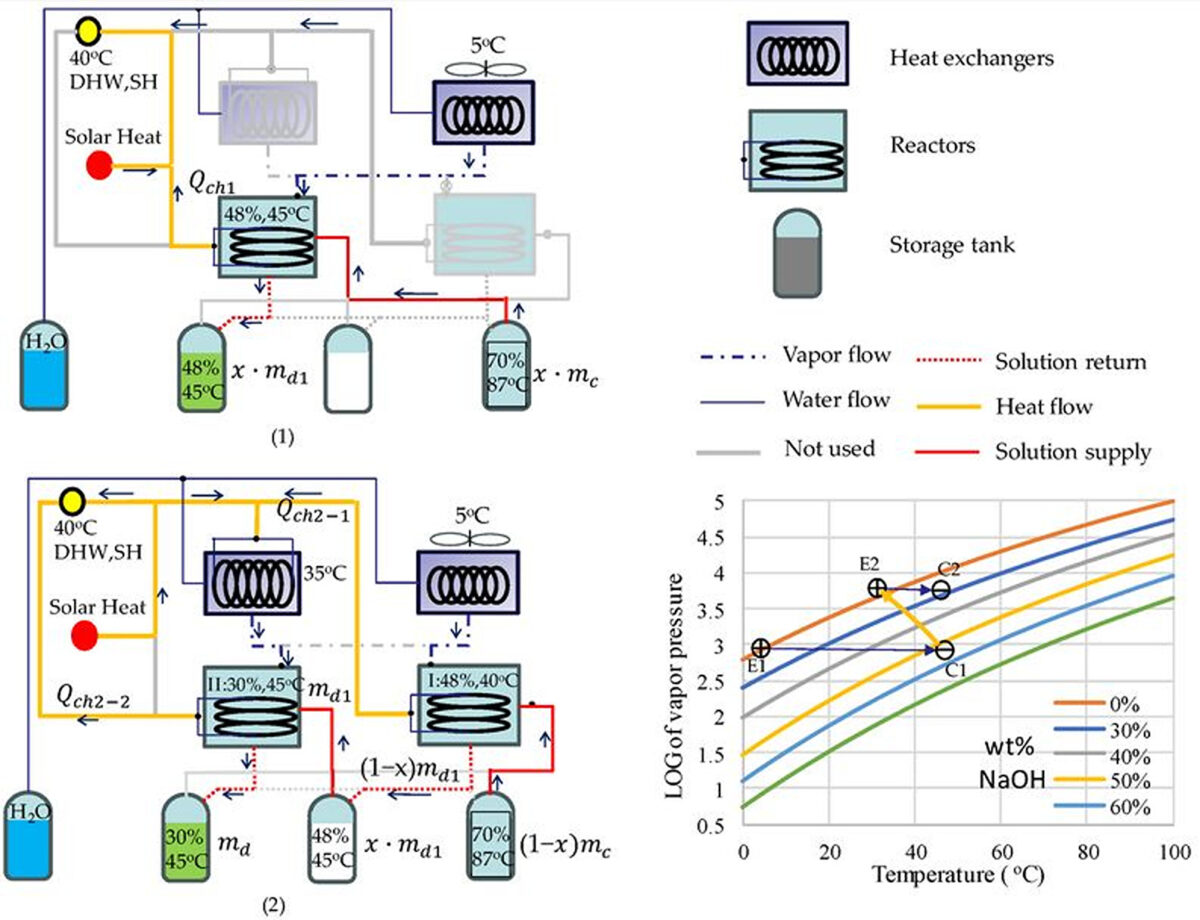
Researchers in China have designed a two-stage, solar-assisted thermochemical heat pump system that uses caustic soda and water as a working pair. The system can reportedly achieve an energy storage density of 363 kWh/m3 and is considered by its creators to be an ideal solution for residential buildings with limited space.
Researchers from China’s Zhejiang University have designed a new solar-assisted system thermochemical heat pump system that can be used for space heating, cooling and domestic hot water (DHW) in residential applications.
“In our work, we proposed a system that aims to achieve greater energy storage density,” said the study’s lead author Guoqing He. pv magazine. “By using a thermochemical heat pump we were able to use more solar thermal energy and reduce electricity demand.”
The main feature of the system is that it depends on a working pair formed by sodium hydroxide (NaOH), also known as caustic soda, and water. According to the research group, the NaOH/water pair has advantages such as low price, high heat transfer coefficient, high energy density, short recovery time and storage temperature compatibility with conventional solar thermal collectors. “We show that this system can operate with a concentration difference of 70% wt and 30% wt, respectively, for the climate in hot summer and cold winter regions in China,” he added.
The system consists of two NaOH reactors, two heat exchangers, four tanks and solar thermal collectors. “During the discharge process, the reactor acts as a heat pump, extracting heat from the low-temperature source through the evaporation of water.” the academics explained, noting that the NaOH reactors work as both a condenser and an evaporator. “The solution absorbs water vapor and becomes diluted, releasing the extracted heat together with the stored chemical energy for heating. During the charging process, solar heat is used to regenerate the solution by desorbing vapor from the solution. The solution becomes concentrated again and thus regains the potential to extract the heat from the low-temperature source for heating in the next cycle.”
The scientists simulated the performance of the heat pump system, assuming it is used in a single-family home with a floor area of 220 m2.2 in Hangzhou, China. The expected annual total heating demand was 11,650 kWh, including winter space heating of 8072 kWh, winter hot water of 1298 kWh and summer hot water of 2280 kWh.
“During the non-heating seasons, the solar thermal collectors charge the solution and keep it at a high temperature until the beginning of the heating season,” they said, describing the operation of the system. “The solution then acts as a heat pump, extracting heat from the low-temperature source and delivering it to the building, together with the solar heat from the collectors and the stored sensible heat in the solution. The solution is cooled and diluted at the end of the heating season and is ready for recharging.”
The analysis showed that the system can achieve an energy storage density of 363 kWh/m3. The group also discovered that the heat pump requires 35.13 m2 solar collectors and 32.47 m3 of storage tanks. “Compared to the sensible seasonal storage, the collector area is reduced by 12.5% and the storage space by 59%, with a possible further reduction through optimization,” they said, emphasizing that the proposed system is a valid solution for residential buildings with limited space. “The collectors designed to drain the solution during non-heating seasons can also produce a significant amount of solar heat for winter heating.”
The research team also highlighted that the initial investment for the system may still be a challenge that needs to be overcome due to its commercial maturity. “Our heat pump is well suited to be integrated with PV in most climates,” he said. “However, the upfront costs may still be too high.”
Looking ahead, the researchers said they want to perform a more detailed dynamic simulation. Their findings are available in the article “Two-stage solar NaOH thermochemical heat pump heating system for building heating: operational strategies and theoretical performance”, which was recently published in energies.
This content is copyrighted and may not be reused. If you would like to collaborate with us and reuse some of our content, please contact: editors@pv-magazine.com.
