
Close Menu
  • News
  • Industry
  • Solar Panels
  • Commercial
  • Residential
  • Finance
  • Technology
  • Carbon Credit
  • More
    • Policy
    • Energy Storage
    • Utility
    • Cummunity
What's Hot

Distributed solar capacity in Argentina grew by 34.5% in the first half of the year

July 23, 2026

The UK government has urged to ensure that plug-in solar is properly regulated

July 22, 2026

Cornwall Insight cuts price ceiling forecast after Burnham’s VAT cut

July 22, 2026
Facebook X (Twitter) Instagram
Solar Energy News
Thursday, July 23
  • News
  • Industry
  • Solar Panels
  • Commercial
  • Residential
  • Finance
  • Technology
  • Carbon Credit
  • More
    • Policy
    • Energy Storage
    • Utility
    • Cummunity
Solar Energy News
Home - Solar Industry - Tin halide perovskite solar cell based on a new precursor additive achieves an efficiency of 12.22%
Solar Industry

Tin halide perovskite solar cell based on a new precursor additive achieves an efficiency of 12.22%

solarenergyBy solarenergyMay 1, 2024No Comments3 Mins Read
Facebook Twitter Pinterest LinkedIn Tumblr Email
Share
Facebook Twitter LinkedIn Pinterest Email

An international research team has developed a new type of perovskite solar cell by using 4-phenylthiosemicarbazide (4PTSC) as a precursor additive. The device showed improved open-circuit voltage and “exceptional” long-term stability.

May 1, 2024 Emiliano Bellini

A group of researchers led by the Chungbuk National University in South Korea has designed a tin halide perovskite (Sn-HP) solar cell that uses an additive known as 4-Phenylthiosemicarbazide (4PTSC) to reduce imperfections in the perovskite layer.

“The use of wide bandgap tin halide perovskites (Sn-HP) provides an eco-friendly option for multi-node Sn-HP photovoltaics,” said co-study author Padmini Pandey. pv magazine. “However, rapid crystallization often results in poor film morphology and substantial defect states, which hinders device efficiency. Our research introduces a new multifunctional additive to address these issues.”

According to the research team, 4PTSC improves solution stability and delays perovskite crystallization through Lewis acid-base adduct formation, yielding defect-free films with preferential crystal growth. “We have chosen a multifunctional molecule that acts as both a coordination complex and a reducing agent, passivating defect formation and improving stability,” Pandey added.

The 4PTSC additive is reported to be able to curb the emergence of defect states through chemical interactions with uncoordinated Sn ions. This in turn is said to stop Sn oxidation and reduce non-radiative recombination, also improving carrier longevity and extraction.

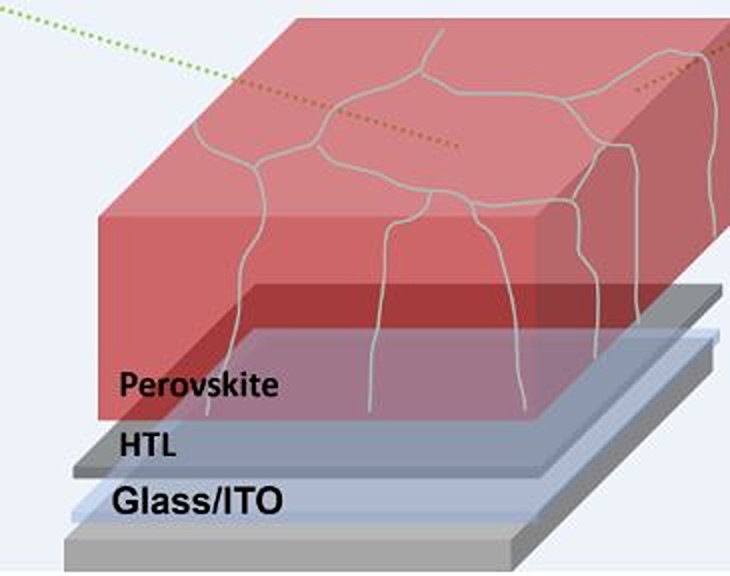
The academics designed the cell with an indium tin oxide (ITO) substrate, a hole transport layer made of PEDOT:PSS, the perovskite absorber, an electron acceptor made of phenyl-C61 butyric acid methyl ester (PCBM), a bathocuproin (BCP) buffer layer and a silver (Ag) metal contact.

See also  US surpasses the production capacity of 50 GW in the production of solar module

Tested under standard lighting conditions, the cell achieved a maximum energy conversion efficiency of 12.22% and a certified efficiency of 11.70%.

“The additive significantly increases the open-circuit voltage to 0.94 V and achieves record highest efficiency for the champion device, low open circuit voltage drop and negligible hysteresis in the wide bandgap Sn perovskite solar cell,” Pandey said. “Additionally, 4PTSC-1.0 devices exhibit exceptional stability for 1200 hours in ambient conditions without encapsulation.”

According to the group, the chemical coordination between 4PTSC and SnI2 protects the perovskite surface and passivates uncoordinated Sn2+ and halide ions, suppressing the formation of deep trap states. “NH2 nucleophilic sites in 4PTSC hinder SnI2 oxidation and ion migration, while the π-conjugated phenyl ring promotes the orientation and stability of crystal growth,” Pandey further explains. “These multifunctional properties collectively improve device efficiency by suppressing the formation of non-radiative defects.”

The scientists presented their findings in the article “4-Phenylthiosemicarbazide molecular additive engineering for wide bandgap Sn-halide perovskite solar cells with record efficiency over 12.2%,” published in Advanced energy materials.

This content is copyrighted and may not be reused. If you would like to collaborate with us and reuse some of our content, please contact: editors@pv-magazine.com.

Source link

achieves additive based cell efficiency halide perovskite precursor solar Tin
Share. Facebook Twitter Pinterest LinkedIn Tumblr Email
solarenergy
  • Website

Related Posts

Distributed solar capacity in Argentina grew by 34.5% in the first half of the year

July 23, 2026

The UK government has urged to ensure that plug-in solar is properly regulated

July 22, 2026

SmartestEnergy, Greentech ink CfD PPA for the Kent solar project

July 22, 2026
Leave A Reply Cancel Reply

Don't Miss
Solar Industry

New water circulation technology promises lower PERC production costs for solar cells

By solarenergyMay 2, 20240

Researchers from Germany’s Fraunhofer Institute for Solar Energy Systems (Fraunhofer ISE) developed models to assess…

Worldwide super councils are not necessarily preferred to use solar energy – PV Magazine International

February 3, 2025

Scenic Hill Solar Developing 18 Project Solar Portfolio for University of Arkansas

May 9, 2025

Huaneng launches tender for 15 GW solar panels – SPE

November 12, 2024
Stay In Touch
  • Facebook
  • Twitter
  • Pinterest
  • Instagram
  • YouTube
  • Vimeo
Our Picks

Distributed solar capacity in Argentina grew by 34.5% in the first half of the year

July 23, 2026

The UK government has urged to ensure that plug-in solar is properly regulated

July 22, 2026

Cornwall Insight cuts price ceiling forecast after Burnham’s VAT cut

July 22, 2026

SmartestEnergy, Greentech ink CfD PPA for the Kent solar project

July 22, 2026
Our Picks

Distributed solar capacity in Argentina grew by 34.5% in the first half of the year

July 23, 2026

The UK government has urged to ensure that plug-in solar is properly regulated

July 22, 2026

Cornwall Insight cuts price ceiling forecast after Burnham’s VAT cut

July 22, 2026
About
About

Stay updated with the latest in solar energy. Discover innovations, trends, policies, and market insights driving the future of sustainable power worldwide.

Subscribe to Updates

Get the latest creative news and updates about Solar industry directly in your inbox!

Facebook X (Twitter) Instagram Pinterest
  • Contact
  • Privacy Policy
  • Terms & Conditions
© 2026 Tsolarenergynews.co - All rights reserved.

Type above and press Enter to search. Press Esc to cancel.