

Researchers from Nanchang University and Trina Solar found that TOPCon solar panels exhibit metastable “degradation recovery” under UV exposure, where light drenching fully restores performance and has no impact on actual energy output. Their findings highlight the need to refine UV testing standards to better reflect field performance and guide PV reliability assessments.
A group of researchers from China’s Nanchang University and solar module manufacturer Trina Solar conducted a series of experiments to assess the impact of ultraviolet-induced degradation (UVID) on the performance of TOPCon (tunnel oxide passivating contact) solar panels and found that this panel type can provide “metastable resilience” in practice.
“Our laboratory-to-field studies confirm that UVID in TOPCon is a photorecoverable metastable effect with no impact on real-world energy production,” said the study’s lead author Zhiwei Li. pv magazine. “This is critical to improving investor confidence and bankability, and provides a clear understanding of reliability for the industry.”
The researchers performed UV-accelerated aging tests on TOPCon solar cells using a HY-UV-4225 chamber equipped with a metal halide lamp emitting in the 280-400 nm range. During these experiments, the UV intensity was set at 180 W/m² and the module temperature was maintained at 60–65 C, where the samples were placed under short-circuit conditions in a chamber at 50–60 C and exposed to a cumulative irradiation dose of 2 kWh/m² from an 800 W/m² light source with a range of 300–1200 nm.
The cells were sandwiched between standard module glass with sealed edges and subjected to a total UV flux of 30 kWh/m². After irradiation, the samples were kept in the dark for seven days before being exposed to natural sunlight for one day. During all phases, the leading edge of the cells was carefully monitored using IV measurements and photoluminescence imaging to assess performance and record any changes induced by UV exposure and subsequent light action.
Three types of TOPCon cells (C1–C3) with different layers of aluminum oxide (Al₂O₃) and silicon nitride (SiNx) were studied and corresponding modules (M1, M3) were fabricated from these cells. The outdoor tests were conducted in Changzhou, China, with modules mounted at a 23° slope and facing due south, exposed to unobstructed sunlight and monitored with meteorological sensors. Laboratory solar simulators were used to quantify degradation and recovery under standard test conditions, while energy yield (EY) and performance ratio (PR) were calculated to assess module performance.
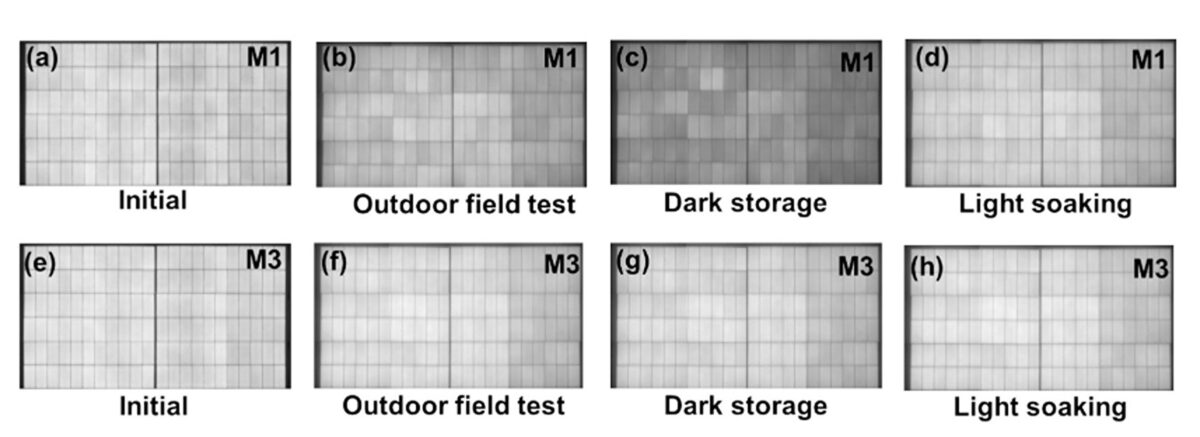
The analysis found that although M1 modules are more sensitive to UV light, their five-month average EY differs from that of M3 modules by only 0.17%. All TOPCon modules, meanwhile, were found to exhibit a metastable ‘degradation-recovery’ cycle when exposed to UV radiation, storage in the dark and immersion in light, driven by synergistic charge redistribution and hydrogen-mediated passivation.
This behavior is consistent with previous research, which noted that power loss occurs during storage in the dark due to laboratory-induced UV degradation. The new field results confirmed that TOPCon modules maintain stable output power under real-world conditions, with light-induced dynamic defect remediation effectively reducing UV-induced degradation.
“Our findings show that TOPCon solar cells exhibit metastable properties,” the researchers emphasized. “UV radiation causes a degradation in performance, dark storage worsens the delayed degradation, and subsequent light-infused treatment almost completely restores cell performance.”
They also explained that the current IEC 61215 standard leaves room for improving UV testing to better reflect the real impact on field energy generation. Both the research community and the PV industry should investigate the UV thresholds that drive degradation and recovery in different technologies, they concluded.
The experiment was described in “UVID of TOPCon solar cells and module power performance in field tests”, published in Solar energy.
This content is copyrighted and may not be reused. If you would like to collaborate with us and reuse some of our content, please contact: editors@pv-magazine.com.
