

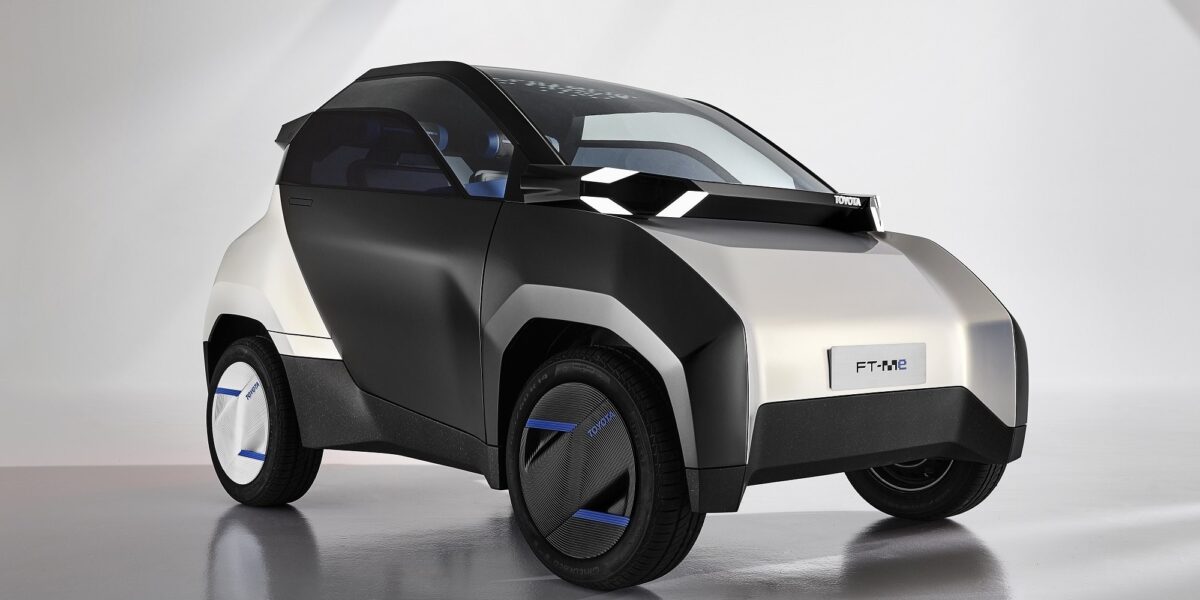
Toyota Manufacturing UK says it is leading a consortium investigating the feasibility of a lightweight electric vehicle for micromobility with a PV roof, digital connectivity and sustainable components.
A consortium led by Toyota Manufacturing UK, a subsidiary of Toyota Motor, is investigating the feasibility of a lightweight two-seater electric vehicle with integrated solar power, digital connectivity and sustainable components.
The feasibility study will focus on a last-mile L6e-type vehicle, modeled after Toyota’s FT-Me, micromobility concept announced earlier this year. An L6 type is a four-wheeled vehicle or quadricycle with a top speed of 45 km.
The project includes a vehicle-integrated solar roof (VIPV) to be designed, developed and validated by consortium partner Savcor, a Finnish technology company. The VIPV is intended to increase driving range by 20%, “creating a solution that supports average daily use without charging,” Toyota Manufacturing UK said in a press release.
Another partner, British ELM Mobility, which according to its website has its own micromobility vehicle, a larger L7eCU type with a loading volume of 4 m2, will explore the potential to maximize shared components. Such work, according to the company, has the potential to reduce duplicative development costs while creating economies of scale.
Digital connectivity components and the use of recycled lightweight, sustainable materials are also planned.
Led by a Toyota team in Derby, England, the project will be supported by researchers from the University of Derby, who will provide expertise in micromobility user behavior and solar energy viability.
The partners in the consortium have secured £15 million ($20 million) in funding, according to a separate announcement from the UK Department of Business and Trade, noting that the funding comes from the Advanced Propulsion Center UK (APC) Collaborative Research and Development programme, focused on zero-emission technologies and new mobility concepts.
Another recent example of solar PV being used in lightweight micromobility vehicles is the European Giants consortium, which is developing VIPV-integrated prototypes of L5, L6 and L7 class vehicles supplied by several international manufacturers. And last year, France’s Croisière Verte team used a modified Citroen Ami to demonstrate the potential of portable solar power and compact, lightweight electric vehicles on an African continental trip.
This content is copyrighted and may not be reused. If you would like to collaborate with us and reuse some of our content, please contact: editors@pv-magazine.com.
