

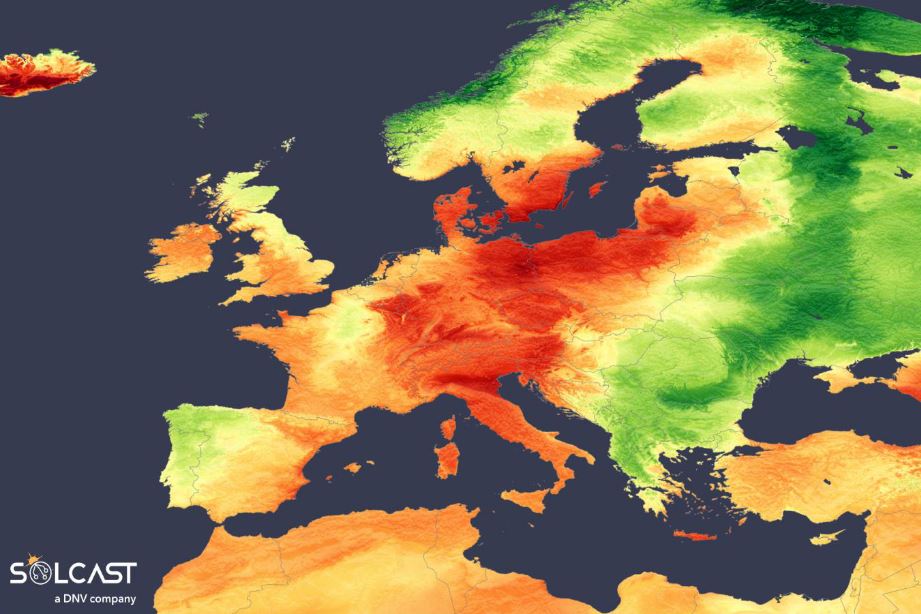
In a new weekly update for pv magazineSolcast, a DNV company, reports that Europe’s solar power generation potential showed a strong east-west split in November, with Eastern Europe experiencing irradiance 15 to 20% below normal due to persistent storms, while much of Western and Central Europe recorded 15 to 20% above average levels under brighter conditions. The Atlantic coast was an exception, as Storm Claudia reduced insolation to near or below average in Portugal, the British Isles and parts of France and Spain.
Solar power generation potential across Europe showed a clear divide between east and west in November, analysis using the Solcast API. Persistent low-pressure systems tracked the eastern regions, bringing widespread cloud cover and rain, while western and central Europe enjoyed clearer skies under higher pressure. The exception was the Atlantic coast, where Storm Claudia reduced insolation to near or below average.
Eastern Europe experienced worse than normal conditions for solar energy generation in November. Frequent storms and frontal activity dominated, with insolation in Greece, Albania, Bulgaria, Romania and Moldova about 15% below normal. Ukraine even did it
worse, a 20% drop, with daily averages dropping from around 1 kWh/m² to 0.8 kWh/m². These reductions exacerbate existing challenges for Ukraine’s power system amid ongoing conflict. Several low-pressure systems drove this pattern, culminating in Storm Adel late in the month. Adel brought floods and hail to Greece and Albania, damaging infrastructure and reinforcing the cloudy trend across the region.
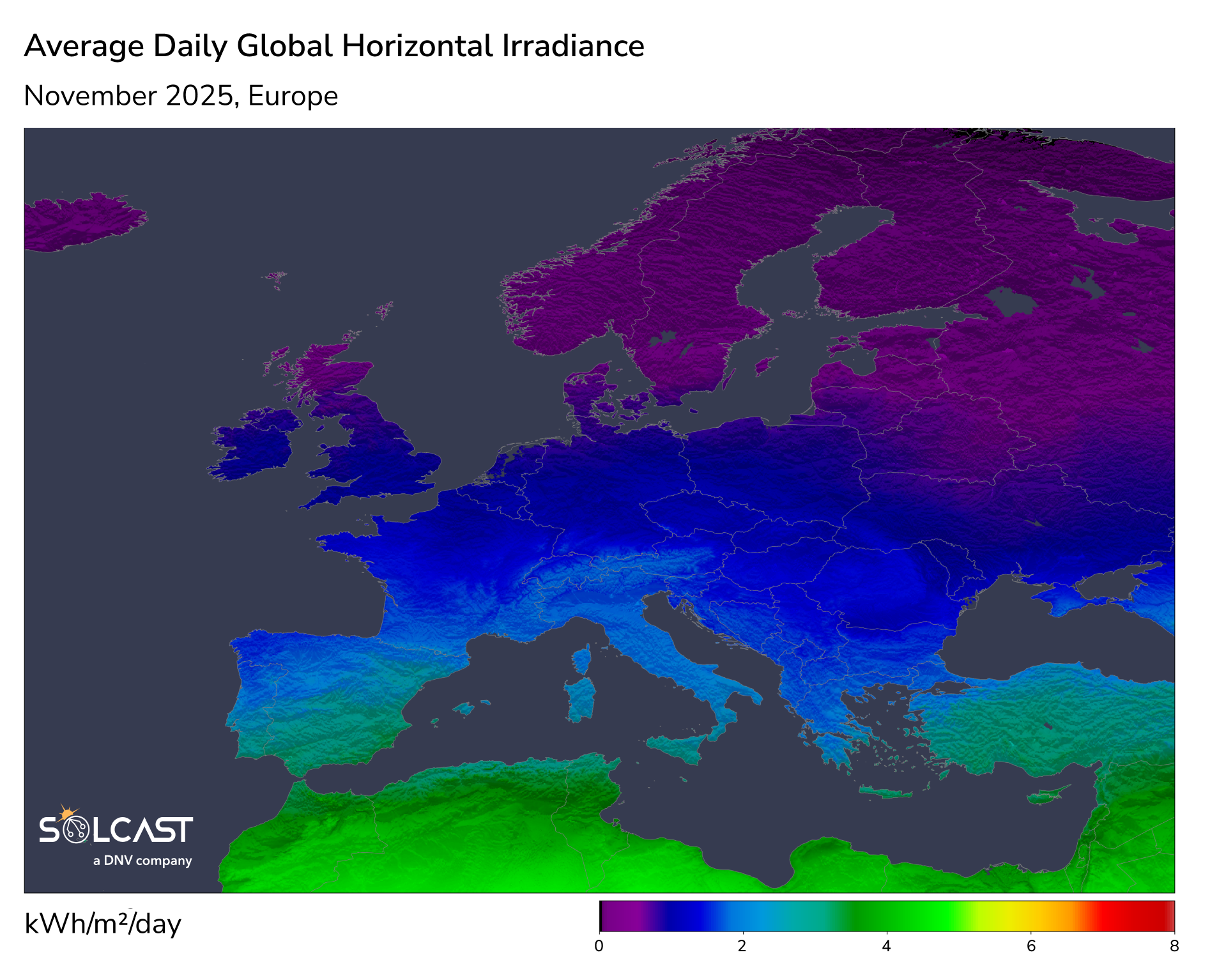
In contrast, much of Western and Central Europe experienced better conditions. A prevailing negative phase of the North Atlantic Oscillation shifted storm tracks southward, leaving northern areas drier and sunnier. Italy, Germany, Switzerland, Czech Republic, Poland and Lithuania recorded irradiance levels 15-20% above average.
Italy was an interesting case. There was heavier than normal rainfall and severe weather outbreaks, consistent with the negative North Atlantic Oscillation which tends to cause wetter conditions around the Mediterranean. However, the rain showers were usually short and intense, alternating with sunny spells, causing the overall irradiance to exceed standards.
Conditions were less favorable along the Atlantic coast. Storm Claudia hit Portugal and the British Isles in the second and third week of November, with cloud cover also reaching France and Spain. In these regions, insolation was near average or slightly below, while Portugal decreased by 5 to 10%. This localized reduction was in stark contrast to the gains observed further east, underscoring the strong regional variability caused by the tracks of low-pressure systems.
Solcast produces these figures by tracking clouds and aerosols worldwide at a resolution of 1-2 km, using proprietary satellite data AI/ML algorithms. This data is used to drive irradiance models, allowing Solcast to calculate high-resolution irradiance, with a typical deviation of less than 2%, as well as cloud tracking predictions. This data is used by more than 350 companies that manage more than 300 GW of solar energy worldwide.
The views and opinions expressed in this article are those of the author and do not necessarily reflect those of the author pv magazine.
This content is copyrighted and may not be reused. If you would like to collaborate with us and reuse some of our content, please contact: editors@pv-magazine.com.
Popular content

