

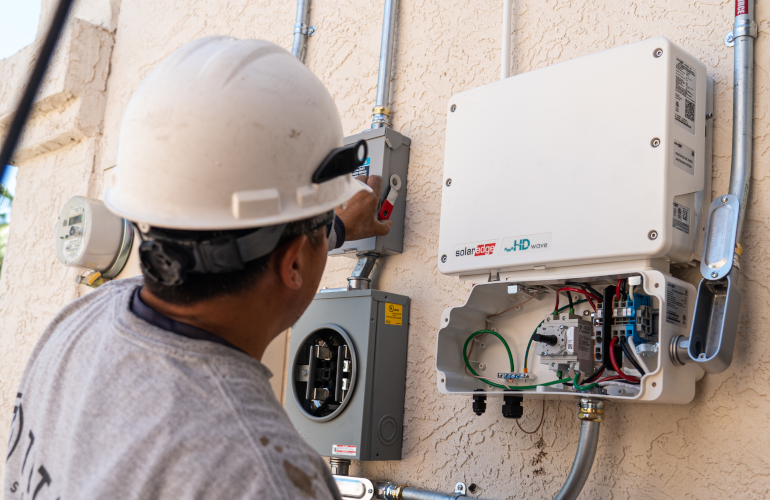
Emerging energy technologies are transforming the electric grid by adding flexibility, reliability and expanded power generation, but can also increase cyber risk because many older devices are not built to meet today’s cybersecurity expectations.

Credit: Titan Solar
UL Solutions has been launched a new certification program which creates the first industry-wide cybersecurity baseline for distributed energy resources (DER) and inverter-based devices, such as microgrids, batteries, hydrogen systems and electric vehicle infrastructure. This certification program provides manufacturers, utilities, regulators and grid operators with a consensus-based framework to mitigate that risk.
“Our new cybersecurity testing and certification program brings clarity and common expectations by providing a standards-based step to reduce cyber risk, which is critical to grid reliability, infrastructure protection and growing public confidence in the new technologies powering communities,” said Ken Boyce, PV at UL Solutions. “By combining cybersecurity assessment with safety testing, we are helping manufacturers build security in from the start and giving buyers confidence in distributed energy and inverter-based products.”
Testing for this cybersecurity certification follows the requirements in UL 2941, the “Standard for Cybersecurity of Distributed Energy and Inverter-Based Resources,” which sets cybersecurity requirements for networked, software-controlled devices that handle significant energy flows and impact the stability of the electrical grid. The standard covers technical controls, such as access management and cryptography, as well as policy areas such as the handling of sensitive data and documentation.
It is designed to complement, not replace, existing safety testing, UL 1741, the “Standard for Inverters, Converters, Controllers, and Interconnection System Equipment for Use with Distributed Energy Resources” – giving manufacturers options for how to meet the required protection.
The new cybersecurity certification program grew out of field work, including test cases published in 2019 by the U.S. Department of Energy’s National Laboratory of the Rockies (NLR) that focused on authentication, authorization, confidentiality and data integrity for microgrid communications. These efforts have highlighted the need for a dedicated cybersecurity standard that addresses the wide range of DER and inverter-based technologies and their complex ownership structures.
“As energy sources integrate with the power grid, cybersecurity can no longer be an afterthought and must be built into the design and deployment of devices,” says Danish Saleem, senior researcher at NLR’s Cybersecurity Research Center. “Certification to UL 2941 by UL Solutions provides the industry with a rigorous, practical path to confirm that these protections are in place, increasing confidence for utilities, owners and communities that rely on these resources.”
Learn more about the cybersecurity of distributed energy and inverter-based resources.
News item from UL Solutions
