

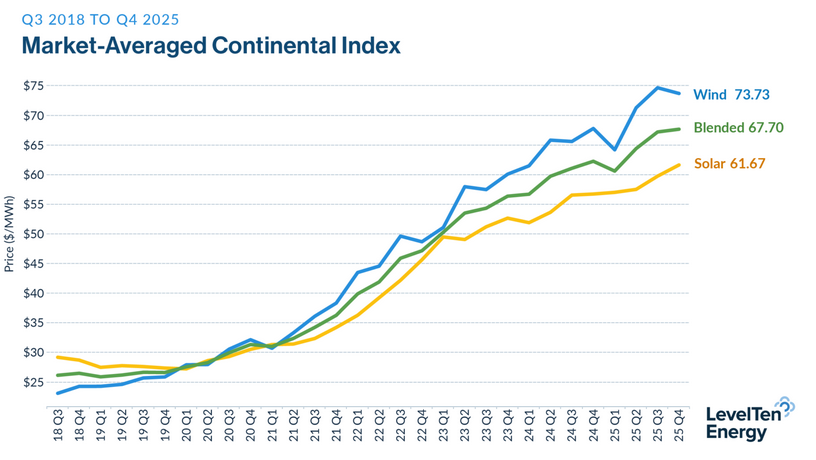
A report from LevelTen Energy shows that PPA solar prices in North America increased 3.2% in the fourth quarter of 2025, representing a nearly 9% increase year-over-year, as developers and buyers navigate a complex ‘post-OBBBA’ regulatory environment.
Prices for renewable energy purchase agreements continued to rise in the final quarter of 2025, driven by persistent policy headwinds and a changing tax credit landscape.
According to the PPA price index for the fourth quarter of 2025 from marketplace operator LevelTen Energy, P25 solar prices rose 3.2%, after a 4% increase in the third quarter.
While solar costs rose, PPA prices for wind energy saw a slight decline, down 1%. However, on an annual basis, both technologies saw prices increase by almost 9% compared to the same period last year.
Post-OBBBA
The market is currently adjusting to the One Big Beautiful Bill Act (OBBBA), which introduced tax cuts. LevelTen noted that the second half of 2025 was marked by “relentless” priorities as companies rushed to safe haven projects.
Despite these challenges, a survey of developers representing more than 230 GW of capacity by November 2029 found that more than 75% of projects scheduled to come online before 2029 expect to successfully maintain access to tax credits.
This clarity has allowed some developers to control prices by removing risk premia that previously accounted for OBBBA-related uncertainties, the report said.
Regional prices
The report highlights the significant price differences between North American ISOs. For solar, P25 prices reached as high as $115 per MWh in ISO-NE and $81.03/MWh in PJM, while ERCOT remained the most competitive at $49 per MWh.
| ISO market | Solar energy price P25 ($/MWh) |
| ISO NE | $115.00 |
| PJM | $81.03 |
| MISO | $64.95 |
| CAISO | $62.00 |
| ERCOT | $49.00 |
In the wind sector, ERCOT has seen a massive 19% year-over-year price increase, fueled by a continued boom in data center development and a premium on available capacity.
Buyer headwind
LevelTen pointed out several factors that could continue to put upward pressure on prices:
- Rate uncertainties: Ongoing Section 232 survey rates increase direct development costs.
- Permitting hurdles: “Tough” new federal permitting procedures have stalled significant amounts of development across the country.
- FEOC: The industry is still awaiting guidance on the Foreign Entity of Concern (FEOC) rules, which are expected to increase compliance costs and further complicate the qualification of tax credits.
Business strategy
Many corporate buyers are now pausing or adjusting their purchasing strategies due to proposed updates to the Greenhouse Gas Protocol (GHGP) Scope 2 standards, the report said. The updates, expected to be completed in 2027, could introduce stricter accounting for hourly matching and physical deliverability.
“The current uncertainty has led some buyers to adjust or even postpone their purchasing strategies,” the report said.
LevelTen encourages industry players to have their say on the proposal, as 97% of companies that track emissions currently use the greenhouse gas GHG.
As buyers and sellers work to achieve a “price equilibrium,” the report said, sellers in markets where contract values are challenging may need to find more tradable price levels to get deals done.
This content is copyrighted and may not be reused. If you would like to collaborate with us and reuse some of our content, please contact: editors@pv-magazine.com.
