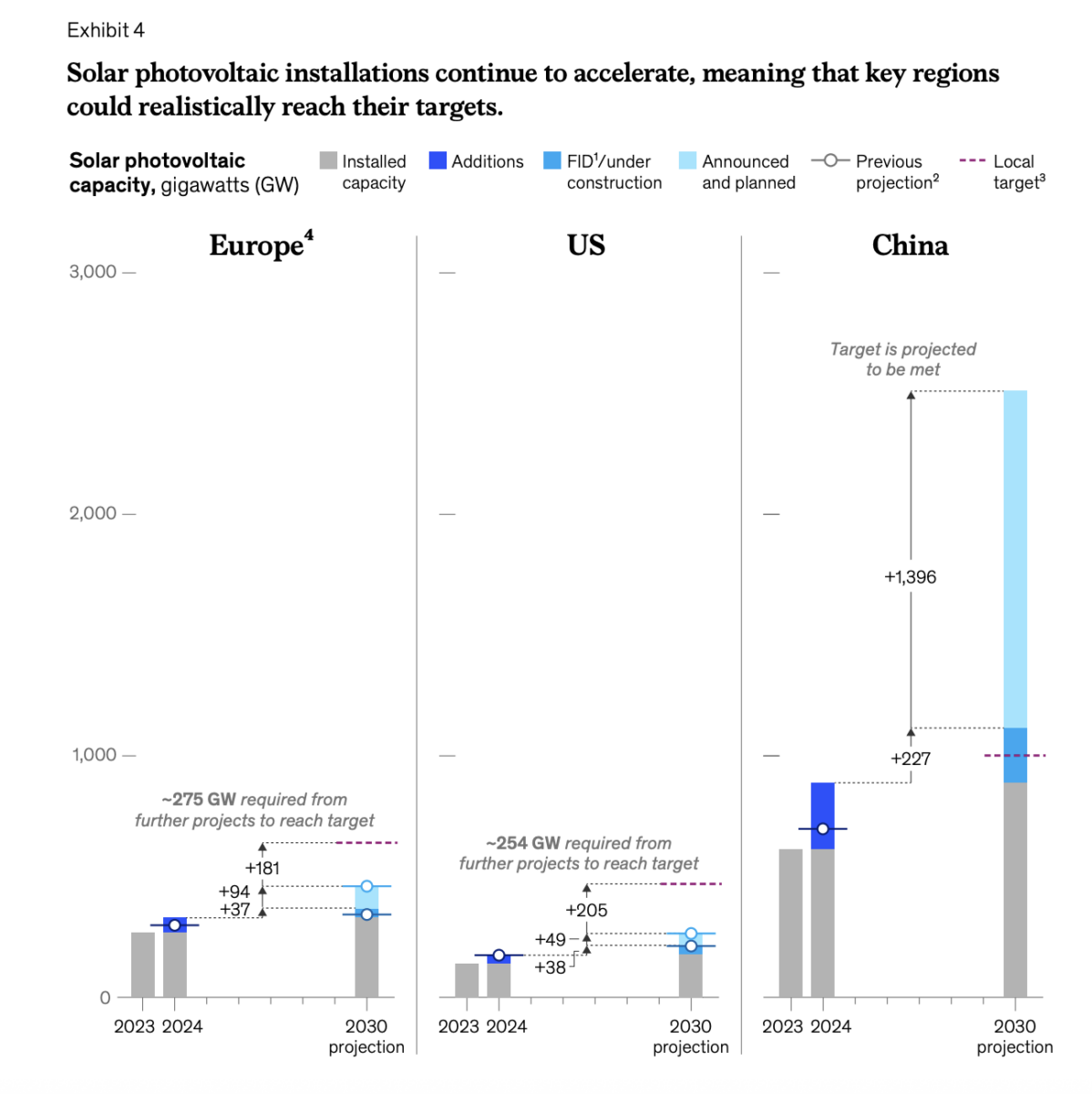
A report from McKinsey and Company says the relative ease of building out solar projects means the US and Europe are likely to meet their deployment targets by the end of the decade, despite current gaps in the pipeline of around 205 GW and 181 GW.
The US and Europe are likely to meet their 2030 solar energy targets, despite current project pipelines being smaller than their end-of-decade targets, according to a report from global management consultancy McKinsey and Company.
McKinseys “Tracking the energy transition: where are we now?” The report analyzes the trajectory of solar, wind and battery energy storage system (BESS) technologies towards the 2030 deployment targets set by China, the United States and the EU-27, Norway, Switzerland and the United Kingdom in Europe.
It says the US is currently about 254 GW away from its 2030 target, while Europe is about 275 GW away. China, on the other hand, has already more than doubled its 2030 target.
Despite the US and Europe currently not having enough announced capacity to meet their 2030 targets, at around 205 GW and 181 GW respectively, McKinsey’s analysis says they are still likely to find this additional capacity and reach their thresholds before the end of the decade thanks to the ease of expanding solar energy.
“While it is easier to track project development for other clean energy technologies, data visibility for solar is more limited due to individual household use and ease of build-out,” McKinsey’s report explains. “For example, a consumer can install solar energy for home use within two months. This means that the announced capacity may be underestimated in this analysis.”
Diego Hernandez Diaz, a partner at McKinsey, explained pv magazine that while core markets will continue to expand, there will also be further growth in demand in less saturated core markets such as Poland. “The advantage of some of these elements is that the more emerging markets can have a better economic interaction and can be built in an economically pragmatic way,” he explained.
The report does acknowledge that this growth trajectory is not guaranteed, citing supply chain risks, tariffs, shifting policy focus and growing political uncertainty as factors that could slow progress. Hernandez Diaz added that there will likely be an effect of shifting regulations across the board.
“Perhaps more importantly, barring any regulation, we continue to see that when the underlying economics work, implementation accelerates,” he said. “All the key regions covered in the report have the underlying foundations to support the continued deployment of further renewable energy sources.”
The report also notes that the battery energy storage systems (BESS) pipeline is growing rapidly in China, the US and Europe, but lagging behind what is needed to meet 2030 targets. McKinsey estimates that approximately 123 GW additional is needed in China, 154 GW in the US and 221 GW in Europe.
The analysts say BESS remains the dominant question mark but can be deployed, permitted, built and interconnected much faster than technologies such as nuclear or gas, where carbon, capture, use and storage (CCUS) has contributed to the rapid growth in recent years.
The report attributes the rapid acceleration of BESS installation to a positive business case for both large-scale operators and households in combination with solar energy. “Load balancing is also becoming a popular source of revenue for battery operators,” the report adds. “Planning and integrating BESS with renewable energy rollout is critical if we are to achieve 2030 net zero targets.”
This content is copyrighted and may not be reused. If you would like to collaborate with us and reuse some of our content, please contact: editors@pv-magazine.com.
Popular content