

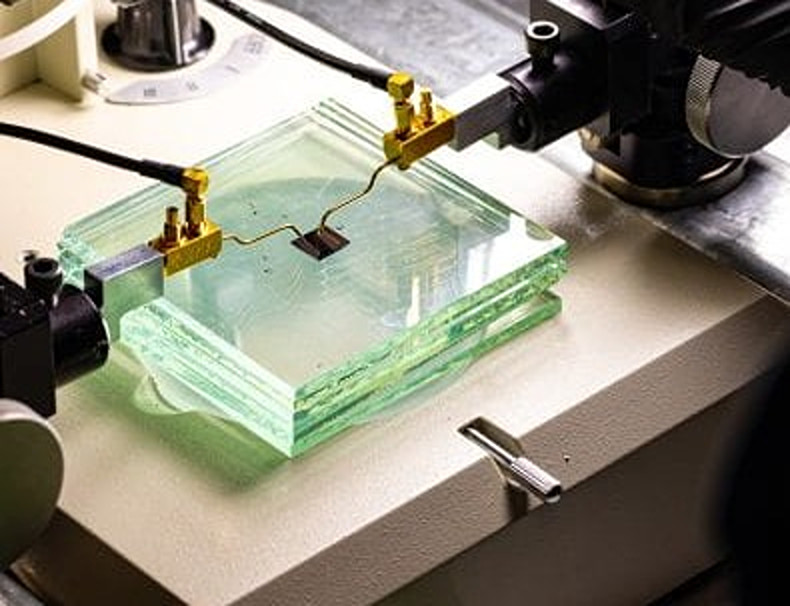
The solar cells combine multi-layer graphene with silicon wafers, harvesting both solar and kinetic energy for continuous use. Tests show that the cells can autonomously drive supercapacitors embedded in a temperature sensor.
Researchers from the University of Arkansas in the United States have fabricated a graphene-based solar cell that can be used in Internet of Things (IoT) applications.
The device was developed as part of a research project intended to develop autonomous sensor systems that draw power from multiple sources in the environment, including solar, thermal, acoustic, kinetic, non-linear and ambient radiation.
Graphene has been widely used in solar energy research for the development of transparent electrodes, contacts, transport layers, and anti-reflective or protective coatings. It is a zero-bandgap semi-metal that can only absorb about 2.3% of visible light per layer and is therefore unable to efficiently harvest solar energy on its own. However, its unique electronic and optical properties allow it to exhibit interesting photovoltaic behavior when integrated into other devices.
“Researchers have explored several techniques to improve the energy conversion efficiency of these solar cells, including optimizing the thickness of the graphene sheets, refining the integration process with the silicon substrate, incorporating additional interfacial materials, doping silicon substrates, using structured silicon surfaces and using silicon nanowires,” the scientists explain.
They also noted that graphene solar cells were chosen over conventional high-efficiency PV cells because graphene can harvest kinetic energy, allowing the device to operate even when sunlight is not available.
To build the cell, the scientists used commercially available 500-μm-thick n-type silicon wafers topped with a thick thermal oxide layer. The top oxide was patterned and etched directly onto the bare silicon, while a second pattern was drawn onto the chip, followed by metal deposition to create two gold bond pads. Multilayer graphene was then deposited on both the exposed silicon and the top interconnect pad.
“Due to the transparency of graphene, light passes through the silicon substrate and is absorbed by the silicon substrate,” the research team explained, noting that the cells were connected in series within a small array. “By selecting and connecting several solar cells in series, we can charge the storage capacitors to the desired voltage level.”
For the temperature sensor system, the team chose to use supercapacitors instead of a battery to reduce overall energy consumption and extend operational life, assigning three storage capacitors to different functional roles.
Laboratory tests have shown that the system works automatically without external power. It relies on a processor that remains in standby mode most of the time and is only activated briefly. “The storage capacitors continuously power our temperature sensor system, even if they are occasionally charged by the solar cells,” the scientists pointed out.
The system was described in “An array of mini graphene-silicon solar cells intermittently charges the storage capacitors that power a temperature sensor”, published in the Journal of Vacuum Science and Technology B.
“The paper confirms that it is possible to create an ultra-low power temperature sensor using graphene-based solar energy,” the academics concluded.
This content is copyrighted and may not be reused. If you would like to collaborate with us and reuse some of our content, please contact: editors@pv-magazine.com.
