

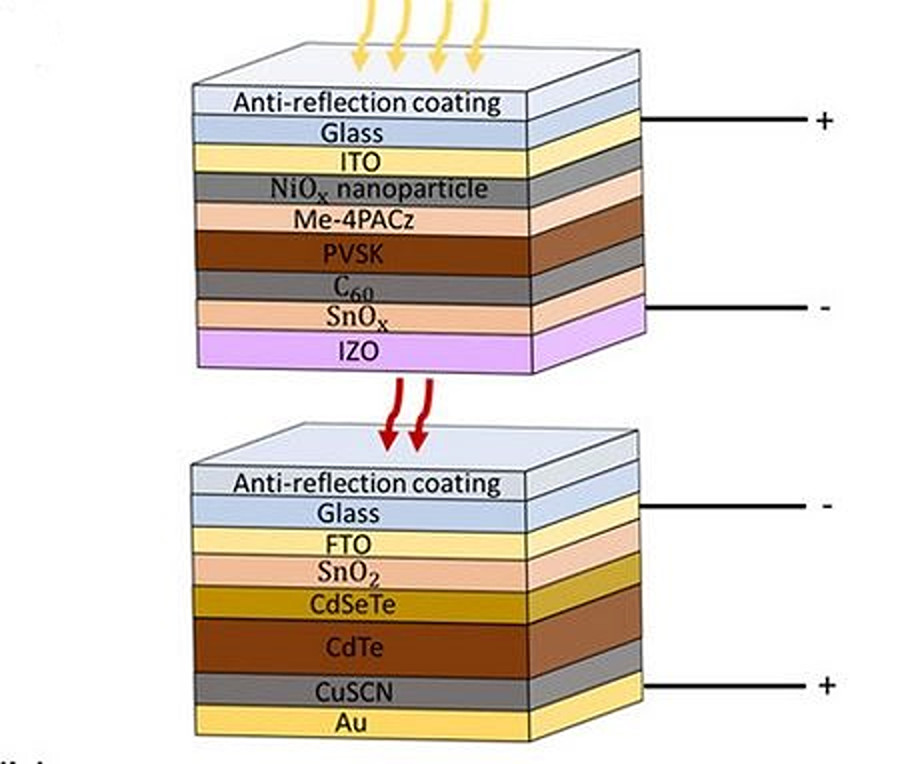
The researchers say the cell has a perovskite cell on top with a transparent back contact made of indium zinc oxide and a commercially established cadmium telluride bottom device. They claim that the champion tandem cell has the potential to achieve 30% efficiency.
A research group at the University of Toledo in the United States has designed a four-terminal (4T) tandem solar cell with an upper device that relies on a perovskite absorber with an tunable wide bandgap and a lower cell that uses a commercially established narrow bandgap. absorber technology made of cadmium telluride (CdTe).
“While much work has been done on perovskite-silicon, perovskite-CIGS, and perovskite-perovskite tandem cells, perovskite-cadmium-telluride tandem solar cells are relatively unexplored,” the scientists said. “Although the efficiency potential of CdTe-based tandems is likely lower than that of CIGS-based tandems due to the larger bandgap of the CdTe bottom cell, the broader commercial success of CdTe solar cells makes them a point of interest when exploring thin-film tandem applications . .”
The academics said a key element of the solar cell is the transparent back-contact (TBC) technology used for the wide-bandgap top-tunable perovskite cell. To construct these contacts, they used indium zinc oxide (IZO) as an alternative to the proven indium tin oxide (ITO).
They prepared the IZO films using the radio frequency (RF) magnetron sputtering technique, an approach that alternates the electrical potential of the current in a vacuum environment onto RFs.
They also explained that their efforts were focused on identifying the ideal IZO thickness as this plays a crucial role in improving the performance and optical transmittance of the semi-transparent perovskite top cell by increasing the perovskite band gap, thereby can emit more long wavelength photons and enter the cell. CdSeTe bottom cell. This in turn compensates for a typical optical loss factor in a 4T tandem configuration.
The top cell is constructed with a substrate made of glass and indium tin oxide (ITO), a hole transport layer (HTL) made of nickel(II) oxide (NiOx), a layer made of a phosphonic acid called methyl substcarbazole (Me-4PACz), the perovskite absorber, an electron transport layer (ETL) that relies on buckminsterfullerene (C60), a tin oxide (SnOx) buffer layerand the IZO back contact.
The bottom cell is designed with a substrate made of glass and ITO, an ETL made of tin oxide (SnO2), a cadmium telluride (CdTe) absorber, a cadmium selenium telluride (CdSeTe) layer, a copper thiocyanate (CuSCN) HTL, and a gold-colored metal contact.
Both cells were covered with an anti-reflective coating.
The best tandem cell configuration was achieved when the top cell absorber was adjusted to have an energy band gap of 1.76 eV. With this value, the device achieved an overall energy conversion efficiency of 25.1%.
The top cell was found to achieve an efficiency of 17.93%, an open-circuit voltage of 1.315 V, a short-circuit current with a density of 17.11 mA cm2and a fill factor of 79.7%. The bottom cell showed an efficiency of 7.13%, an open-circuit voltage of 0.842 V, a short-circuit current with a density of 11.15 mA cm2and a fill factor of 76.0%.
“The result proves the concept that the 4T perovskite-CdSeTe tandem configuration can be used to improve the efficiency of commercial CdSeTe thin-film solar cells,” the researchers said, adding that they are currently outlining a roadmap to increase the device’s efficiency by up to 30% . “Our analysis shows that highly efficient 4T perovskite-CdSeTe tandem solar cells are feasible with the future advancement of both PV cells.”
The details of the new cell design can be found in the study “Perovskite-CdSeTe tandem solar cells with four connections: from 25% to 30% energy conversion efficiency and more”, which was recently published in RRL solar energy.
The University of Toledo has developed several types of CdTe solar cells in recent years. The devices include a 20% efficient cell based on a commercial tin(IV) oxide (SnO2) buffer layer, a 17.4% efficient device using a copper-alumina layer on the back of the CdTe thin film, and a solar cell based on an indium-gallium oxide (IGO) emitter layer and a cadmium stannate (CTO) transparent conductor as front electrode.
This content is copyrighted and may not be reused. If you would like to collaborate with us and reuse some of our content, please contact: editors@pv-magazine.com.
