

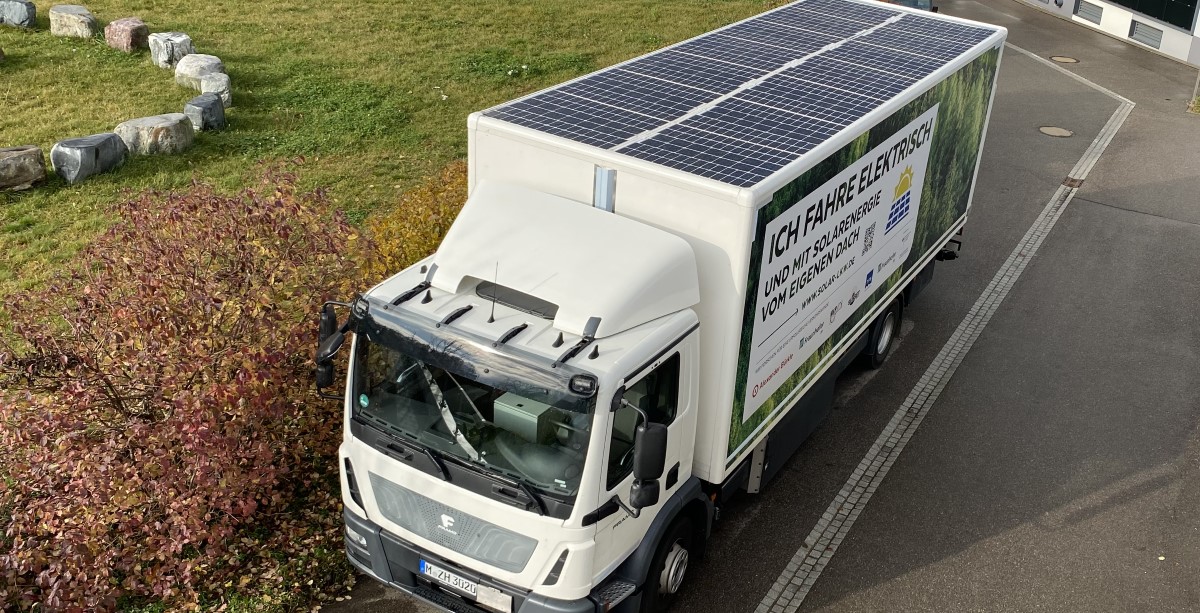
Germany’s Fraunhofer ISE investigated the thermal effects and net energy gain of a 3.2 kW vehicle-integrated PV system (VIPV) installed on a truck with a refrigerated freight storage area. It turned out that in some cases the battery storage system could meet the full energy needs of the cooling unit all year round.
The German Fraunhofer Institute for Solar Energy Systems ISE (Fraunhofer ISE) has investigated the thermal effect and net energy gain of a 3.2 kW vehicle-integrated photovoltaic (VIPV) system in a refrigerated truck with a flatbed and found that the generated solar energy easily offset the extra energetic demand caused by the PV system itself and offset the total annual demand of the vehicle’s chiller.
“Although there is an expected increase in the energy demand of the cooling unit, it was somewhat surprising to see how easily the solar energy compensates for this increase and remains extremely beneficial in terms of the energy balance,” says the study’s corresponding author, Luis Eduardo Alanis, narrated pv magazine.
In the study “Thermal effect of VIPV modules in refrigerated trucks,” published in Solar energy materials and solar cellsthe research team conducted their analysis based on the expectations that the VIPV system would increase the energy demand of the cooling unit and that headwinds would have a cooling effect on the PV array.
The team modeled several scenarios to make an informed assessment of energy balance. “A one-dimensional thermal simulation model based on a Resistance-Capacitance methodology has been created and experimentally validated,” the academics said.
The model took into account several parameters that influenced the cooling load of the truck’s refrigeration unit, including geolocation, material specification of PV modules, weather data, basic geometry and forced air convection caused by vehicle movements. It contained Bill of Materials (BOM) data for two module designs, one with insulation layers of foam and plywood for refrigerated applications, and one with foam layers and no plywood for non-refrigerated freight applications.
The VIPV module BOM used as a basis for the study had previously been developed and validated in a previous project led by Fraunhofer ISE, known as Lade-PV.
The model was used to predict the thermal behavior of the VIPV system in three cities in Europe: Stockholm in Sweden, Freiburg in Germany and Seville in Spain. It predicted that, for a stationary case, the air in the refrigerated cargo space in Stockholm, Freiburg and Seville could be heated by an average of 0.36 C, 0.5 C and 0.67 C respectively over a year, and up to 3, 12 C. 2.98 C and 2.61 C respectively as maximum value.
The team also modeled the PV cooling effect of forced convection at a wind speed of 50 km/h. It noted that the temperature of the “solar cell dropped significantly.” In the case of Freiburg, this meant that a maximum air temperature increase of 0.6 C was predicted, as opposed to the calculated 2.98 C in a steady-state scenario.
The team noted that the convective heat loss due to the movement of a vehicle with integrated PV is “significant” and said this is a “highly relevant” aspect to consider when analyzing the thermodynamics and yield potential of such systems. This was shown in two scenarios at 2 C and -18 C.
The researchers concluded that although VIPV adds heat to the system, which affects the energy demand of the cooling unit, the energy gained from the PV installation “significantly exceeds the increased cooling demand.” They added that “sufficient battery storage” could enable the PV to meet the energetic needs of the cooling unit all year round.
The team also emphasized that the annual results described in the study are “referential only” and that “numerous additional variables” can influence both the energy demand of the cooling unit and the total annual yield of the PV system.
“A simulation tool can only go so far in understanding a phenomenon that has so many variables and is so complex to model,” Alanis explains. “It would be interesting for us to find the right partners with whom we can take this further and possibly put this to the test in practice. We can also consider expanding the simulation model and considering more influences in the future. For example, loading and unloading freight.”
This content is copyrighted and may not be reused. If you would like to collaborate with us and reuse some of our content, please contact: editors@pv-magazine.com.
