

When a company – whether a developer, an independent power producer (IPP) or a utility – decides to build a solar PV installation, its scope goes beyond supplying electricity to the grid.
More and more projects are implementing strategies or applications that go beyond electricity generation, such as agrivoltaic solar energy (agriPV) or biodiversity applications. In Britain, projects must deliver a net biodiversity gain of at least 10%, but some companies are achieving much more than that target.
This is the case with IPP British Solar Renewables (BSR), which has gone one step further as it aims to achieve at least 60% of net biodiversity gain across its 1.2 GW portfolio of solar and battery energy storage system (BESS) projects. reaches up to 184.2% and even beyond.
“It’s really embedded in part of BSR’s culture,” explains Fran Button, the company’s deputy CEO.
Make a promise for every solar park
Button adds that when investigating biodiversity applications and how to achieve levels of more than 200%, this can be linked to what is already present on the solar farm site, and what will be done with it.
“We’re trying to be good stewards of that land and give it back in kind of a better condition in terms of soil health and in terms of kind of biodiversity and things like that, while at the same time producing electricity,” Button says.
Something that is rooted in the company’s identity and its nature conservation promise. Button explains that this commitment emerged from a series of commitments to the communities that the IPP makes with its solar PV projects and shows how the land will be managed, based on its specific characteristics. Because when we talk about the net gain in biodiversity, there is no one-size-fits-all.
“If you take the example of the yellow rattle, which is a parasitic plant. It holds the grass when it’s growing well, and is great for pollinators. The downside to this is that there’s no point in someone recommending this as something to plant everywhere because they don’t like all soil types,” Button explains.
The location of the project will already have an impact on the process of what can be carried out, because not only the soil will differ, but also the flora and fauna. This can mean many things, from using wildlife corridors to creating ponds and ditches or using local suppliers for wildflower seeds.
“We’re going to treat each project as an individual project in itself, choosing suitable wildflower seeds or planting suitable trees, and in that way caring for and maintaining the land. And that’s really what the Conservation Plan is about. It was our promise to the community that we’re living up to.”
How the net benefit for biodiversity is calculated
Button explains Solar energy portal how the company aims to achieve 184.2% of net biodiversity gain for the Hooton Pagnell Renewable Park and how an independent ecologist calculates this metric and what is currently on the site – in this case winter wheat, oilseed rape and legumes include the crops and some grasslands – prior to construction of the solar power plant.
The ecologist measures the habitat units currently on the site and assesses the changes that have occurred after the solar farm was built, including looking at the potential percentage of hedge units and watercourse units to obtain the overall calculation.
Button adds that the ecologist can make recommendations to improve the biodiversity of the solar farm, as biodiversity programs are not exclusive to the construction phase of a project, but continue throughout its operational life.
“What the ecologist is doing is they are effectively recommending things to get that net biodiversity gain. In this particular case we will be introducing grassland and wildflowers where there was heavy cropping. We are going to increase the hedgerow units so they will increase by 10.65% and that both helps with screening, but it also helps with the net biodiversity gain.”
Conservation of biodiversity during the O&M phase
These and other applications contribute to achieving such a high net benefit for biodiversity, which is not only achieved during the construction phase of the project, but must also be maintained once operational.
A clear example of this from the Hooton Pagnell project is the planting of 90 trees that need to be maintained so that they can survive over the life of the project. “When you get into the management phase, it’s a whole different ball of worms to maintain those larger units of biodiversity,” Button says.
Furthermore, Button highlights the advantage of being an IPP as the company not only builds the project, but is also responsible for the operation and maintenance (O&M) of the plant while it is in operation. Button adds that the O&M phase is a “big part” of the entire biodiversity ecosystem for a solar project.
“The great thing about being your own maintenance and operations contractor is that you can adjust and change things to see what kind of work is happening on a particular site,” Button explains.
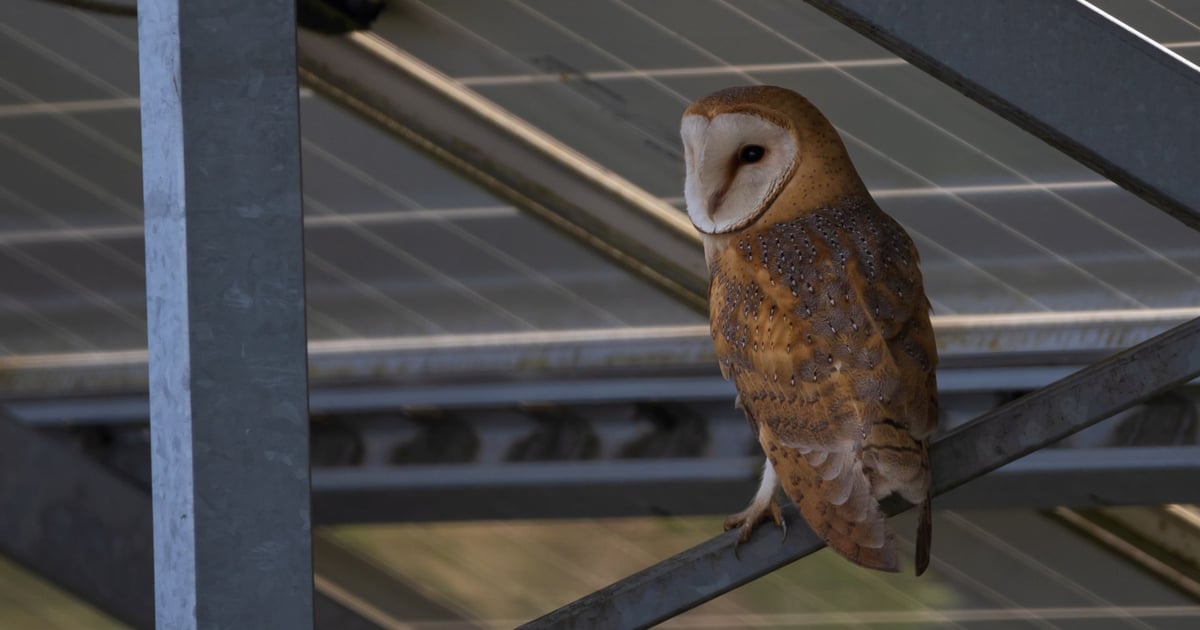
Implementing biodiversity measures can help bring wildlife to a solar PV farm. Image: BSR.
Implement seasonal biodiversity
Ownership of the project gives BSR another advantage, as the company can conduct experimental work and see which applications work best. Button gives the example of rotational grazing, a project where the company has been working with the Bumblebee Conservation Trust on one of its solar PV installations.
“There are some very rare shrill carder bumblebees in Somerset, not in that particular spot, but very close by. And what we were hoping to do is create some great habitats for bumblebees, and hopefully, with a bit of luck, maybe encourage the shrill carder to be down there. But if not, then it would benefit a lot of other different pollinators,” Button explains.
A project that includes a seasonal element and can be implemented together with other specific aspects of a solar power plant, as in the case of the same project, which allows the farmer to keep heritage sheep and use them for grazing, which in itself saves time and money for the operation and maintenance of the plant.
“What we’re doing at the moment is we’ve cordoned off certain parts of the park so that at certain times of the year the bumblebee, the mix of wildflower seeds, grows and doesn’t get eaten by the sheep. They’re great for pollinators. They die back, the seeds fall to the ground, and at that point the sheep can go out to graze that part of the land, but the other part of the year they graze on the other part of the land.
“With these kinds of practices you can create an environment where you have nature and you specifically take care of pollinators or whatever, but you can also do some low-density grazing and produce energy at the same time. So in the operation and maintenance phase, that’s one of the options that are open to that,” Button explains.
Button emphasized that being an IPP gives the company the advantage to implement these seasonal applications and respond more proactively to nature, such as exploring the cultivation of hay crops, as Britain experienced a very dry summer last year.
“It wasn’t really our intention to take away the hay crop this year, but with the drought coming and there being a lack of feed for the animals, it made perfect sense to do that. And because we have control over that, because it’s our solar farm and we’re the operations and maintenance contractor, we were able to do it in a controlled and managed way, for the benefit of the farmer and ourselves.”
The importance of soil sampling
When asked which biodiversity programs are worth applying to any project, regardless of location or state of the land, Button says soil sampling would be her top tip.
“Soil sampling is a real game changer for us, and we do it very voluntarily, with the intention of using that to adapt what we have planned,” says Button, adding that the company has its own biodiversity and land manager, who helps sort out what works and what doesn’t for a specific project.
“Work out what kind of soil you have, and then you can buy suitable wildflower seed, and you can factor that into the maintenance of it, because otherwise you’re wasting a lot of money while the seed doesn’t take off or dies, and then you don’t meet the criteria that you should meet in terms of net biodiversity gain.”
Button adds that water is also another important factor to consider when implementing biodiversity applications as it is important for wildlife.
“Even if it’s a shallow pond or a ditch or something like that, where wildlife can live, drink or come, I think that creates the kind of habitat that animals want to live in,” Button says.
During our conversation, Button highlighted several other projects and research taking place, which demonstrate not only her personal interest in biodiversity, but also BSR’s work to implement as many applications as possible in each solar energy project, so that it is not just an installation that generates electricity, but also an ecosystem in which animals and plants can live together.
And also for wild animals lovers to take photos like the ones that illustrate this article.
