

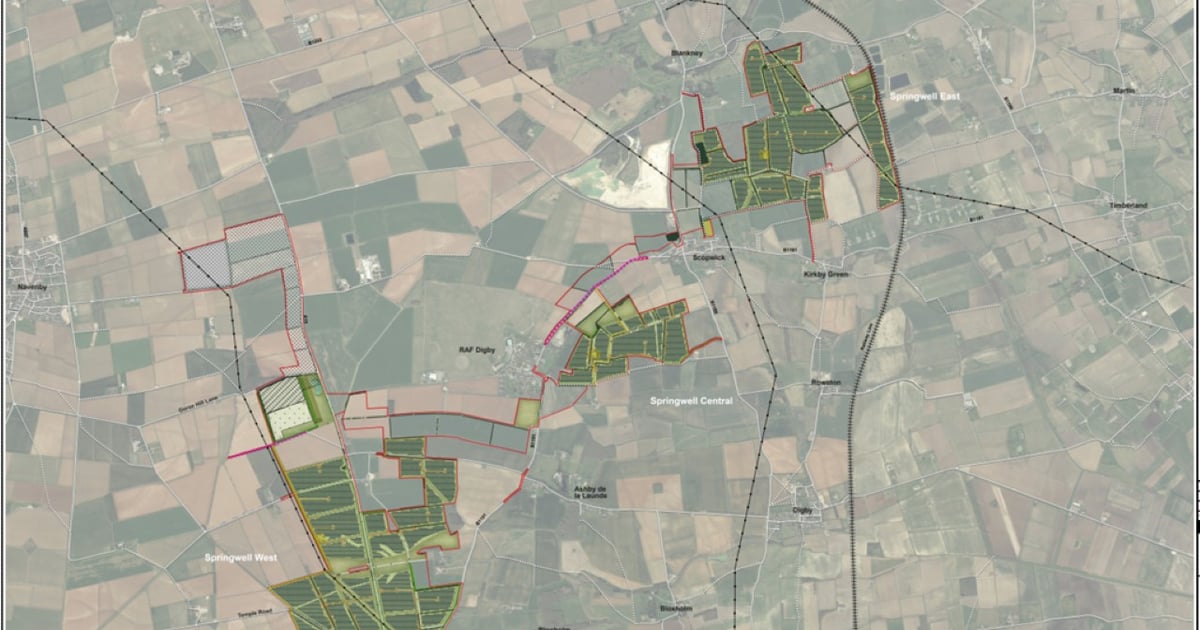
The UK government has approved plans to build an 800 MW solar power plant in Lincolnshire.
The Springwell solar power station is being developed in collaboration with EDF subsidiary EDF Power Solutions UK and Luminous Energy, a UK-based developer.
The 800MW solar PV plant will be built on land in North Kesteven, Lincolnshire, and will be co-located with a battery energy storage system of an undisclosed size.
The British government said the approval of the power plant marks its commitment to “learn lessons from the conflict in the Middle East,” which has seen global oil and gas prices rise.
Energy Minister Michael Shanks said: “It is vital that we learn the lessons of the conflict in the Middle East – solar energy is one of the cheapest forms of energy available and is the way we get off the rollercoaster of international fossil fuel markets and secure our own energy independence.”
Springwell is the largest clean energy NSIP to be approved by the current administration, and the 14e solar NSIP. Most recently a DCO was awarded for BOOM Power’s 237.5 MW Fenwick solar power plant.
Although the amount of land to be covered by the solar panels themselves at the power station was reduced from 816 hectares to 594 hectares after initial consultation, the project has seen massive public disagreement.
Partly due to the number of PV installations planned or approved for construction in Lincolnshire and surrounding counties in the east of England, consumer interest in local projects is low. Developers choose this area because it has high irradiation levels and sufficient network capacity, thanks to the historical fossil energy generation there.
Although a project of Springwell’s size would still be considered an NSIP, recent changes to the National Planning Policy Framework (NPPF) in the UK This means that local governments will have a say in larger solar energy projects in their area.
NPPF is changing to make solar energy decisions more local
One thing driving local criticism of large-scale solar power plants in Britain is the feeling that the decision is made in Westminster with little to no input from local people.
Two former NSIPs have been removed from the Planning Inspectorate website and resubmitted to local planning authorities (LPAs) since the start of this year.
RWE’s Lostrigg Solar project and TotalEnergies’ Hedgehog Grove solar power station will now be approved under the Town and Country Planning Act (TCPA) and submitted to Cumberland Council, Uttlesford District Council and Braintree District Council respectively.
At the end of March, Solar energy portal reported that the first solar PV installation planned with a capacity of more than 50 MW had been submitted to a municipal council since the government’s changes to the NPPF came into effect.
Theoretically, the increased boundary will see more developments go to the LPAs for approval, giving locals more say over developments.
According to the project page for the 98MW Hedgehog Grove project, TotalEnergies’ decision to move to the TCPA “allows for a more locally focused consultation.”
When the threshold for a project to be considered an NSIP was 50 MW, many developers did not find it cost-effective to go through the more complex and expensive process of obtaining a development consent (DCO), meaning very few projects were planned with capacities between 50 and 150 MW.
RWE’s decision has not been publicly explained, but a letter to the Planning Inspectorate dated 7 May 2025 (shortly after the second round of consultation required by the DCO process concluded) states that RWE would submit to Cumberland Council following the Government’s decision to amend the NPPF.
While most UK solar NSIPs have over 150MW, two that have received DCOs (one of them in the last year) have capacities in the theoretically financially unfeasible zone: Little Crow Solar in Lincolnshire And Stone Street Green in Kent.
