

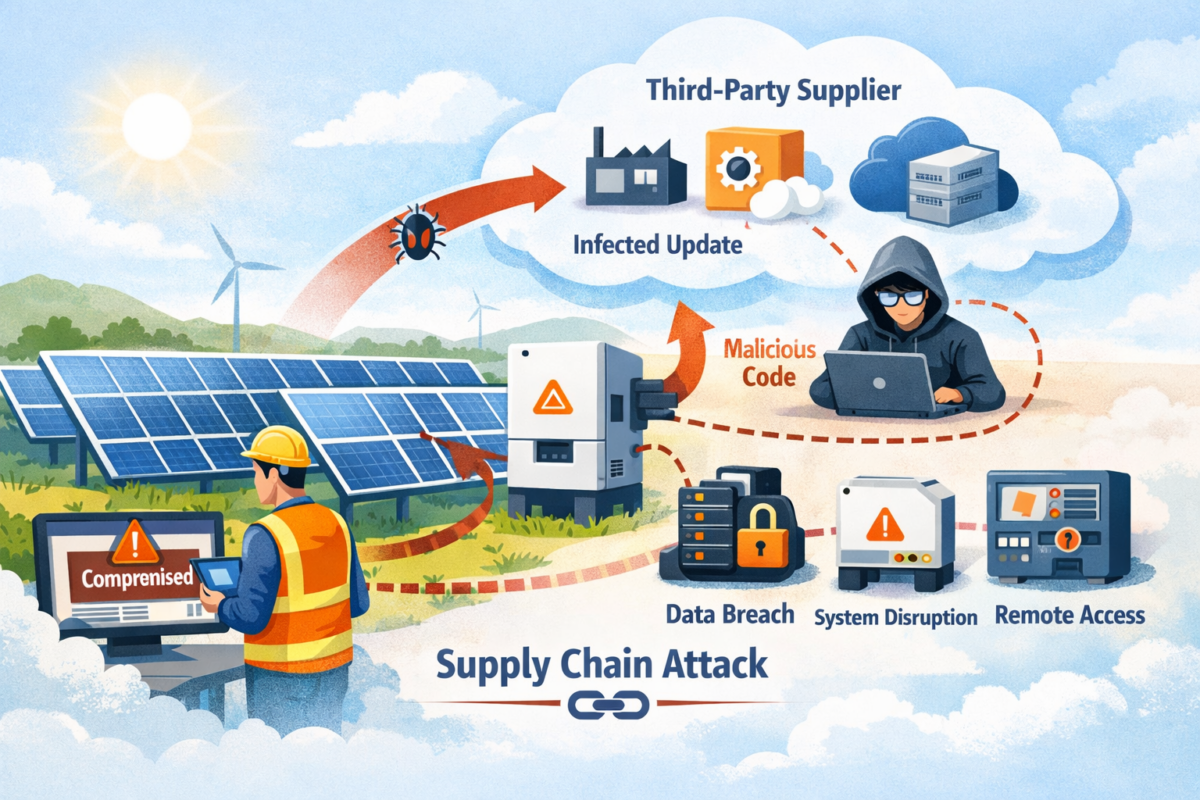
Supply chain cyber attacks are a major category of threats that affect digital and cyber-physical systems that rely on a network of third-party suppliers, manufacturers and service platforms. In PV environments, where systems rely on inverters, monitoring software, firmware updates and cloud services from third-party providers, these attacks can undermine trust in the entire ecosystem.
These attacks involve inserting malicious code, backdoors or vulnerabilities into products or services before they reach the end user. Rather than attacking a PV system directly, adversaries compromise a vendor, such as a software vendor, equipment manufacturer, or service partner, and use that trusted relationship to gain access. As a result, operators may unknowingly deploy compromised components within their infrastructure.
Supply chain attacks can target PV systems and solar power plants by using firmware updates for inverters, software updates for monitoring platforms, or third-party communications gateways. Once integrated, the malicious component can enable unauthorized access, data exfiltration, or system manipulation. Because these components are trusted, such attacks can go unnoticed for a long time.
These attacks can also indirectly cause operational and physical risks by altering system behavior, disrupting communications, or introducing hidden backdoors that can be activated later. Inverters, controllers and SCADA systems can operate with compromised logic, potentially leading to instability, inefficiency or safety issues. Additionally, large-scale deployments of identical components allow a single compromised vendor to impact multiple locations simultaneously.
“Supply chain attacks are especially dangerous because they turn trusted components into attack vectors at scale,” Uri Sadot, Managing Director of SolarDefend and chair of SolarPower Europe’s Digitalization workstream, told pv magazine. “They can turn trusted suppliers into Trojans within critical infrastructure.” He added.
Operational modes
Supply chain attacks can occur at different stages of the product or service life cycle. They can occur during software development, where attackers inject malicious code into applications or updates. Alternatively, they can occur during hardware manufacturing or distribution, where components are tampered with before they are deployed. In more advanced scenarios, attackers compromise update servers or delivery mechanisms to distribute malicious payloads to many systems simultaneously.
For PV systems, a supply chain attack often starts by targeting a supplier that provides commonly used components such as inverter firmware, monitoring platforms or cloud-based services. Attackers can compromise the vendor’s internal systems, modify software updates, or insert hidden files
turning functionality into legitimate products. When operators install updates or deploy new equipment, the malicious code is introduced into the PV environment.
Common techniques in PV environments include trojanized software updates, compromised firmware, and exploitation of trusted remote maintenance tools. In distributed solar farms, attackers can leverage centralized update mechanisms to affect multiple installations simultaneously, increasing the impact.
Once the attack is active, operators may not immediately detect problems because the affected components appear legitimate. Over time, signs of this may include unusual system behavior, unexplained data anomalies, or unauthorized communications with remote servers. In many cases, detection only occurs after significant impact or through external disclosure.
Defense
One possible defense against supply chain attacks in PV systems is to implement strict supplier risk management practices, including security assessments and verification of supplier integrity. Operators must ensure that vendors follow secure development practices and provide transparency in their security controls.
Code signing and verification mechanisms are also critical to ensure that software and firmware updates are authentic and have not been tampered with. Regular integrity checks can help detect unauthorized changes to system components.
Network segmentation can limit the impact of compromised components by isolating critical systems such as inverters, SCADA platforms and monitoring tools. This reduces the ability of malicious code to spread throughout the environment.
Continuous monitoring and intrusion detection systems (IDSs) can help identify abnormal behavior originating from trusted components, such as unexpected communications or unusual system activity. However, to be effective, these tools must be combined with threat intelligence and automated response capabilities.
Maintaining an inventory of all hardware and software components (asset management) is also essential so that operators can quickly identify and respond to vulnerabilities or compromised suppliers.
Overall, supply chain attacks pose a serious risk to PV systems, particularly affecting their integrity, reliability and operational security. By exploiting trusted vendors and components, these attacks can bypass traditional defenses and impact multiple systems simultaneously.
While measures such as vendor assessments, code verification, segmentation, monitoring and asset management can reduce risk, no control alone is sufficient. Systems should be designed with layered security, continuous component validation, and rapid response strategies.
This approach not only helps detect and contain compromised elements early, but also limits the attacker’s ability to scale their impact on interconnected PV systems.
“These attacks don’t break in – they come in through the front door. A trusted channel will be used to take them to a place where they will remain hidden until it is too late,” Sadot said.
This content is copyrighted and may not be reused. If you would like to collaborate with us and reuse some of our content, please contact: editors@pv-magazine.com.
