The latest analysis from Wood Mackenzie examines how 13 of the world’s major energy markets are being affected by the current fuel crisis, with the markets most dependent on fuel imports most at risk. The consultancy says average generation costs in these 13 markets will increase by $2.30/MWh if a de-escalation of the conflict allows a moderation in fuel prices in the second half of 2026, and rise to an average of around $8.30/MWh if current high price levels persist throughout the year.
The Middle East crisis has divided global energy markets into winners and losers, according to the latest analysis from Wood Mackenzie.
The consultancy’s latest insight, The Great Power Divide, details how thirteen energy markets – Brazil, China, France, Germany, India, Italy, Japan, South Korea, Spain, Thailand, the US, Britain and Vietnam – are being affected by the ongoing crisis. Since the beginning of the conflict In Asia, spot LNG prices have risen 94%, while coal prices have risen 17-31%.
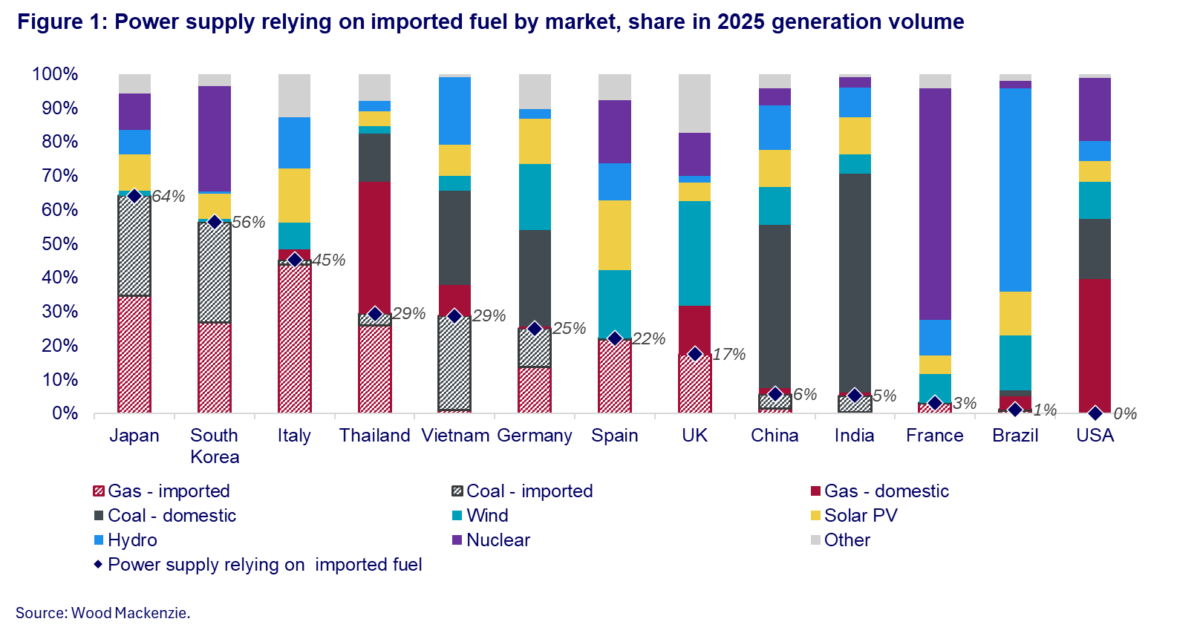
Wood Mackenzie found that the countries most dependent on fuel imports are at greatest risk of significant cost escalations and potential supply constraints. Japan is the most vulnerable of the energy markets studied, with 64% of electricity generation dependent on imported coal and gas, followed by South Korea with 56% and Italy with 47%.
In contrast, the US and Brazil showed minimal vulnerability, at 0-1%. Along with China and India, these countries are considered more isolated due to their domestic sources of fossil fuels and renewable energy sources, such as Brazil’s hydropower-dominated generation mix.
At the request of pv magazine If renewables could help ease the situation for the countries hardest hit by the crisis, Xizhou Zhou, Executive Vice President and Global Head of Power and Renewables for Wood Mackenzie, said investments in non-fossil energy sources will take time to translate into meaningful changes in the generation mix.
“For example, after a decade of phenomenal growth in renewables, China still sources 56% of its energy from coal and gas, compared to a 68% share in 2015,” Zhou explains.
Zhou added that while renewables are an important part of the solution, many of the markets analyzed, such as Japan, South Korea and Germany, have or had large nuclear fleets that could protect them from fossil fuel market shocks.
“Germany has chosen to close them all. Japan is still struggling to close nuclear power plants after Fukushima and South Korea’s previous governments also planned to shut down nuclear power plants, although the current government is much friendlier,” he said.
Zhou also told it pv magazine that demand side management should not be underestimated.
“For example, after the Fukushima accident, Japan shut down all its nuclear capacity to generate 30% of its energy, while coal and gas ramped up to help fill the gap. Demand-side measures were introduced – including making short-sleeved shirts acceptable in business environments in the summer to reduce demand for AC power – and power consumption never recovered to pre-Fukushima levels,” he explained.
The latest analysis from Wood Mackenzie adds that the average cost of power generation is likely to increase by $2.30/MWh in the 13 markets analyzed under the base case, which assumes that geopolitical de-escalation will allow a moderation in fuel prices in the second half of 2026.
In the case of high fuel price sensitivity, assuming current high price levels continue until 2026, average generation costs would increase by 26% on average to approximately $8.30/MWh. For the most affected markets, average generation costs would rise to $22.40/MWh in Italy, $17.00/MWh in Japan and $14.40/MWh in South Korea.
Allen Wang, vice president of Asia Pacific Power and Renewables Research for Wood Mackenzie, said these cost increases would represent significant policy challenges that would require governments and utilities to make difficult trade-offs between financial support mechanisms, regulatory interventions and retail tariff adjustments.
“For emerging markets with limited budget capacity, higher fuel costs also translate into greater reliability risks as securing incremental fuel supplies becomes increasingly challenging. during periods of market tightness,” Wang added.
This content is copyrighted and may not be reused. If you would like to collaborate with us and reuse some of our content, please contact: editors@pv-magazine.com.
Popular content