

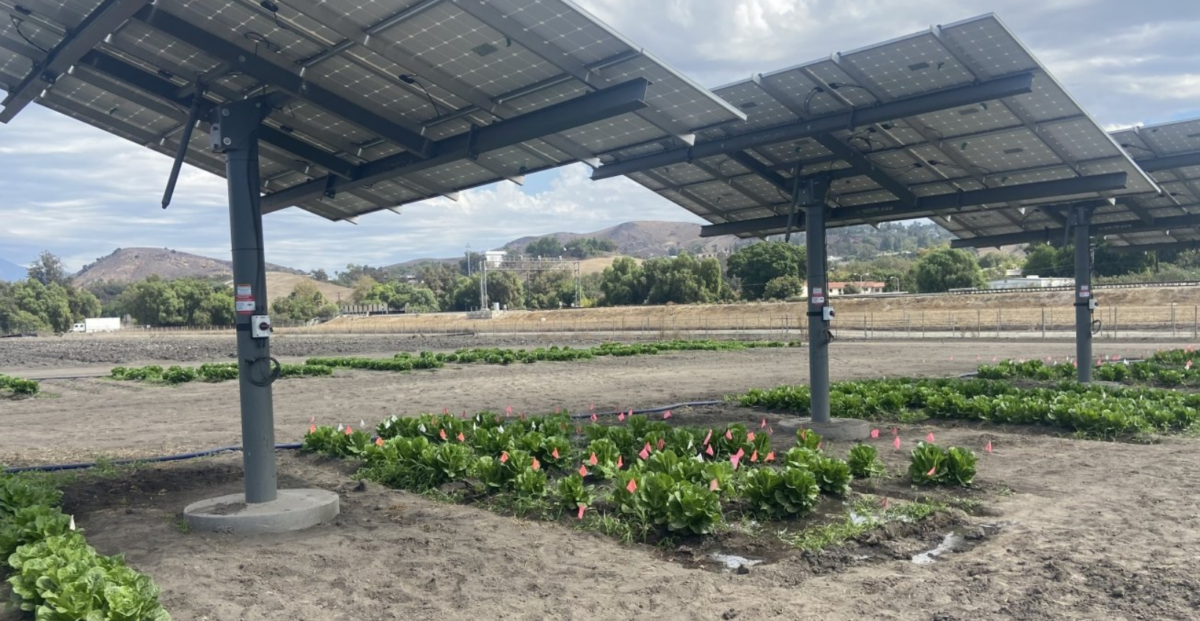
US researchers are testing regenerative agrivoltaic systems on a farm in Southern California, combining solar panels with soil-healing practices such as composting, cover crops and no-till farming to improve crop yields, soil health and water use efficiency. The pilot will evaluate the technical, environmental and economic feasibility and explore how this land sharing approach can optimize food and energy production, reduce irrigation needs and inform large-scale implementation and policy frameworks.
Researchers at Pitzer College in the United States have proposed combining regenerative agriculture with agrivoltaic energy in an effort to maximize the benefits of both activities.
Regenerative agriculture is an agricultural approach that revitalizes soils, ecosystems and communities and goes beyond simply sustaining production. It improves and enriches the land over time through practices such as cover crops, no-till agriculture and rotational grazing, which restore soil health and increase biodiversity. Techniques such as agroforestry, composting and polycultures further strengthen ecosystems, creating a system that nourishes soils, supports communities and produces sustainable food.
“Regenerative agricultural voltaics does not necessarily require higher capital expenditures than conventional agricultural voltaics,” said the study’s lead author Kevin B. Grell, pv magazine. “In fact, regenerative practices tend to replace capital inputs with labor inputs. In regions where ambient heat reaches a point where panel efficiency is affected, regenerative land management practices can actually contribute to greater ambient cooling than conventional practices, increasing PV output and in turn reducing levelized energy costs (LCOE).”
“Different regions face different challenges in food and energy production,” said co-author Sophie Parker added. “For example, hot and dry regions face challenges related to crop irrigation. Rainy regions face challenges related to maximizing the efficiency of electricity production from PV sources, given limited sunlight. Locations closer to the poles experience greater seasonal fluctuations in day length, meaning crop production is seasonally limited, and the tilt of solar panels requires more seasonal adjustment. Deploying regenerative agriculture could be used to address some of these challenges to address these challenges, but the details of how a particular regenerative agrivoltaic site can be adapted to address these challenges will be region-specific.”
Come to the on March 5 Double harvest, double problems: addressing EPC barriers in the design of agrivoltaic systems pv magazine session in English at KEY – The Energy Transition Expo in Rimini.
Experts will share insights on current agricultural voltaic technologies, key design choices and key barriers to standardized, scalable dual-use projects in Europe and Italy, including region-specific EPC issues.
In Southern California’s Inland Empire, The Nature Conservancy and Pitzer College are part of a collaborative group led by the Robert Redford Conservancy that has established a regenerative agrivoltaic site at California Polytechnic University on Pomona’s Spadra Farm. Growing season conditions at this location are hot and dry.
“There we have the opportunity to study how the regenerative agricultural practice of compost addition, coupled with the deployment of PV, could improve soil moisture and potentially reduce the need for irrigation. While the addition of compost alone, or the shade that PV alone provides, can each provide a water savings benefit, it will be interesting to see what happens when these two practices are combined. In locations where crop growth does not require irrigation, there may be other benefits that come from regenerative agrivoltaic energy,” emphasized Grell.
He also explained that no PV configuration is inherently incompatible with regenerative agriculture. “Whether it is the usual fixed-tilt or single-axis tracking, over the horizontally placed ‘fence-like’ structures to the canopies used in viticulture, there appear to be no limitations due to the regenerative practices. It is more a matter of certain mounting geometries being better suited than others, if the agricultural function involves the integration of livestock. But that will also be the case with conventional solar grazing systems.”
Grell also emphasized that regenerative agriculture often replaces chemical and mechanical inputs with biological processes and labor management, making regenerative agricultural voltaic systems more labor intensive. “In arid and semi-arid areas such as Southern California, the shading of the panels can provide an additional benefit to farm workers, enabling forms of highly labor-intensive agriculture in areas where heat exposure would otherwise make such agricultural models impossible,” he also stated.
In the study “Regenerative agrivoltaics: Challenges and opportunities in Southern California’s Inland Empire region”, published in Energy nexusGrell and his colleagues presented the demonstration site and explored the challenges and opportunities of implementing regenerative agricultural voltaics as a land sharing strategy.
The site features six 2.4m steel columns, each supporting twelve solar panels, suitable for both solar energy optimization and access to agricultural machinery, with the energy stored in a 5.12 kWh mobile battery. The project includes agricultural voltaic and control blocks, with subplots managed using regenerative and conventional practices in a randomized design. There, the researchers will investigate how shading combined with regenerative agriculture affects crop yields, soil health, water use efficiency and economic viability, with data collected on soil chemistry, microbial life, pollinators, water infiltration, crop production and energy production.
The project evaluates the technical, ecological and economic feasibility and at the same time forms the basis for large-scale experiments and policy frameworks. Future research should examine real-world economic performance, system design, and scale-dependent effects, including water, soil, and microbial responses.
“While large-scale experiments are needed to reveal hidden or muted synergistic effects and verify the generalizability of pilot projects, they also have important implications for the social sciences,” the research group concluded. “Determining economic variability at the agribusiness level involves estimating initial investment requirements, ongoing fixed and variable costs, as well as the revenues generated from the system.”
This content is copyrighted and may not be reused. If you would like to collaborate with us and reuse some of our content, please contact: editors@pv-magazine.com.
Popular content
