

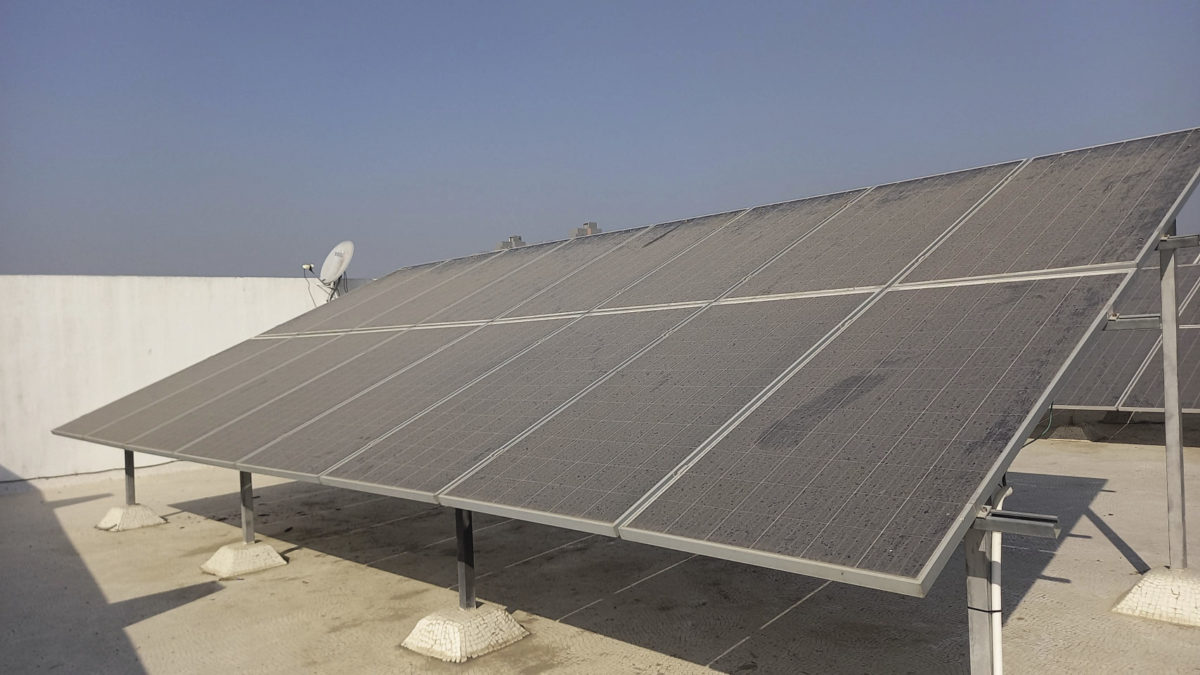
Scientists in Peru have proposed a standalone, deployable system that quantifies energy losses due to dust build-up on PV modules. It uses both artificial neural networks and electrical models for predicting pollution loss.
Researchers from Peru have developed a standalone, deployable system that can reportedly quantify energy losses due to dust build-up on PV arrays before deployment.
The proposed approach combines methods from neural networks and incremental guidance, which is one of the most widely used maximum power point tracking (MPPT) techniques due to its simplicity and low implementation complexity.
“This system facilitates pollution analysis before implementation and during operation of PV systems. It can take into account spatial inhomogeneities of dust accumulation and the long-term degradation of PV modules through recalibration and retraining,” the scientists explained. “The proposed system integrates an artificial neural network (ANN), an electrical model and MPPT based on incremental conduction. This combination makes it possible to estimate daily energy losses due to pollution in a PV array with minimal maintenance requirements.”
The proposed method was tested on a system with a 5W monocrystalline silicon PV test module, a DC-DC single-ended primary induction converter (SEPIC), a pyranometer, module temperature sensors and a computer with a 28 nm ARM Cortex-172 processor. which manages the ANN. In addition to the ANN predictions, the group tested the system using an electrical model that uses iterative solutions, meaning that the calculation is repeated several times until a good result is obtained. Both systems use measured solar radiation and temperature as input.
The tests took place between September 2020 and September 2021, with the PV module being cleaned once a month. The first month’s data was used to train the ANN model, using 14,000 measurements in 150 iterations. The electric model, on the other hand, did not require any training as it is based only on the measured data and the PV specifications.
“Both models showed similar performance in estimating the energy yield of a clean PV module, with the ANN model demonstrating lower computational costs,” they said. “The ANN model also showed slightly better accuracy, with a mean absolute percentage error (MAPE) of 0.5% compared to 0.6% for the electric model. These results indicate that while both models are effective, the ANN model offers advantages in terms of computational efficiency and adaptability for retraining to compensate for module degradation in the long term.”
The results of the one-year tests showed that with a monthly cleaning schedule, energy loss due to contamination fluctuated between 4% and 7% for most months. Increased losses of up to 10% were recorded in construction activities in the area in months. “Our findings demonstrate the system’s ability to accurately predict performance loss due to pollution without the need for a full installation of the PV system,” the researchers pointed out.
Concluding their work, they added that “the Incremental Neuroconductance system provides a robust and flexible solution for quantifying pollution losses in PV modules, contributing to more effective maintenance schedules and improved PV plant performance.”
The system was presented in “Incremental neuroconduction to analyze performance losses due to pollution in photovoltaic generators”, published in Energy reports. The research was conducted by scientists from Peru’s National University of San Agustín and the Pontifical Catholic University of Peru.
This content is copyrighted and may not be reused. If you would like to collaborate with us and reuse some of our content, please contact: editors@pv-magazine.com.
