

Find better photovoltaic materials faster with AI
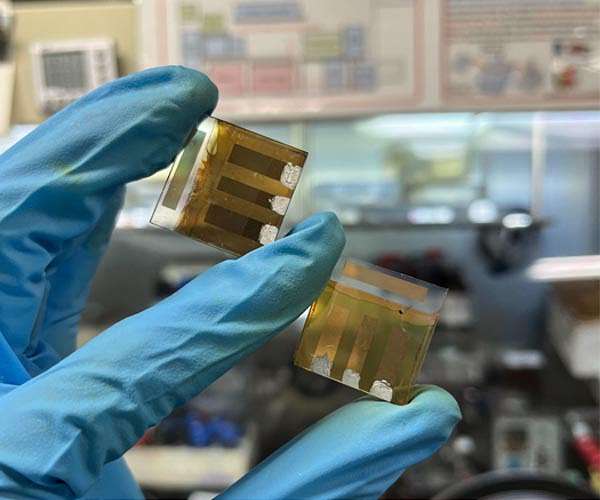
Researchers from the Karlsruhe Institute of Technology (KIT) and the Helmholtz Institute Erlangen-Nurnberg (Hi Ern) have developed a new AI-driven workflow that drastically accelerates the discovery of high-quality materials for Perovskiet solar cells. By synthesizing and testing only 150 targeted molecules, the team achieved results that usually require hundreds of thousands of experiments. “The workflow that we have developed will open new ways to discover quickly and economically high -quality materials for a wide range of applications,” said Professor Christoph Brabec of Hi Ern. One of the newly identified materials improved the efficiency of a reference solar cell by around two percentage points and reached 26.2 percent.
The research started with a database that contained the structural formulas of about a million virtual molecules, which can be synthesisable from commercially available connections. 13,000 molecules were randomly selected from this pool. KIT -researchers have applied advanced quantum mechanical methods to evaluate important properties such as energy levels, polarity and molecular geometry.
Training AI with data from 101 molecules
From the 13,000 molecules, the team 101 chose the most diverse features for synthesis and tests at Hi Ern’s Robotic Systems. These molecules were used to manufacture identical solar cells, making precise comparisons of their efficiency possible. “The possibility of producing similar samples through our highly automated synthesis platform was crucial for the success of our strategy,” Brabec explained.
The data obtained from these initial experiments were used to train an AI model. This model then identified 48 extra molecules for synthesis, aimed at those predicted to offer high efficiency or to show unique, unforeseen properties. “When the Machine Learning model is uncertain about a prediction, synthesizing and testing the molecule often leads to surprising results,” said the Pascal Friederich venue of Kit’s Institute or Nanotechnology.
The AI-led workflow made the discovery of molecules that are able to produce solar cells with above-average efficiency, which exceeds some of the most advanced materials that are currently in use. “We can’t be sure that we have found the best molecule of a million, but we are certainly close to the optimum,” Friederich noted.
Ai versus chemical intuition
The researchers also gained valuable insights into the decision -making process of the AI. The AI identified chemical groups, such as Amines, associated with a high efficiency, but overlooked by traditional chemical intuition. This possibility underlines the potential of AI to discover previously non -recognized opportunities in material science.
The team believes that their AI-driven strategy can be adjusted for a wide range of applications beyond perovskite solar cells, including the optimization of full device components. Their findings were achieved in collaboration with scientists from Fau Erlangen-Nurnberg, Ulsan National Institute of Science, the Xiamen University and University of Electronic Science and Technology of South Korea and the Chinese University of Chinese and the University of Electronic Sciences. The research was published in the Journal Science.
Research report:Inverse design of molecular gap-transporting semiconductors tailor-made for perovskite solar cells
