

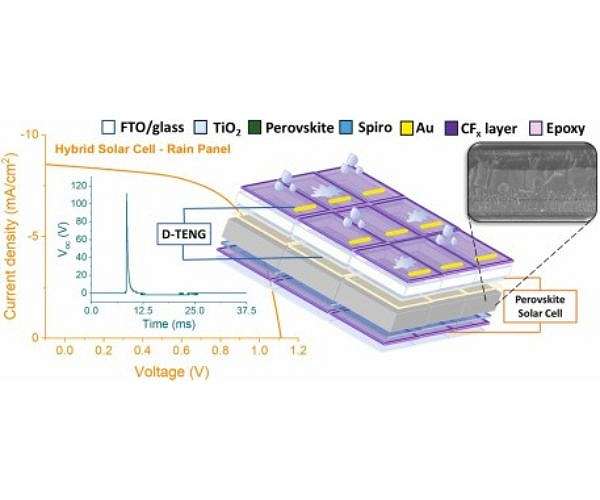
A team from the Institute of Materials Sciences of Seville, a joint center of the Spanish National Research Council and the University of Seville, has developed a hybrid energy harvesting device that can simultaneously generate electricity from both sunlight and rain. The concept is based on a thin multifunctional film that protects perovskite solar cells from harsh environmental conditions, while a triboelectric nanogenerator can capture the kinetic energy of raindrops as electrical output.
The work focuses on halide perovskite solar cells, which are photovoltaic devices made of synthetic materials with a crystalline structure and strong light-absorbing properties. While silicon remains the dominant solar cell technology, perovskites are attracting attention because they can deliver high conversion efficiency at a potentially lower cost, but they suffer from degradation and instability when exposed to humidity, temperature cycles and other environmental factors.
To address these weaknesses, the researchers used plasma technology to create and deposit a protective coating about 100 nanometers thick directly on the perovskite cells. This ultra-thin film acts as an encapsulant that chemically shields the perovskite layer and improves optical response, improving the cells’ ability to absorb incoming light and maintaining performance over time.
At the same time, the film is designed with a triboelectric surface that generates an electric charge when bumped or rubbed, converting the movement of raindrops into usable electric current. In the team’s tests, the hybrid coating enabled nanogenerators to produce more than 100 volts from a single water droplet impact, with reported peak values around 110 volts per droplet, which is sufficient to power small portable electronics under laboratory conditions.
According to the researchers, the coatings can be produced in a scalable manner using sustainable plasma processes, and have demonstrated remarkable stability even in extreme environments, such as long-term immersion in water. The hybrid devices have also been shown to continuously power simple electronic loads, including light-emitting diode circuits, while helping perovskite solar panels withstand fluctuations in humidity, which typically undermines long-term operation.
“Our work proposes an advanced solution that combines photovoltaic technology of perovskite solar cells with triboelectric nanogenerators in a thin-film configuration, demonstrating the feasibility of implementing both energy harvesting systems,” says ICMS researcher Carmen Lopez. By integrating the photovoltaic and triboelectric functions into a single coating, the architecture aims to provide power regardless of whether conditions are sunny, cloudy or rainy.
The team sees the technology as a response to the limitations of conventional batteries and the reduced efficiency of solar panels during cloudy or rainy periods. Their hybrid solar-rain approach is designed to provide a higher degree of energy autonomy for portable and wireless electronic devices, allowing continuous operation as environmental conditions change.
The authors say the device concept has broad potential across the Internet of Things sector, from environmental sensors that monitor humidity, rain or pollution, to structural sensors embedded in bridges and buildings, as well as weather stations and precision farming systems. In these scenarios, autonomous energy sources that utilize multiple energy flows from the environment could reduce the need for battery replacement or wired connections.
“Its implementation in so-called smart cities is feasible, such as in signage, autonomous auxiliary lighting or monitoring, because it can withstand adverse weather conditions and the presence of rain, humidity and thermal cycles. It would also be applicable for distributed energy structures in remote, inaccessible or isolated areas, such as maritime stations,” said ICMS researcher Fernando Nunez. The hybrid coating concept could therefore support both urban infrastructure and remote installations where maintenance is difficult.
The authors describe their thin-film triboelectric-coated modules as hybrid solar-rain panels, or rain panels, that can harvest energy from different environmental sources through a single surface. They see plasma-deposited coatings as a multifunctional strategy that protects both sensitive energy devices and layers in additional harvesting opportunities without major changes to the underlying cell architecture.
Research report:Waterproof hybrid perovskite solar cell – droplet triboelectric energy harvester
