

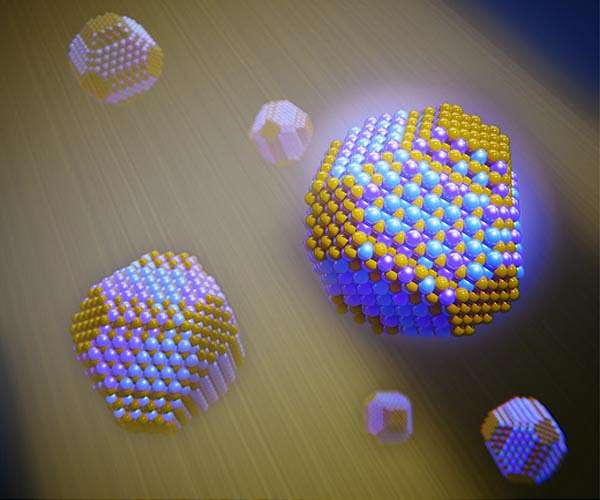
Liquid Crystal Antisolvent produces consistent nanocrystals
A Research Team from Postech led by professors Young-Ki Kim and Yong-Young Noh has introduced an innovative approach for the manufacture of Perovskite nanocrystals (PNCs), important semiconductor materials for applications of the next generation. The new method achieves remarkable uniformity and efficiency, promises to overcome long -term challenges in conventional synthesis and to increase the commercialization of opto -electronic devices such as LEDs and solar cells.
The research was conducted by professors Young-Ki Kim and Yong-Young Noh from the Chemical Engineering department in Postech, in collaboration with Ph.D. Candidate Jun-Hyung IM, Dr. Myeonggeun Han from Samsung Electronics and Dr. Jisoo Hong from Princeton University. Their findings have been published in ACS Nano, a valued international magazine in the field of nanotechnology.
PNCs offer considerable potential for advanced solar cells and highly efficient displays because of their adjustable light absorption and emission, which can be adjusted precisely by particle size and shape by the quantum limitation effect. Traditional methods such as hot injection and ligand-assisted reprecipitation (LARP) often produce particles with inconsistent dimensions due to high synthesis temperatures and complicated experimental setups. This inconsistency often requires extra processing, reducing overall productivity and limiting industrial applications.
To tackle these problems, the Postech team has adjusted the LARP technique by replacing the conventional anti -volvent with a liquid crystal (LC). Liquid crystals have both liquid -like mobility and crystal -like molecular order, aligned along a preferred direction defined by a director to generate elastic forces. When external tension is exercised, these forces reorient the molecules and produce significant elastic tribes. By maintaining all other synthesis circumstances while the anti-volvent was replaced by LC, the researchers controlled the growth of PNCs so that their expansion was stopped when the extrapolation length (?) Of the liquid crystals, which made large-scale production without extra treatment steps possible.
Further analysis revealed that the interaction between Liganden attached to the PNC surfaces and the rod-like LC molecules improves ligand gasket. This denser arrangement minimizes surface errors and significantly improves the luminescence properties of the nanocrystals.
Professor Young-Ki Kim explained: “The synthesem method developed by our research team is very compatible with existing synthesis techniques, such as ligand exchange and microfluïdic synthesis, and will improve the performance of various opto-electronic devices, including LEDs, solar cells, lasers and photo detectors.” He also stated: “This technology makes the large-scale production of uniform, powerful nanocrystals possible at room temperature and we expect it will help accelerate the commercialization of opto-electronic devices based on Nanokrystal.”
Financing for this research was provided by the Basic Research Program (Hanwoomul-Phagi Basic Research) and the Pioneer program for promising future convergence technology of the National Research Foundation of Korea (NRF).
Research report:Controlled synthesis of perovskiet nanocrystals at room temperature by liquid crystalline templates
