
Close Menu
  • News
  • Industry
  • Solar Panels
  • Commercial
  • Residential
  • Finance
  • Technology
  • Carbon Credit
  • More
    • Policy
    • Energy Storage
    • Utility
    • Cummunity
What's Hot

Fraunhofer ISE develops colored film technology for patterned solar panels

April 23, 2026

Thermoacoustic heat pumps are on the verge of commercial breakthrough – SPE

April 23, 2026

The federal court has halted Trump administration orders that hinder solar and wind energy development

April 23, 2026
Facebook X (Twitter) Instagram
Solar Energy News
Thursday, April 23
  • News
  • Industry
  • Solar Panels
  • Commercial
  • Residential
  • Finance
  • Technology
  • Carbon Credit
  • More
    • Policy
    • Energy Storage
    • Utility
    • Cummunity
Solar Energy News
Home - News - Research shows that the efficiency of hot-carrier solar cells has improved
News

Research shows that the efficiency of hot-carrier solar cells has improved

solarenergyBy solarenergySeptember 25, 2024No Comments3 Mins Read
Facebook Twitter Pinterest LinkedIn Tumblr Email
Share
Facebook Twitter LinkedIn Pinterest Email

Research shows that the efficiency of hot-carrier solar cells has improved


Hot-carrier solar cells, first proposed decades ago, have been a major focus in surpassing the Shockley-Quisser efficiency limit in single-junction solar cells. Despite their theoretical advantages, these cells have faced significant challenges, especially in rapidly extracting hot electrons across material interfaces.

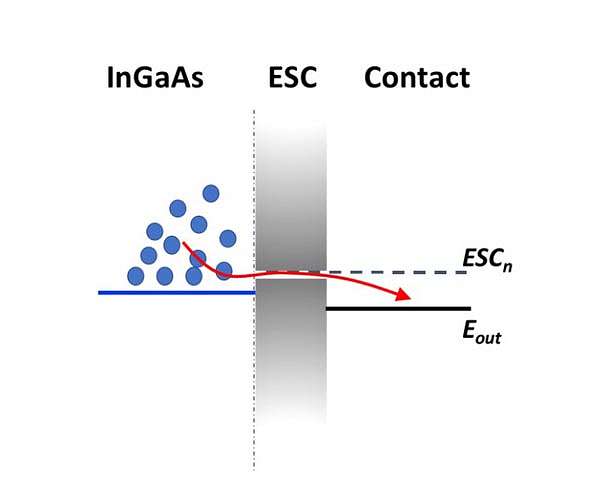
Recent studies have explored the use of satellite valleys in the conduction band to temporarily store hot electrons before extraction. However, a parasitic barrier at the interface between the absorber and extraction layers has posed a major obstacle. This barrier complicates electron transfer, which takes place in real space rather than in momentum space. When the energy bands between materials are not perfectly aligned, electrons bypass the barrier through a tunneling process, which is influenced by complex band structures.

In a new study published in the ‘Journal of Photonics for Energy (JPE)’, researchers examined volatile states and their impact on electron tunneling using an empirical pseudopotential method. This approach helped calculate energy bands in momentum space and aligned them with experimental data, providing valuable insights into the mechanics of hot carrier extraction between valley states and between material interfaces.

The research provides a deeper understanding of tunneling processes and could lead to more efficient hot carrier solar cells, potentially breaking the efficiency limits of current solar technologies.

The study specifically highlighted that the tunnel coefficient, which measures how easily electrons move through the barrier, is exponentially large in indium-aluminum-arsenide (InAlAs) and indium-gallium-arsenide (InGaAs) structures due to mismatched energy bands. Even mild interfacial roughness – just a few atoms thick – can severely hinder electron transfer, consistent with observed performance issues in experimental devices using these materials.

See also  Investments in off-grid solar energy will fall by 43% in 2023 – SPE

However, the situation improves with aluminum-gallium-arsenide (AlGaAs) and gallium-arsenide (GaAs) structures. In these systems, aluminum in the barrier drives degeneration in lower energy satellite valleys, leading to better energy band alignment and more efficient electron transfer. The tunnel coefficient in AlGaAs/GaAs structures can be as high as 0.5 to 0.88 depending on the aluminum composition, indicating a significantly more efficient transfer process.

These findings indicate the potential for solar photovoltaics in the valley, which could enable solar cells that exceed current efficiency limits by one bandgap. In high electron mobility transistors made of AlGaAs/GaAs, electron transfer from AlGaAs to GaAs is common, but hot carriers in GaAs can also gain enough energy to return to AlGaAs – a process known as real-space transfer. Although this process is usually undesirable in transistors, it is beneficial for solar photovoltaics in valleys, where efficient storage and transfer of hot carriers are crucial.

Research report:On the use of complex band structure to study solar photovoltaics in valleys: towards efficient hot carrier extraction


Source link

cells efficiency hotcarrier improved Research shows solar
Share. Facebook Twitter Pinterest LinkedIn Tumblr Email
solarenergy
  • Website

Related Posts

Fraunhofer ISE develops colored film technology for patterned solar panels

April 23, 2026

The federal court has halted Trump administration orders that hinder solar and wind energy development

April 23, 2026

Solar energy’s rebound effect could increase European electricity demand by 5% by 2050 – SPE

April 23, 2026
Leave A Reply Cancel Reply

Don't Miss
Solar Industry

Improving the performance of the Dual-Axis Solar Tracker with new optimization techniques

By solarenergySeptember 24, 20250

Researchers in India have developed two optimization techniques for ZonnetRacker, can increase the power generation…

Root-Power submits construction applications for 210MW BESS

September 10, 2024

UK Study means that space-based solar energy can supply 80% of the needs of renewable energy in Europe-PV Magazine International

September 2, 2025

Fotovoltaic modules test in the summer of Antarctica – PV Magazine International

March 14, 2025
Stay In Touch
  • Facebook
  • Twitter
  • Pinterest
  • Instagram
  • YouTube
  • Vimeo
Our Picks

Fraunhofer ISE develops colored film technology for patterned solar panels

April 23, 2026

Thermoacoustic heat pumps are on the verge of commercial breakthrough – SPE

April 23, 2026

The federal court has halted Trump administration orders that hinder solar and wind energy development

April 23, 2026

Zendure launches battery ranges for residential PV – SPE

April 23, 2026
Our Picks

Fraunhofer ISE develops colored film technology for patterned solar panels

April 23, 2026

Thermoacoustic heat pumps are on the verge of commercial breakthrough – SPE

April 23, 2026

The federal court has halted Trump administration orders that hinder solar and wind energy development

April 23, 2026
About
About

Stay updated with the latest in solar energy. Discover innovations, trends, policies, and market insights driving the future of sustainable power worldwide.

Subscribe to Updates

Get the latest creative news and updates about Solar industry directly in your inbox!

Facebook X (Twitter) Instagram Pinterest
  • Contact
  • Privacy Policy
  • Terms & Conditions
© 2026 Tsolarenergynews.co - All rights reserved.

Type above and press Enter to search. Press Esc to cancel.