

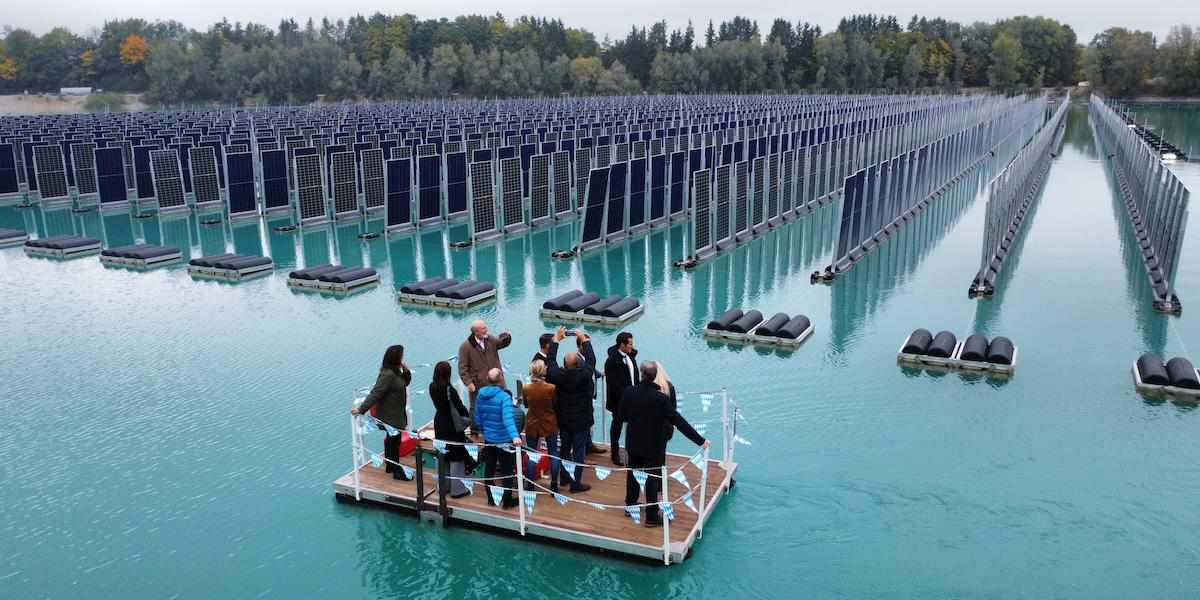
Sinn Power has deployed a 1.8 MW vertical solar panel on a quarry lake in the Bavarian municipality of Gilching. The company emphasizes the ecological benefits of the vertical system configuration and, perhaps surprisingly, its high resistance to storms.
German developer Sinn Power has announced the completion of what it claims is the world’s largest floating photovoltaic installation, featuring vertically oriented solar panels.
The company said its SKipp-Float system offers notable benefits in storm resistance. The mounting structure is designed to allow the modules to flex under wind loads via a cable system, minimizing wind resistance while providing significant stability against wave action.
The system became operational on August 21 at a gravel quarry in Gilching, Bavaria, in southern Germany, and was officially inaugurated last Friday. Bavarian Prime Minister Markus Söder was one of the main speakers. The groundbreaking ceremony in November, when some 50 modules had already been installed, had already attracted high-profile visitors, including Economy Minister Hubert Aiwanger. Sinn Power first announced the project in April last year.
Despite the relatively long implementation phase, unplanned delays were reportedly minimal. Gottfried Jais, Managing Director of Kies- und Quetschwerk Jais GmbH & Co. KG, the project partner that owns the quarry lake and uses the electricity generated for its operations, expressed its gratitude for the quick approval process during the inauguration.
According to yield forecasts, the gravel pit could reduce electricity purchases from the grid by up to 70%, with the surplus electricity supplied to the national grid.
The solar panels are arranged vertically in an east-west orientation with a row distance of 4 meters. Each SKipp-Float unit requires only a narrow, keel-like base that extends approximately 1.6 meters underwater, which the company says ensures a small footprint.
Exact figures were not provided in Sinn Power’s press release, and the Federal Network Agency’s market data register contains no entry for the site. According to Sinn Power, the floating assembly covers only 4.65% of the lake’s surface, well below the maximum of 15% allowed under the German Water Resources Act. Plans are already underway for a second phase of expansion, which would add a further 1.7 MW to the site.
In addition to the low land use, Sinn Power emphasizes other ecological benefits. The design of the system improves oxygen exchange, ensures that sunlight reaches the water surface and promotes the natural circulation of the water layers.
The company also noted that buoys installed before construction indicate that water quality has generally improved since commissioning. Nesting waterfowl have been observed on the floats, and schools of fish have gathered near the keel-like reset weights.
These reset weights mainly have a stabilizing function: if the modules tilt under wind or wave loads, the weights ensure that they return to an upright position. Sinn Power reports that the technical reliability of the patented system has been confirmed in the first weeks of use.
The company sees potential applications for its system in any year-round artificial water body with a depth of 1.6 meters or more, especially gravel pits and quarry lakes that fall under the 15% area rule of the German Federal Water Resources Act. Target users include companies with high electricity demand or planned electrification strategies.
Like other providers of vertical PV systems, Sinn Power emphasizes the favorable generation profile for both self-consumption and electricity marketing in the grid.
This content is copyrighted and may not be reused. If you would like to collaborate with us and reuse some of our content, please contact: editors@pv-magazine.com.
