
Close Menu
  • News
  • Industry
  • Solar Panels
  • Commercial
  • Residential
  • Finance
  • Technology
  • Carbon Credit
  • More
    • Policy
    • Energy Storage
    • Utility
    • Cummunity
What's Hot

Dutch solar owners asked to switch off during peak periods to ease the distribution crisis

June 7, 2026

The hydrogen flow: Toyota demonstrates its racing prototype on liquid hydrogen

June 7, 2026

Era of electrification exposing Australia’s weakest link

June 6, 2026
Facebook X (Twitter) Instagram
Solar Energy News
Sunday, June 7
  • News
  • Industry
  • Solar Panels
  • Commercial
  • Residential
  • Finance
  • Technology
  • Carbon Credit
  • More
    • Policy
    • Energy Storage
    • Utility
    • Cummunity
Solar Energy News
Home - Technology - Indium-free chalcopyrite solar cell achieves an efficiency of 12.25% – SPE
Technology

Indium-free chalcopyrite solar cell achieves an efficiency of 12.25% – SPE

solarenergyBy solarenergyNovember 14, 2024No Comments3 Mins Read
Facebook Twitter Pinterest LinkedIn Tumblr Email
Share
Facebook Twitter LinkedIn Pinterest Email

Japanese scientists have developed a wide bandgap chalcopyrite solar cell that can reportedly achieve high open-circuit voltage and fill factor values. The device is intended for use in top cell applications in tandem devices.

November 14, 2024
Emiliano Bellini

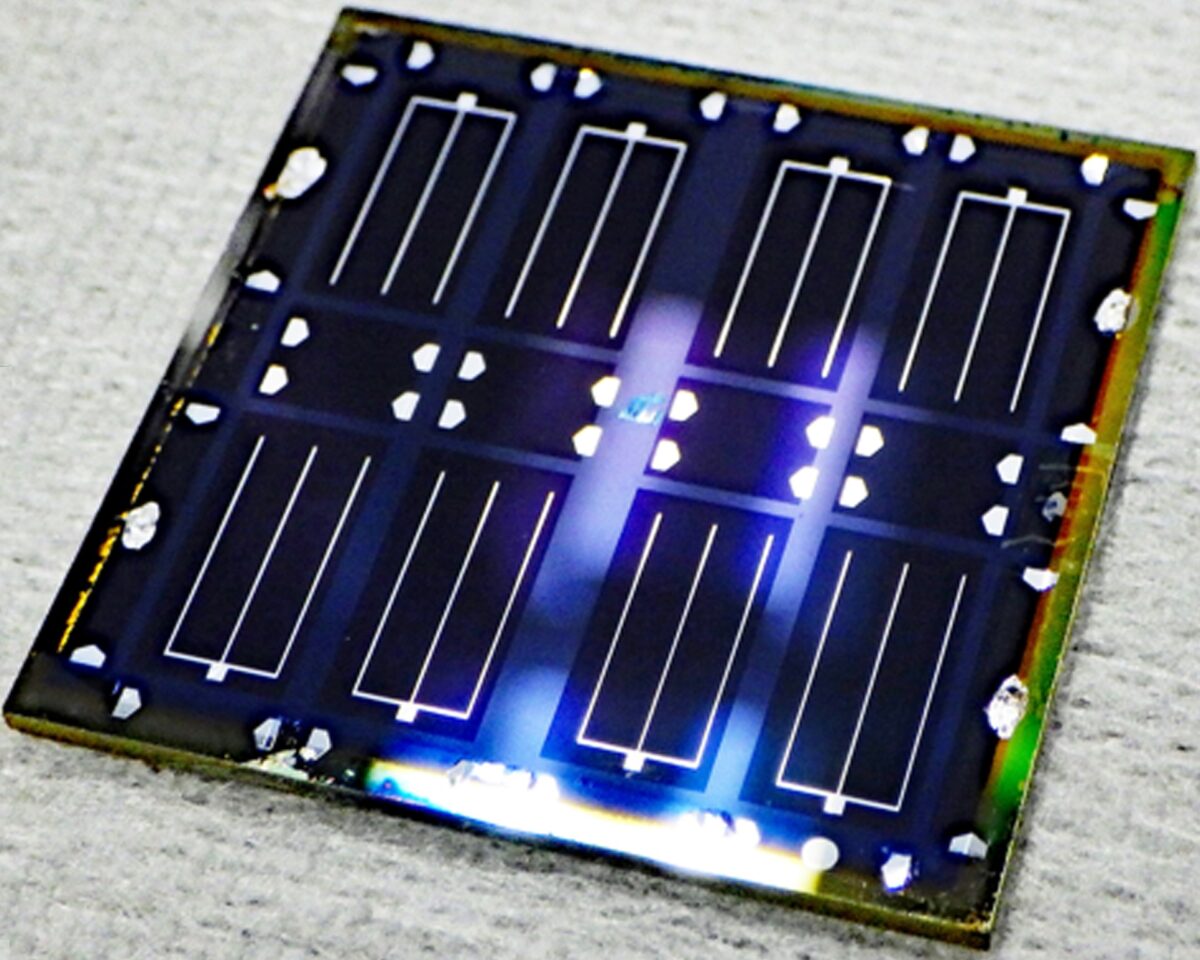
Scientists at the National Institute of Advanced Industrial Science and Technology (AIST) in Japan have fabricated a wide bandgap thin-film solar cell based on an indium-free chalcopyrite (CuGaSe2 or CGSe) absorber.

CuGaSe2 has an energy band gap of 1.7 eV. It has so far been used in solar cells with a limited fill factor and no-load voltage. “We used techniques that can achieve simultaneous achievement of high open-circuit voltage and fill factor values,” says the study’s lead author, Shogo. Ishizukatold pv magazine. “Our large opening chalcopyrite cell could be used for top cell applications in tandem devices.”

In its previous studies, the research group emphasized the incorporation of aluminum (Al) into CuGaSe2 thin films led to deterioration rather than improvement in solar cell performance. However, it turned out that THe incorporation of a very small amount of aluminum (Al) into the rear region of CuGaSe2 films are effective in improving open circuit voltage, fill factor and cell efficiency. “This result is mainly due to the formation of a back-surface field (BSF) that enhances the collection of minority carriers,” the report said.

The academics built the cell with a substrate of soda lime glass (SLG) covered with molybdenum (Mo)a back contact, an indium-free chalcopyrite absorber, a 110 nm cadmium sulfide (CdS) buffer layer, a window layer of zinc oxide (ZnO), and a grid electrode.

See also  Supplies of clean ammonia will increase enormously, says BNEF – SPE
Schematic representation of the solar cell

Image: National Institute of Advanced Industrial Sciences and Technology (AIST)

Through standard test conditions, the scientists found that the champion cell achieved an energy conversion efficiency of 12.25%, an open-circuit voltage of 0.959 V, and a short-circuit current density of 17.64 mA cm3.–2and a fill factor of 72.5%.

“The photovoltaic efficiency of over 12% demonstrated in this study stands out as a milestone among large-aperture Ga-based (In-free) chalcopyrite solar cells,” said Ishizuka. “The Al-containing CuGaSe2 film device was stable in air, with no significant change in device properties observed for weeks, even without a protective seal.

The results have been validated by the Japan Electrical Safety and Environment Technology Laboratories (JET).

The device was introduced in the study “Enhancing the Photovoltaic Efficiency of Wide Band Gap Indium-Free Chalcopyrite Solar Cells via Aluminum-Induced Field Effect on the Back Surface”, published in ACS applied materials and interfaces.

“There is scope for further research regarding different combinations of different Al and RbF supply times and amounts, including an investigation into the effect of RbF supply during the second phase,” the research team said referring to the future directions of his work. . “Such approaches are worth exploring further to potentially further improve photovoltaic performance.”

This content is copyrighted and may not be reused. If you would like to collaborate with us and reuse some of our content, please contact: editors@pv-magazine.com.

Popular content

Source link

achieves cell chalcopyrite efficiency Indiumfree solar SPE
Share. Facebook Twitter Pinterest LinkedIn Tumblr Email
solarenergy
  • Website

Related Posts

Dutch solar owners asked to switch off during peak periods to ease the distribution crisis

June 7, 2026

Letter from China’s PV Industry: Arctech wins 2.1 GW solar deal

June 5, 2026

ComEd starts a new energy pilot with a solar rebate on the roof of a brewery

June 5, 2026
Leave A Reply Cancel Reply

Don't Miss
Energy Storage

Brazil seeks Chinese investment ahead of first large-scale battery auction – SPE

By solarenergyOctober 31, 20250

Brazil’s Ministry of Mines and Energy is looking to woo Chinese companies for its first…

Autowell -Technology reveals 0BB tool for multiple Silicon PV module technologies

March 12, 2025

E.on opens consultation on revised 25mw Coventry Solar Plans

July 8, 2025

The capacity of renewable energy could overtake natural gas by 2029

July 3, 2025
Stay In Touch
  • Facebook
  • Twitter
  • Pinterest
  • Instagram
  • YouTube
  • Vimeo
Our Picks

Dutch solar owners asked to switch off during peak periods to ease the distribution crisis

June 7, 2026

The hydrogen flow: Toyota demonstrates its racing prototype on liquid hydrogen

June 7, 2026

Era of electrification exposing Australia’s weakest link

June 6, 2026

‘Come out from behind your screen, our industry is ultimately about people’

June 6, 2026
Our Picks

Dutch solar owners asked to switch off during peak periods to ease the distribution crisis

June 7, 2026

The hydrogen flow: Toyota demonstrates its racing prototype on liquid hydrogen

June 7, 2026

Era of electrification exposing Australia’s weakest link

June 6, 2026
About
About

Stay updated with the latest in solar energy. Discover innovations, trends, policies, and market insights driving the future of sustainable power worldwide.

Subscribe to Updates

Get the latest creative news and updates about Solar industry directly in your inbox!

Facebook X (Twitter) Instagram Pinterest
  • Contact
  • Privacy Policy
  • Terms & Conditions
© 2026 Tsolarenergynews.co - All rights reserved.

Type above and press Enter to search. Press Esc to cancel.