

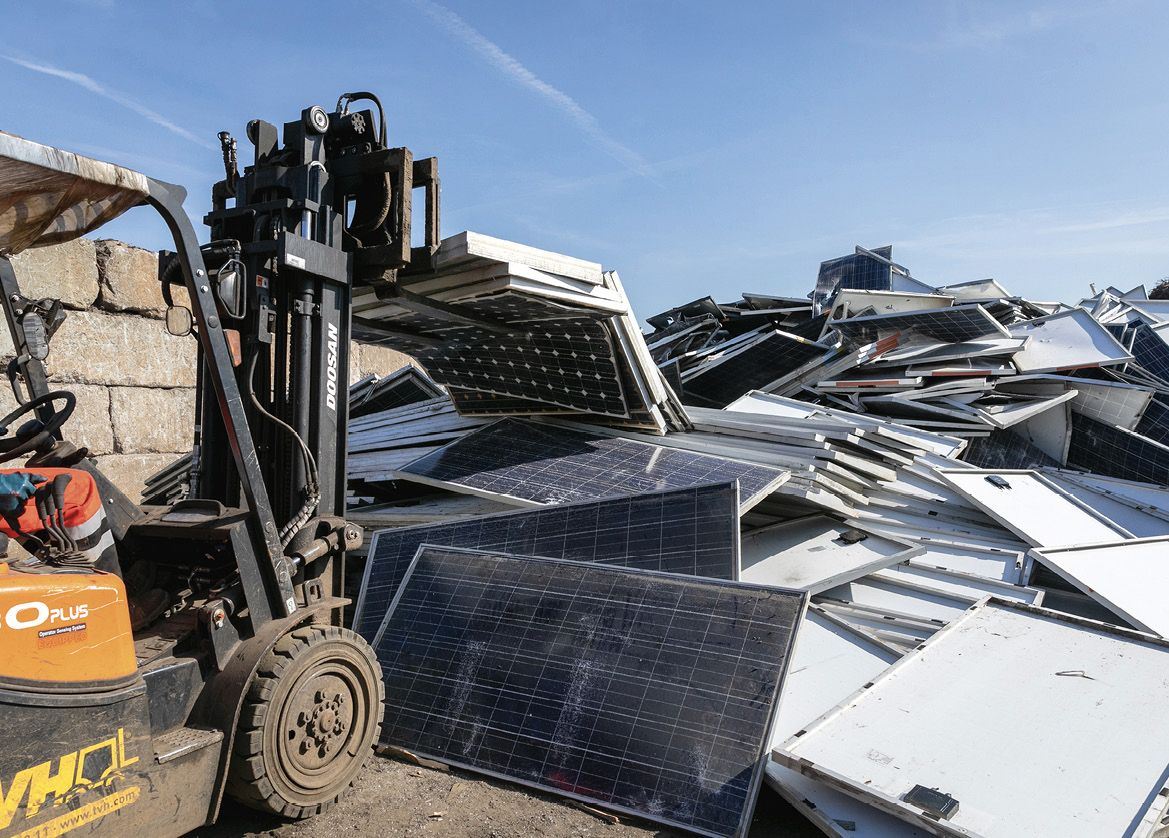
The “Status of PV module recycling in IEA PVPS Task 12 CountriesThe report provides the most detailed global assessment to date of how different regions are preparing for what could become one of the renewable energy sector’s most pressing sustainability challenges.
Europe is leading the way with a mandatory recycling framework
Europe continues to set the global standard for PV waste management through the Waste Electrical and Electronic Equipment (WEEE) Directive. The directive requires all EU member states to either operate their own take-back and recycling programs or join producer compliance schemes, setting recovery targets of 85% and recycling rates of 80%.
In 2022, European countries collected almost 50,000 tons of PV module waste from 18 countries, significantly more than previous years. Italy led with 21,500 tonnes collected, followed by Germany with 16,500 tonnes, representing the largest amount among EU countries.
This growth reflects both the growth of the European solar energy market and the increasing volumes of modules reaching the end of their lifespan. In Germany, the volume has grown significantly, with forecasts suggesting that waste volumes could reach between 400,000 and 1 million tonnes by 2030.
The recycling infrastructure is evolving to meet this demand. German business group Reiling operates what is now Europe’s largest dedicated PV recycling facility in Münster, with a capacity of 50,000 tonnes per year. Meanwhile, France’s organized system, managed by the non-profit organization Soren, processed 7,143 tonnes in 2024, achieving a recycling rate of 86.81%.
Asia Pacific markets take different approaches
Outside Europe, different countries are developing different approaches to PV waste management. Despite no specific legislation on PV waste, Japan processed an estimated 2,079 tons of module waste in 2022, of which 1,638 tons were recycled and 441 tons were reused.
The country is also moving towards a more structured approach. Japanese authorities have issued a regulation mandating the recycling of waste PV modules and setting up a payment scheme managed by an independent organization.
South Korea has taken a different approach and has introduced extended producer responsibility (EPR) regulations for PV modules from 2023. In its first year, the system exceeded expectations and recycled 688 tons, compared to the target of only 159 tons. The country has set up a network of specialized recycling companies in five regional centers with a combined capacity of 14,725 tons per year.
China, as the world’s largest PV market, faces the biggest challenge. Projections indicate that cumulative end-of-life PV module volumes could reach 1 million tons by 2030 in a regular loss scenario, or 4 million tons in an early loss scenario. Several major Chinese companies have already established recycling lines for PV modules, including State Power Investment Group and JinkoSolar.
Technological progress is aimed at restoring high value
The recycling technology landscape is constantly evolving, with research and development projects focusing on recovering high-value materials rather than just achieving high recycling rates per weight. European Union-funded projects such as PHOTORAMA and EVERPV are developing multi-stage pilot lines that can process both crystalline silicon and thin-film modules, aiming for recovery rates of 95-98% for metals.
These projects explore cutting-edge delamination approaches, including diamond wire cutting, waterjet technology and infrared lamps. The focus shifts from simple mechanical processing to chemical recovery methods that can extract highly pure materials that are suitable for reuse in new PV modules or other high-quality applications.
Japanese research, supported by NEDO, aims to achieve material recovery rates of more than 80%, while keeping net treatment costs below 3 Japanese yen per watt. Australian projects are aiming for even higher recovery rates, targeting more than 95% for silver, copper, silicon and glass.
The economic challenges remain significant
Despite technological advances, the economics of PV recycling remain a challenge. The report notes that current low volumes, limited recycling technologies, logistical challenges and underdeveloped markets for recovered materials result in “high cost, low yield scenarios” for PV module recycling.
In the United States, recycling costs can exceed $14 per module, while landfilling waste costs only $1-5. This cost disparity is one of the industry’s major barriers to sustainable end-of-life management.
As a result, companies are investing in dedicated PV recycling equipment and processes, while some are exploring mobile recycling units that can be deployed directly to decommissioning sites to reduce transportation costs.
Regulatory momentum is increasing globally
Outside the established European framework, regulatory momentum is growing globally. Australia expects to implement a mandatory product stewardship program by 2025, while several US states have adopted or are developing PV-specific end-of-life regulations.
The report identifies this regulatory evolution as crucial to the development of the industry. “Further improvement of PV EOL recycling and associated logistics and secondary market development is needed to meet future demand for materials at costs comparable to the production of virgin materials,” the authors conclude.
Looking ahead
Projections suggest that by 2050, cumulative PV module waste worldwide could exceed 200 million tons under different scenarios, and the report emphasizes that sustainable solutions require the integration of “regulatory and technological approaches” adapted to the specific conditions of each region.
Success will depend not only on developing better recycling technologies, but also on creating economic incentives, establishing collection networks and building markets for recovered materials.
The transition from today’s experimental recycling efforts to tomorrow’s industrial operations represents both a challenge and an opportunity for the solar industry. How well the industry manages this transition will have a significant impact on the long-term role of solar photovoltaics in the global energy transformation.
Author: Ignacio Landivar
Download the manual
To access the full Status of PV module recycling in IEA PVPS Task 12 Countriesyou can download the latest edition here.
About IEA PVPS Task 12
IEA PVPS Task 12 aims to quantify the environmental profile of PV systems compared to other energy technologies and address critical environmental, health, safety and sustainability issues to support market growth.
For more information, please contact the IEA PVPS Task 12 Managers: Garvin Heath and Etienne Drahi.
The views and opinions expressed in this article are those of the author and do not necessarily reflect those of the author pv magazine.
This content is copyrighted and may not be reused. If you would like to collaborate with us and reuse some of our content, please contact: editors@pv-magazine.com.
