

The NIMBY arguments against solar and storage range from the insane (solar panels suck up all the sun’s energy!) to the indisputable (projects are changing rural landscapes). Regardless of opinion, the solar and storage developer’s priority is to hear community concerns and find solutions. One obvious concern that community members may have with large-scale battery energy storage systems (BESS), especially as more and more are installed in urban areas, is their noise levels. Residents will continue to live and work near these systems long after the developer has moved to the next location.
It’s a valid concern, says Thomas Corbishley, chief consultant at an acoustics consultancy Noise monitoring services.

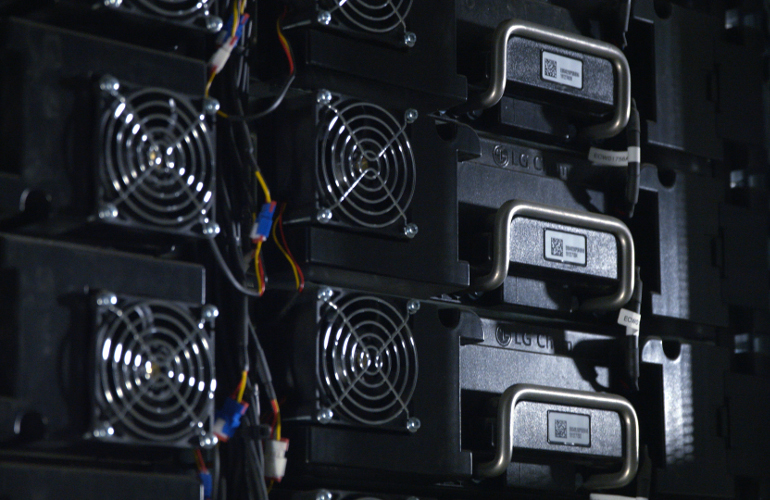
Lithium batteries at the Moss Landing Energy Storage Facility in California, showing their inner workings. Credit: Vista
“Locations using the loudest equipment can generate noise levels of 70 dBA 15 meters away from the batteries. This level is well above typical permitted noise levels for residential areas,” he said. “By comparison, highway noise is typically 70 to 80 dBA at the same distance. However, roadway noise is less disruptive because it is broadband in nature – [meaning that] the road noise is not tonal as BESS equipment can be.”
The “loudest” components of a BESS are usually the cooling systems, inverters and transformers. The cooling and ventilation system of a BESS includes noise-producing fans and pumps, which operate regularly. Solar installers are familiar with inverter noise, which is more of a consistent hum that can be noisier on a larger installation. Transformers also create a low-frequency hum that is still noticeable.
“For batteries the size of a large shipping container, we measured noise levels up to 92 dBA at 1 meter from the fans,” said Corbishley. “The fans often produce a whirring noise. These types of tonal noises can be very intrusive and annoying to people.”
But there are ways these energy storage noise makers can be designed to limit their acoustic nuisance, both during production and at the project site. The sooner noise reduction measures are taken, the more acceptable a BESS will be to a community.
A battery is only as noisy as its parts
Sharon Santhoshapplication engineer at the global BESS integrator and designer Wärtsilä energy storageQuestions about battery noise have increased in recent years.

Credit: Wärtsilä
“Five years ago, acoustic studies were incidental; now almost every project includes noise criteria,” she said. “Local authorities and local residents are becoming increasingly aware of operational noise and its effect on quality of life and community wellbeing, so noise is now a limiting factor for permits and community acceptance. We are seeing more stringent thresholds, especially for nighttime, often 30-40 dBA at the nearest house and 70-90 dBA at the unit, allowing noise modeling at an early stage is essential.”
BESS is usually loudest at night, when the batteries are actively working and cycling. This is the opposite of when other sources of environmental noise, such as road traffic, are loudest, which can increase noise.
Because Wärtsilä has some control over the production of its Quantum energy storage systems, the company can tailor acoustic performance to project requirements. For example, enclosures can be designed with high-quality wall materials and well-sealed entry points to prevent sound leaks. Santhosh said the company can also integrate silencer kits and anti-vibration materials and pads between the base and the equipment to stop mechanical noise transmission. Wärtsiläs GEMS optimization software can adjust fan speeds depending on system needs and can help reduce noise levels at different times of the day.
Corbishley from Noise Monitoring Services said these small changes can go a long way to reducing noise pollution.

Noise monitoring services that measure noise levels at a BESS location.
“We have conducted tests that show the battery fans run at 70% of their standard operating speed, reducing noise levels by 4 or 5 dBA – a noticeable reduction,” he said. “At one site we were working on, the fan speed could be reduced by up to 50%. This typically reduces noise levels by 10 to 13 dBA, which is a very significant reduction.”
The type of BESS used can also influence the noise level. The move to liquid-cooled systems means fewer fans, which reduces some noise. The duration of a system also determines its noise level, says Martin Rheault, VP of business development and sales for North American BESS integrator EVLO energy storage.
“The use case of a specific BESS project also plays a role: whether the system delivers lower power over a long period (four or eight hours) or higher power over a shorter time frame will influence cooling needs and noise levels,” he said. “The more power, the more cooling is required, and the greater the noise output.”
Rheault said the trend toward longer duration energy storage (systems that operate at intervals of more than eight hours) will also reduce noise levels.
“These systems typically operate at lower power for longer periods, which reduces the need for intensive cooling from HVAC equipment, and therefore results in a lower acoustic impact from these energy storage projects,” he said.
Be a courteous neighbor
EVLO has identified that noise requirements are just one factor increasing in the community at BESS sites, alongside fire safety, property value impacts and wildlife considerations.

EVLO systems installed in Vermont.
“The responsibility for minimizing this impact is shared between the BESS provider and the project owner,” Rheault said. “While the supplier integrates these considerations into the system design, the project owner can also plan for optimal site selection and mitigation strategies. Together, this ensures that energy storage remains a solution with a minimal footprint on surrounding communities, while optimizing the benefits of BESS as a flexible energy asset.”
Murray Stacy, vice president of Sound Fighter Systemsa supplier of outdoor sound-absorbing products used in industrial and commercial settings, said its company has been called to more BESS locations recently. Designed for maximum acoustic performance and long-term outdoor exposure, the SonaGuard system works great at reducing BESS noise on site. Instead of dealing with source-specific sounds in a battery project, the SonaGuard absorbs sound from all rooms.
“Many people were first introduced to highway noise barriers, which were traditionally sound-reflective concrete, but have now moved on to the more advanced noise barrier components found in products such as our SonaGuard barrier system,” said Stacy. “The SonaGuard sound panels are tuned to attenuate the most common frequencies associated with the noise sources at BESS sites, in addition to many other sources of outdoor noise, such as electrical substations, power generation and data centers.”
The advisors at Noise Monitoring Services have done that surveys conducted at many existing BESS projects, mainly in California and Arizona. When changes cannot be made to the manufactured product itself, Corbishley said the most common noise mitigation options his company suggests is installing sound walls such as SonaGuard from Sound Fighter Systems. Reorienting equipment to direct sound away from the nearest homes can also make a big difference. HVAC systems are typically located only on one side of a BESS so that they can be directed away from nearby homes. Additionally, increasing the space between battery units and sensitive areas can reduce perceived noise.

An example of efforts to limit noise pollution Noise monitoring services.
“Although the greatest benefit comes from limiting noise at the source, installation and site layout are crucial parts of acoustic mitigation,” says Santhosh from Wärtsilä. “Mechanical insulation between the unit and the foundation can prevent vibrations from amplifying noise. Orientation is also important by pointing transducers or vents away from nearby receptors and spacers to allow for sound propagation; overall noise exposure can be significantly reduced.”
As more BESS projects are installed across the country and in more urban environments, Sound Fighter Systems’ Stacy says recognizing the community’s concerns will go a long way.
“Transparency, empathy and community involvement from the start are a sensible strategy,” he said. “Too often, noise is an afterthought without any budgetary considerations, and then site owners try to fix the problems with the cheapest possible treatments. Such solutions rarely solve the noise problem and often cause unrest in the community due to the owner’s perceived lack of empathy, lack of knowledge, or both.
“Instead, you need to deploy aggressive and progressive preventive noise abatement tools and share with the community that you are proactively using the best technology available to them,” Stacy continued.
Noise levels must be taken into account at every step of BESS deployment: initial production, project design and long-term operation.
“Designing for low noise is not just about compliance; it is about building trust in the community and ensuring that energy storage remains a welcome part of the local environment in the long term,” said Santhosh.
