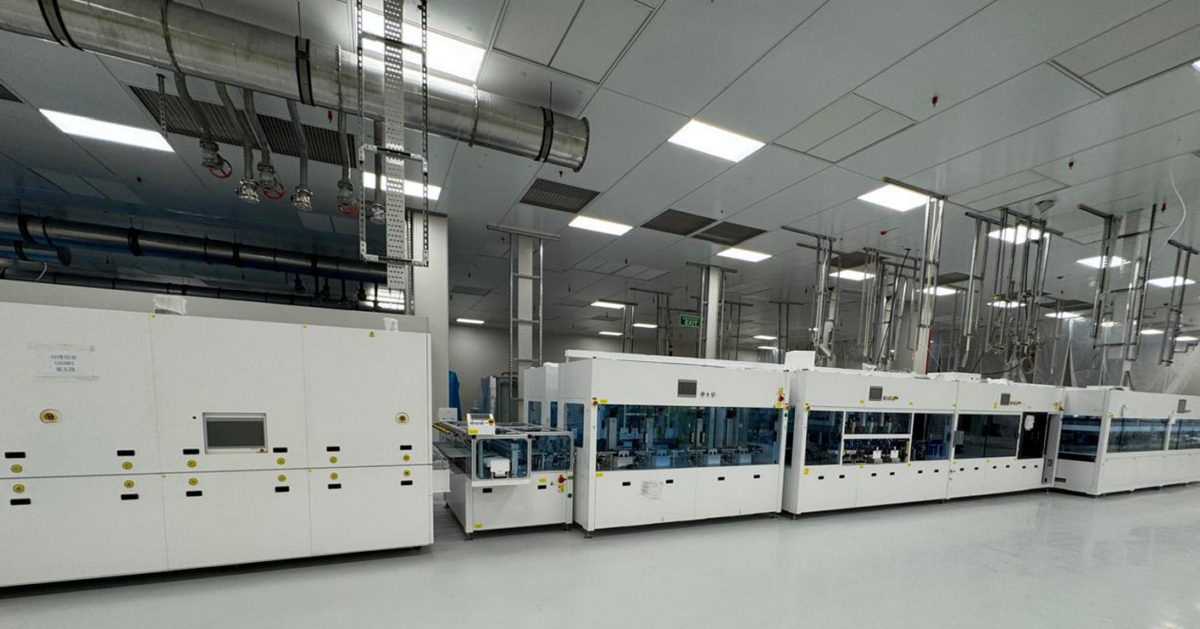
Reliance Industries Ltd’s solar cell line in the Jamnagar complex
Image: Reliance Industries
Reliance Industries Ltd has become the first company to secure the inclusion of heterojunction (HJT) solar cells in the Approved List of Models and Manufacturers (ALMM) issued by India’s Ministry of New and Renewable Energy (MNRE), marking a milestone for the country’s solar manufacturing sector. The quoted cell production capacity is 1,238 MW per year, for 210mm x 105mm sizes with zero busbar designs. The cells have an efficiency of up to 25.6% and an output power ranging from 5.28 W to 5.66 W.
Reliance’s HJT modules were previously included in ALMM List I for modules. The stated module production capacity is approximately 1,716 MW per year, consisting of monofacial and bifacial glass-to-glass configurations, with power up to 720 W.
As per MNRE rules, from June 1, 2026, all government-backed solar projects must use modules manufactured from cells sourced from ALMM List II. Reliance’s HJT cell manufacturing facility at Jamnagar is part of the compliance strategy, enabling modules to meet Domestic Content Requirements (DCR) standards for both cells and modules.
HJT cells produced at Reliance’s Dhirubhai Ambani Green Energy Giga Complex are positioned as an upgrade over conventional PERC and TOPCon technologies. The company’s HJT modules offer efficiencies of up to 23.12%, while cell-level roadmaps target efficiencies of up to 26.5% via perovskite-tandem integration. HJT technology also offers a lower temperature coefficient, improving high-temperature performance and reducing degradation by approximately 25% over its lifetime compared to conventional silicon modules, the company said.
Reliance Industries is developing an integrated solar energy manufacturing facility with an initial capacity of approximately 10 GW per year, scalable to 20 GW. The company is also building an integrated battery manufacturing ecosystem, covering cell manufacturing as well as packaging assembly and containerized energy storage systems (ESS), with an initial capacity of 40 GWh, expandable to 100 GWh in later phases.
This content is copyrighted and may not be reused. If you would like to collaborate with us and reuse some of our content, please contact: editors@pv-magazine.com.
Popular content