

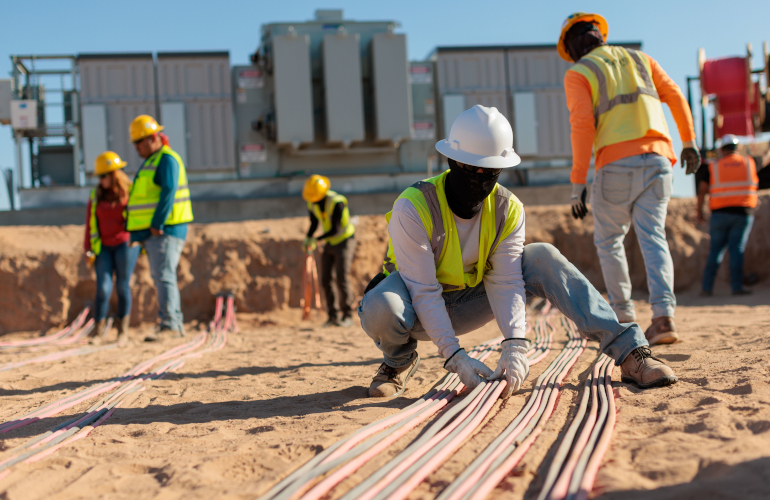
Underneath almost every solar field, out of sight and often out of mind, lies a network of underground cables whose unexpected failures have become one of the industry’s most pressing reliability issues. Unlike cables in a typical utility that operate at a rated load of 25%, renewable energy power cables typically operate at a load of 90 to 110%. These “feeder” cables extract energy from the solar field and send it to the electricity grid of the local energy supplier. The power is then mixed with other power sources and ensures that the entire electricity grid continues to function optimally.

Credit: DEPCOM, a Koch Engineered Solutions company
The safe and reliable operation of cables feeding the grid from a solar field is critical. Nobody wants to generate power only to lose it on cables. The expected lifespan of renewable power cables is about 40 years, but realistically the lifespan of cables will be gone much sooner. This leaves network owners wondering what can be done to extend the life of the cable.
Renewable feeders are reaching their limits
Underground cables spend much of their existence in water due to the natural water in the ground. The temperature of the Earth at 6 feet depth is 54°F with 100% humidity. This natural water bath provides sufficient water for the cable to absorb moisture into the insulation. Water diffuses into the cable and slowly attacks the insulation. The insulation of the underground cable prevents electrons from escaping from the conductor and being lost in the ground. This water diffusion causes the cable to age faster than if it were in a dry environment. Once electrons are lost in the ground, the cable can fail catastrophically much faster. The double whammy of a higher load on the cable (which makes the cable warmer) and the presence of moisture in the insulation causes premature cable breakage.
An easy way to restore performance

Credit: Southwire
Despite all the potential damage that can befall these cables, solar project owners can do something to protect and extend the life of their cables. Silicone cable rejuvenation restores the strength of the insulation, dries out the cable and extends its lifespan by many years.
The process is simple: the cable is insulated and de-energized and special connectors are connected. Silicone fluid is then passed through the guide. This liquid will diffuse into the insulation and chemically remove the water and fill any voids in the insulation. This restores the strength of the insulation to as new or better. Once the process is complete, the cable can easily be expected to last the entire life of the solar field.
A cable failure in the field can result in days or weeks of downtime while repairing the fault site or waiting for a replacement cable. The entire rejuvenation process can be completed in a few hours, making it six to 12 times faster than cable replacement and an optimal choice for cable reliability, Southwire has found.
Furthermore, the process of silicone rejuvenation is economically and environmentally beneficial. Typically, it costs significantly less than half the cost to renew a cable compared to replacing the same cable. The environmental impact is also significant: rejuvenated cable has a 99.9% better carbon footprint than cable replacement.
Timing is important, evaluate early

Credit: Southwire
It is recommended to look at the cables in solar fields five years after installation. This is when groundwater fills the insulation and begins to weaken the strength of the cable and shorten its lifespan. Southwire has found that some solar cables that have not been treated to remove water have failed within a decade.
Early inspection can save a cable before it breaks. Early cable failures lead to an unreliable power system and will eventually need to be replaced or repaired (spliced) with silicone injection to restore its strength. In addition, it is imperative that cable faults are resolved, repaired or replaced as quickly as possible. If the initial fault is not resolved immediately, it may lead to other faults in the system due to the similarity of the other surrounding cables and the environment in which they are located.
The whole purpose of the solar panels is to keep the power cables performing optimally and fully powered. Obviously it makes sense to keep the cables working as long as the field is economically viable. For more than 35 years, utilities, industrial complexes and renewable energy fields have been using silicone rejuvenation on electrical cables. Since the demand for electricity increases every year, rejuvenation is a logical and easy solution to extend the life of the cable instead of opting for complete replacement.
Dr. Wayne Chatterton has a Ph.D. in organic chemistry from the University of Toronto (1990). He has spent his entire career in the electrical industry. Previously, he worked at Dow Chemical in the development of cable rejuvenation fluids and UtilX/Novinium. Currently Dr. Chatterton Vice President Services Solutions Sales at Southwire and senior member of the IEEE and ASTM Committees D9 and D27. He has worked on transformer fluids, circuit breaker lubricants, insulating rubbers, diffusion pump fluids, and has numerous patents on cable rejuvenation fluids and processes.
