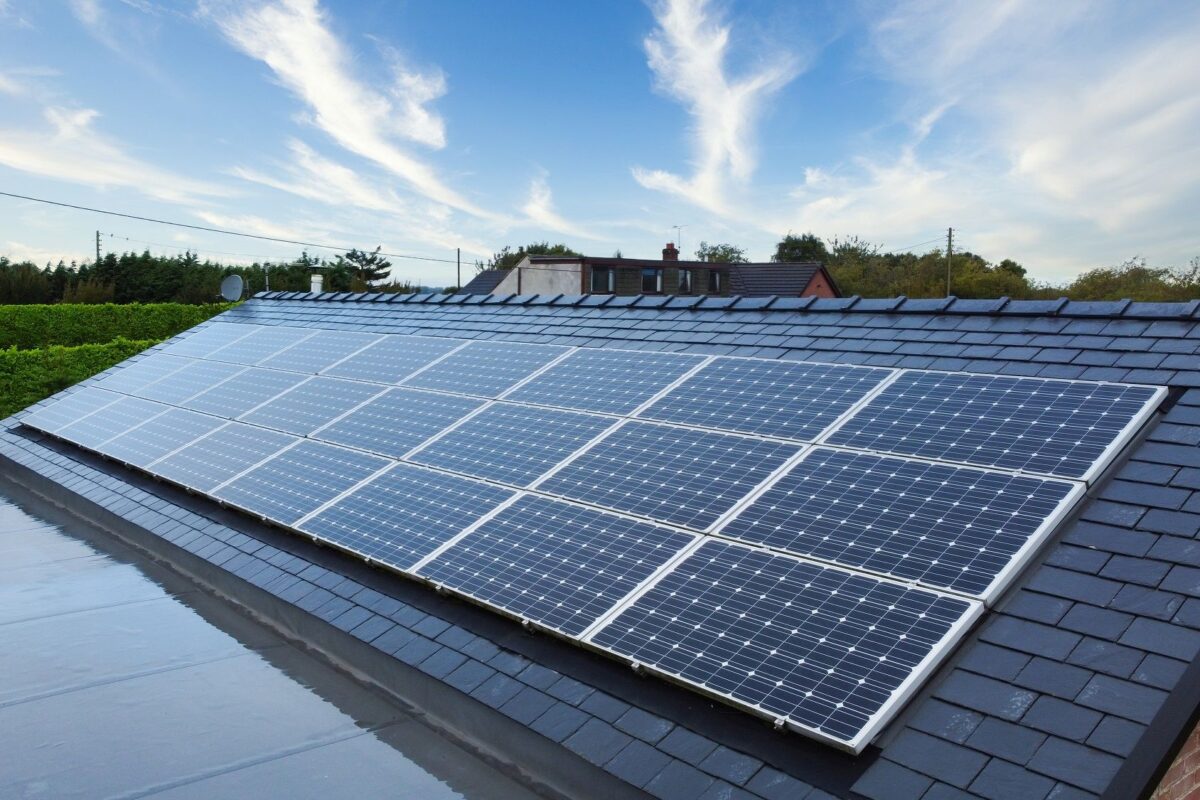
March 2026 saw a return to installation volumes not seen since 2012, when rooftops and large-scale solar deployment in Britain reached a new milestone. Even higher monthly installation volumes are expected as further government support kicks in.
Millions of solar installations are now powering UK homes and the electricity grid, according to the latest government deployment data, with installation volumes reaching a rate not seen for more than a decade.
Total solar capacity reached 22.1 GW at the end of March 2026, according to preliminary data from the Department of Energy Security and Net Zero (DESNZ), and while large-scale projects represent the lion’s share of generation capacity, growth in rooftop demand pushed the total number of installations to 2,003,000.
There were 27,607 installations registered in March 2026, representing a capacity of 121 MW: the most installations recorded in any calendar month since 2012. A total deployed capacity of 2.3 GW has been added since March 2025, representing 11.7% growth for UK solar over the twelve-month period.
Around 16% of added solar capacity in the 12 months to the end of March came from one site: the 373MW plant at Cleve Hill which came online in July 2025 – the UK’s largest solar power station to date.
Source: UK Department of Energy Security and Net Zero (DESNZ)
At least 38% of the UK’s solar capacity (8.4 GW) came from ground-mounted or standalone installations, including 25 operational solar farms with revenue from the UK government’s Contracts for Difference (CfD) scheme – 19 of which came online in 2025 and four in 2026.
That share is on track to grow significantly, with the UK government targeting at least 45 GW of solar capacity by 2030. The latest CfD auction round, which closed in February 2026, delivered a record 4.9 GW of solar capacity across 157 power stations.
Solar panels with a capacity of less than 50 kW are also increasingly supported by subsidy support. Arrays of this size accounted for 99% of total installations and 37% of total deployed capacity at the end of March 2026. Demand for this segment has taken a positive turn since early 2024.
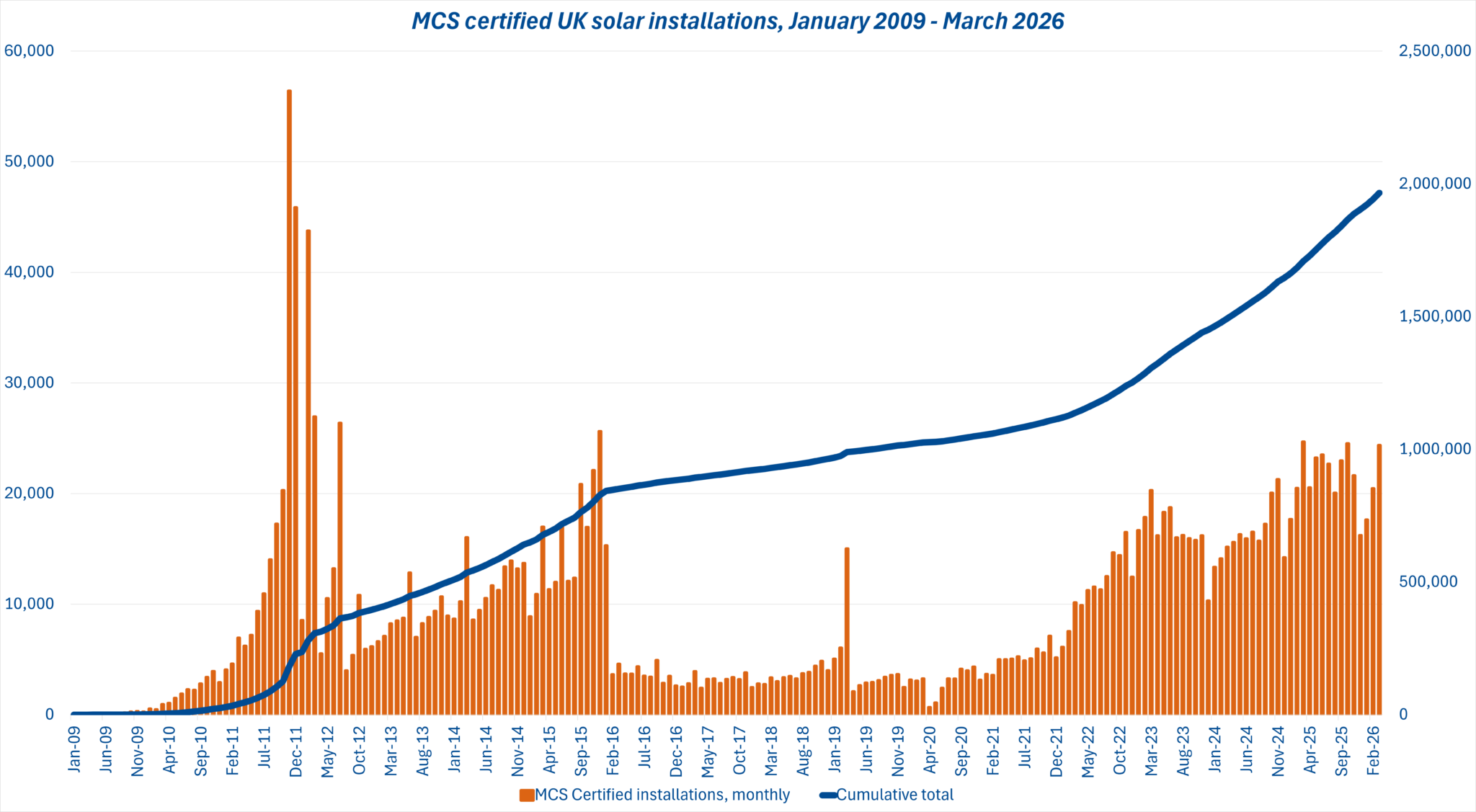
Source: MCS Data Dashboard
The latest data from certification body MCS shows that small-scale installations have returned to volumes not seen since the application feed-in tariff was closed. Residential installations accounted for 66% of the total by volume in March 2026, reaching a total of 85 MW.
MCS certification is not mandatory for rooftop solar installations in the UK, but does give households access to the Smart Export Guarantee – which ensures consumers are paid for exporting excess electricity to the grid.
Higher monthly installation rates for residential solar are expected. The UK government has committed to spending £15 billion ($20 billion) on a residential energy efficiency investment programme, which includes grants and loans to support millions of new roof installations by 2030.
The grant support will be available for new solar energy, battery energy storage, heat pump installations and other energy efficiency technologies. The UK government also recently committed to legalizing plug-in “solar panels” on balconies by summer 2026.
This content is copyrighted and may not be reused. If you would like to collaborate with us and reuse some of our content, please contact: editors@pv-magazine.com.
Popular content